


In praise of missing the mark
I am sitting on a bus singing a song as Gaeilge to some American musicians. It’s a slow air, about being far from home. We have not told them what the song is called, or what its lyrics mean – the specificity of place, the almost physical longing for the familiar. They are listening intently and I can see that they can feel what the music is communicating it. The nuance is lost, the detail is fuzzy, but the feeling – the meaning – is there. My own command of Irish is cerebral rather than emotional, but for me, too, the melody raises goosebumps and evokes a kind of homesickness I’m not sure I’ve ever genuinely experienced.
….
I am tidying up in the kitchen while my five year old sits with my mother, looking for words in a printout of nonsense letters. They hover with the pen, and every few moments one of them says “Oh!....no” as they find a nearly complete word. Once in a while they find a full one, and excitedly mark it. At the end of the exercise they have found more than 50 words, some of them quite dubious; I’m not sure they would pass muster on a Scrabble board. But on these two pages of gibberish, they are significant, each one a victory. The chance letter combinations, the unconnected words, come together to tell a kind of story.
…..
Later the same day, my two older children are seated at the computer with their grandfather, the source of the nonsense pages, who is teaching them basic coding. They write commands under his instruction, and at the press of a button, a disembodied voice reads out an approximation of their names. They are delighted, and run the command dozens of times, until the voice loses what semantic force it ever had, becoming a kind of white noise.
….
I am reading Finnegans Wake, and talking to a friend about it. The friend, who is Italian, but who has fluent English, is frustrated by the language, does not plan to finish the book. She has never been to Ireland. I describe for her a walk down Henry Street at Christmas time, and we talk about a walk through one of the street markets in Milan, where she lives and works. I describe how the multitude of voices, in various languages, consisting of shouted fragments rather than conversation, compete and coalesce, so that at the end of the walk you have had a coherent sonic experience that has its own kind of narrative force. When I first read Wake, without any real sense of its richness and intentionality, this cacophonous walk was the closest sensory approximation I had to it.
….
I am scrolling idly through Twitter, where I pause at an account that has posted several images of bell peppers cut in half, with googly eyes stuck on them, giving the appearance of shock in the vegetables. A little further I see a cat whose head is tilted so that it looks like a crow, and later still a picture of what looks like a judgmental corgi. I send a video of a raccoon confused by its food melting away to a group of friends. One of them sends back a picture of a building whose architecture gives the impression of a face.
….
My youngest son, just six months, sits in his high chair, cooing excitedly at a spoonful of mashed fruit. He bangs the spoon on the table attached to the chair, splattering fruit everywhere, and after several attempts, delightedly jams the other end of the spoon into his mouth. He seems momentarily confused by the literal fruitlessness of this endeavour. I inform him that it’s the wrong end of the spoon, and am reminded of Wittgenstein’s theory of meaning-as-use, which he distinguished from ostensive or Adamic naming in the Tractatus Logico-Philosophicus. The practice of misuse is a form of linguistic corruption, by this theory, since the meaning of a term is determined by context as well as object. A broom that is used to break a window, he argues, is in a meaningful way no longer a broom. In this context, I muse, the spoon is both no longer a spoon, and even more purely a spoon, since my son is simultaneously not using it as intended and achieving the purposive end of a spoon by misusing it. My father remarks that no form of classical AI would be able to make that distinction, and I am struck again by the meandering paths by which we make meaning, and by how many ways there are of understanding the world.
….
As the pandemic marches on, Protean and elusive, seemingly endless, the conversation about strategy continues at a level I can no longer hear with any clarity. Curves and charts and data points proliferate meaninglessly; we cannot learn enough, it seems, to usefully predict two steps ahead. A plan is followed, but the landscape shifts too quickly to reach the end of the projected trajectory, and we are scrambling, again, for understanding. Information, we are reminded, is not meaningful in itself. Understanding, again, rests on context, and such shifting sands elude coherence.
….
My child asks me whether trees can talk, as we walk through the woods in our local park. I explain that trees and plants communicate, but that I don’t understand how, exactly. They talk to each other using roots and leaves, but not using language, like we do, I say. The question is repeated for squirrels, and for the sea. I hear of the death of Brendan Kennelly, and re-read his “Poem From a Three-Year-Old”, which so perfectly encapsulates the desire to convert information to meaning, in its apparently meandering connections between flowers and people, life and death, and its ringing final question “and why?”
….
My job, which I love, and from which I am currently on leave, is to trace some of the ways in which we find meaning in the world. In the past couple of years, I am finding that work more and more challenging. Some of that is because I have moved from the certainty of (relative) youth into the marshy indefiniteness of (young) middle age, or at least of definite adulthood (I am 36). My own thinking about how the world works has been upended, by listening to students and colleagues, and by reading the creative and critical work of writers and scholars who see the world differently to my safe, conventional, immensely privileged corner of it. It has been uncomfortable to re-examine my cosily cerebral understandings of race, of gender, of ableism and security and rights and existence itself, but I appreciate the chance to do it, the freedom and stability in my life that makes these re-examinations a joy rather than a threat, though it is certainly humbling. My students, especially, come to the world, and to the texts we read together, rich with empathy and curiosity, finding in them connections and quandaries I had never seen. Reading the thoughts of scholars and experts, and of those who inhabit lives historically marginalised, my understanding of language is changed, my speech more thoughtful. While I cannot inhabit the worlds of these individuals, I can grasp fuzzily at elements of their experience, adding new dimensions to my perspective on the world, and on my ability to move through it kindly, mindfully and with purpose. And so, week by week, my world is remade. Every day I encounter the myriad methods by which we make sense of ourselves and our place in society; language is a social act, fundamentally optimistic, a reaching beyond the self. One imagines Wittgenstein in the time he spent in Connemara, on the wild, tumbling edge of Europe, the “last pool of darkness”, feeling his way through the echoing isolation that he saw as the only possible environment for meaningful thought. It is notable that while Wittgenstein is reported to have said “I can only think clearly in the dark”, that thought finds its value in expression, in the intersubjective representation and exchange of ideas; that even this fact of thinking clearly in the dark gets its significance from being shared. More than that, as later readers of his have noted, the ultimate goal of communication is recognition, acknowledgment, the sense of being less alone.
It is this drive that fascinates me, the desire to find – or make – meaning in information. I once hear humans described as “semantophiles”, seekers after meaning, and it is certainly the case that we are congenital pattern-seekers; hence the faces in buildings, hence our projection of emotions on animals, hence the pathetic fallacy, hence religious faith. Hence, too, science, which of all things believes in meaning (though not necessarily purpose): “A child said, What is the grass? fetching it to me with full hands”. Whitman is prompted by the question to consider the many possible meanings of grass, none of them related, really, to what it is. Meaning is not necessarily information, but information plus context – the object within the pattern. A box of jigsaw pieces is not a picture until you put it together. Like the small episodes I outlined at the beginning of this piece that got me thinking over this subject, it is the context in which we receive information, often, that determines how we use it or are affected by it. In class, I repeat often that “what does it mean?” is a less useful question than “what is it doing?” Meaning comes from pattern-seeking, and the pattern tends to determine – or at least shade – the meaning. Of course, this tendency is perfectly explicable, at one level: patterns help us to make relatively rapid judgments about safety, about threat, about food. Babies go through at least one prelinguistic stage where they are markedly more interested in observing patterns than almost anything else; a child of six months old or thereabouts will test the replicability of an experience, throwing a toy on the floor to see whether it will fall each time, whether it will be returned, how the pattern might change with repetition. We are delighted by patterns, by the familiar, the parsable. We seek what we can recognise and relate to, even if it means losing the detail. As nature abhors a vacuum, the human psyche is hostile to real randomness.
But, by the same token, such inveterate pattern-seeking can cause problems, too, in misconstruing patterns, or seeing them where there are none. Recently, a meme has been circulating on social media tracing the differences between data, information, knowledge and wisdom using dots as an illustrative tool. In the final panel of the image, the dots are connected to form the shape of a cartoonish winged unicorn. The caption reads "Conspiracy Theory”. In his recent book The Irrational Ape, David Grimes explores the history of conspiracy theories and of poor thinking generally. He points out that “once someone yields to conspiratorial ideation, they begin to see sinister machinations everywhere”; that is to say, when we identify a pattern, we continue to trace it, even if the trail we are following is an illusory one. Grimes also notes that “stories have a deeper resonance than facts alone”, which he uses to explain the structure of his book, but which strikes me as a key element of human communication. We grasp at stories rather than facts alone because stories afford greater scope for affective empathy, for minor points of contact or familiarity that allow us to orient ourselves to a different perspective without losing our bearings. What is especially interesting about our engagement with stories, I think, is how differently we can read them. The infinite variations of interpretation, inflection and influence that we can find in language, written and oral, is a function of that general pattern seeking tendency; it is characterised by a lack of precision, a vagueness and mutability that should impoverish meaning but instead enriches it. Hamlet’s famous first soliloquy gives us an example of this: the differently rendered versions of “O, that this too sullied/sallied/solid flesh would melt” has been a point of much discussion, with arguable points in favour of all three versions. But when the play is performed, of course, the audience hears not only whichever word the actor uses, but echoes of all three possible words. It’s not exactly a mondegreen, more a multiplicity of possible echoes.
While I spend much of my time occupied with the precise elements of a text, or
trying to explain the precise spelling or use of a word, what is perhaps most
awe-inspiring about human communication, then, is its vagueness, its
infinitude, its sheer multiplicity. We apply this superpower of approximation
throughout our encounters with the world, misusing things with ingenious
variety. In his book The Practice of Misuse, Ray Malewitz explores the
social construction of material objects, and how we break and remake things
according to our own needs. A thing is not determined by its intended use, he
argues, or by the conditions of its production, but by its actual use – its context and operation.
He quotes Ken Adler: “To reduce an object to its function involves more than an
failure of attention; it is a slur on the ability of human ingenuity to
repurpose the material world and on the power of things to reshape the contours
of human experience. Who hasn’t bent a paperclip to an untoward end?” The
paperclip he refers to, of course, evokes in contemporary contexts the famous
interview question, attributed to numerous tech and engineering firms,
including Microsoft and Google, that asks candidates to “do something with this
paperclip”, ostensibly to ascertain their creativity. It’s true that we are
good at imagining uses for things; classical AI couldn’t extrapolate from the
intended use of something to its possible other applications, but people do
nothing but creatively misappropriate and repurpose things. Outside of the
material manipulation of the world, oral language is especially apposite for
this repurposing: resonant, heavy with otherness, replete with the
almost-spoken. The emotive force of music underscores this further, bringing
out inarticulate – inarticulable – feeling that is all the more powerful for
its generality. Found poetry is a kind of linguistic practice of misuse: the
spark of meaning ignited by the chance juxtaposition of words can resonate more
deeply because of its apparent randomness than chosen words.
Our tendency to approximate meaning, to fill in the blanks with purpose and power, is one of our most human traits, by turns amusing, ingenious and fatal. Religious beliefs and conspiracy theories, and foreign songs about homesickness and monkeys (or preschoolers) at typewriters (or computers), and noisy streets and sticky spoons are all evidence of the productive power and potential of imprecision. Wallace Stevens wrote “It comes to this: that we use the same faculties when we write poetry that we use when we create gods”; our gods are murky, our poetry mumbled, our imaginations liberated by indistinctness. Far from accuracy and exactness, perhaps the defining characteristic of humanity is our limitless capacity to do things slightly wrong.
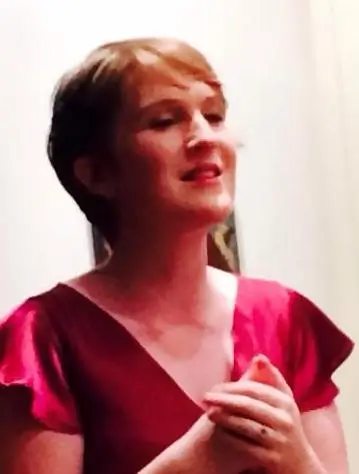
Clare Hayes-Brady is
a lecturer in American Literature at University College Dublin. Her PhD focused
on communication in the work of David Foster Wallace. Other research interests
include the interaction of literature with film; transatlantic cultural
heritage; performative sexuality (both normative and queer), resistant gender
modes and the history of burlesque; digital humanities and modes of
transmission; adolescence in contemporary fiction, and dystopian narrative.
More work by Clare Hayes-Brady


Tel: 028 7126 6946
Email: hueditor@theverbal.co
Verbal, Stable Lane and Mall Wall, Bishop Street Within, Derry/Londonderry, BT48 6PU
 company
Copyright © 2026 Honest Ulsterman