


Graphic Novels, Comics and the Aesthetics of Absurdity.
I
wrote in this magazine some months ago about the hysteria that dogs the digital
cultural marketplace, arguing that the apocalyptic view of publishing is
perhaps exaggerated. As I wrote then, while digital book sales have not –
despite direst predictions – brought about the death of the physical book,
changing modes, means and economics of production have certainly wrought
changes in the form and focus of publishing. The growth of graphic novels and
comics is a case in point, blossoming in both print and digital formats,
gaining traction as a “serious” art form, lining Hollywood pockets and spawning
a vibrant (and overdue) academic discourse. As many, if not most, of these
academics have noted, graphic novels and comics have not always been taken
seriously as a cultural product, despite their long tenure at the coalface of
popular culture. Dedicated shops have come out of the shadows (in the popular
imagination, as well as the commercial reality) from the dark, dusty havens of
the terminally uncool – Forbidden Planet and Sub-City in Dublin, for example –
to bright, trendy shopping centre fixtures. Production values have skyrocketed,
and the cheap and cheaply produced Beano,
Dandy, Archie and Wonder Woman
issues beloved of children have given way to gorgeous hardbacks produced in
small, glossy print runs by indie presses like McSweeney’s. In short, the comic
as print artefact has become a sort of cult product in recent years. This
growth has paralleled the emergence of “nerd culture” into the cultural
mainstream (or, depending on your view, of the mainstream catching up with
nerd-dom, as Wil Wheaton and Nathan Fillion, two nerd culture heavyweights,
have argued). Comic book afficionados, long the butt of jokes, are no longer
the tragic, overweight loner of The
Simpsons’ Comic Book Guy character. Now they are represented by the scruffy
sex appeal of Neil Gaiman, author of the Sandman
graphic novels, who is married to Amanda Palmer, a marker of cool beyond almost
all else. Comics are sexy. As for serious, in the wake of the decidedly
literary MAUS and Persepolis, even the redoubtable
Margaret Atwood has turned to the form, releasing her own graphic novel, and a
superhero graphic novel at that, Angel
Catbird. Manga reimaginings of Shakespeare abound. Comics are serious.
Cinemas are packed with adaptation after adaptation of superhero stories, with
Hollywood betting on the longeivty of the type over the next half decade at
least. Comics are cool. Comics, in short, are having a moment. And why not?
Graphic novels as a form offer a unique reflection on a world dominated by
visual cues. Writing in 2013 about the importance of studying graphic novels
like any other literature, Robin A Moeller argued that as students text and
tweet, combining text and image in dynamic and innovative ways, “the ways in
which these different modes of presenting information work together to create
meaning is very similar to the way that graphic novels use text and iage to
create meaning” (Moeller, 15). Indeed, Moeller argues that particularly with
younger male readers, graphic novels cater to the visual/spatial learning style
that dominates among adolescent males, making them an especially powerful
teaching tool in high school settings. Pedagogies aside, sales histories
suggest that graphic novels and comics do indeed appeal particularly to young
male readers – cinematic renditions certainly reflect this trend – and this
particular combination of text and image ceratinly seems to have come into its
own as a cultural manifestation in the twenty-first century.
While the popularity and reach of these forms has risen steadily since the middle of the twentieth century, Hilary Gray notes that graphic novels began to be taken truly seriously as a form in the mid-1980s, with the publication of Watchmen, by Alan Moore; Batman: The Dark Knight Returns, by Frank Miller; and Maus, by Art Spiegelman, all literary works prioritising narrative over art. Spiegelman’s Pulitzer award in 2002 for Maus cemented the graphic novel as a form ripe for critical attention, and in both critical and academic circles these texts have garnered serious consideration in recent years. The sustained narrative of a graphic novel offers the same heft as a traditional novel, with the additional force of visual imagery, so this is perhaps not surprising in a decisively visual age.
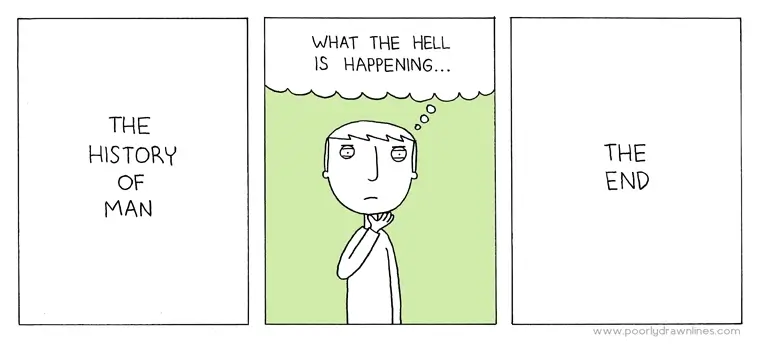
Simultaneously, in the digital world, the popularity of web comics, evocative of the cartoon strips of weekend newspapers, has grown exponentially, from the stick figure mathematics of xkcd.com to the intellectual humour of existentialistcomics.com, the often baffling Hark, A Vagrant and the absurd and often dark Poorly Drawn Lines, among (literally) countless others. Comic strips, unlike graphic novels, remain a sort of hybrid between visual and verbal art, a complex form of their own, asking different things of both artist and reader. These comics are successful in part because of their multiplicity; in a space of infinite iterations, there is no need to appeal broadly, so niche interests can dominate the form. Comics about exhausted motherhood like Hurrah for Gin, surrealist considerations of dogs, shrimp and space at The Oatmeal and Allie Brosh’s near-perfect millenial musings on Hyperbole and a Half, to name a few,offer a balance of absurd comedy and trenchant political commentary, profound emotional engagement and serious philosophy in graphic form. From the deeply serious to the sublimely ridiculous, web comics have emerged as a slightly more in-depth form of artistic reflection than the ubiquitous meme. Comic strips are often used as visual aids in explaining ideas, given the ease and economy of including images in digital content. In some sense, then, comics, in one form or another, seem to be the cultural product of the present age.
The breadth of style, range of topics and varying levels of seriousness mean that it would be fruitless to attempt anything approaching a full taxonomy of the form, but there are notable subsections, including the high-gloss, high-colour superhero strip or book, which evokes the heyday of the comic in the 1940s and 50s, preceding the first panic about the pernicious influence of comics in 1954 with Frederic Wertham’s Seduction of the Innocent, which famously decried comics as depraved, violent and dangerous to the moral character of young people. The familiar lines of manga, with its over-large eyes and limbs, its block colours and stylised action lines, speaks to the extravagance of Japanese visual culture. The many contrasts between these and other styles highlight the possibility that while we think of comics as a genre, we might better think of them as a medium; indeed, taking a cue from visual art, we would not think of oil painting as a genre, nor assume that all oil paintings have something in common beyond their production medium, so why would we make the same assumption of graphic novels and comics?
Of course, graphic novels and web comics are not really the same medium, and the distinction between “hard-copy” and digital products is one of medium, so perhaps we might properly speaking consider it a set of forms that captures a particular zeitgeist. The web comic, which I am chiefly interested in here, can span an almost infinite set of topics, aesthetics and objectives: as Randall Munroe, creator of xkcd.com, said in a Rolling Stone interview in 2014:
“It used to be if you wanted to do a newspaper comic, you had to appeal to a pretty big chunk of the newspaper's readership for them to want to keep you around. Dilbert would be office humor, but even that is pretty widely experienced. One of the nice things about the Internet is you can do a comic that's just for Ph.D. students, or for truck drivers, and you get to reach all of them without having to satisfy the other 99%.”
Munroe’s point is well made here, but while xkcd is indeed a comic of narrow parameters in terms of its topics, its aesthetic and tone have caught the popular imagination. Indeed, the fact that a web comic creator is being interviewed by Rolling Stone rather supports the argument that the appetite for these cultural products is on the increase, and that the Internet is the perfect creative home for it. Munroe’s work on xkcd has developed from sketches on squared notepaper (the comic originated from doodles in his physics class, reassuring for those of us prone to daydreaming!) to a series that pushes the boundaries of what constitutes a comic. Issue #1110, “Click and Drag”, in particular, exploits the mobility of the online format in a way that is extremely unusual: the comic’s fourth and largest panel expands inwardly like a panoramic photograph, which the reader can explore by clicking and dragging their mouse. If printed at 300dpi, according to an Atlantic interview, the image would be 46 feet wide. “Click and Drag” is a feat of art and engineering, using cyberspace as a canvas, but it is not necessarily a literary form as we would normally recognise it. Munroe has since branched out into infographics more specifically, and has published two books of visual explanation. However, his engagement with language throughout xkcd and his infographic books brings us squarely back to the literary; in an interview with Ars Technica blog he mentions a taxonomy for dinosaurs from his most recent book, Thing Explainer, which uses only the thousand most common English words. The dinosaur taxonomy includes “Slow rocks with legs and a head”, the bitey kind” and “animal that looks like a tree in water …but it can eat you”. It is strikingly reminiscent of Jorge Luis Borges’ Celestial Emporium of Benevolent Knowledge, in which animals are divided into fourteen categories, including “fabulous ones”, “et cetera”, “those that have just broken the flower vase:, and even, in a Russellian flourish, “those that are included in this classification”. At its heart, xkcd works to communicate ideas, finding language unequal to its task. In this respect, too, it evokes Borges, whose maddening, exciting work sought new ways to make language more flexible, more representative, more useful. More pedestrianly, xkcd is about explanations – its most famous issue is probably #386:
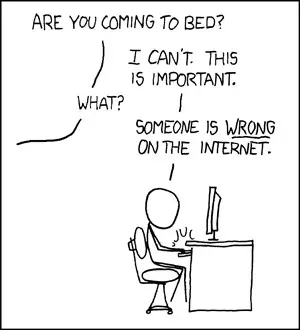
In this image, the aesthetic of the drawing, primitive in style though it is, is particularly important. Dominated by text, the dialogue is enough, strictly speaking, to convey the comic’s message. Off-centre in the foreground of the single panel, a stick figure is hunched in a desk chair, tapping furiously at the keyboard. No other context is offered, and the image is ostentatiously unadorned. Nevertheless, the comic relies on our semiotic literacy no less than did the opulent religious paintings of Paolo Uccello. As Uccello and his contemporaries assumed that their viewers would recognise Christian symbolism without gloss, so this image presents a pared-down image of familiar frustration: the stick figure, though expressionless, sits with its spine tensely curved, head inclined towards the keys. The sound lines coming from the keyboard are jagged, suggesting impatience and rapid, persistent typing. Although it does not add information, as such, to the panel, the image greatly enriches the guiding dialogue that visually dominates the scene. Webcomics, like any visual medium, assume a level of cultural familiarity on the part of the viewer. The success or failure of translation is interesting in this regard, and the current mania for manga versions of Western narratives is an interesting case study; does Hamlet, for example, change as a narrative, when a manga aesthetic is applied? I would argue that it does, in much the same way as any plot is affected by the aesthetic of its setting.
The use of deceptively
primitive aesthetics for dramatic effect is a common tool in web comics. Like
the early satirical cartoons in Punch
and similar publications, to which they owe much of their development, these
commentary comic strips give the impression of being slapdash work of the
moment. It is more common to see stick figures and haphazard-looking lines with
exaggeratedly childish features than to see dense, careful drawing (although,
again, xkcd’s Munroe veers into this
occasionally). Allie Brosh, in Hyerbole
and a Half (strictly speaking a blog that uses comics rather than a comic
series), deliberately uses primary colours and childish shapes to intensify the
absurdity of her autobiographical character’s narratives. Like Munroe, Brosh
has published a book of her work, with a sequel due for release this year.
Brosh’s drawings, made with the computer programme Paintbrush, depict scenes
from her childhood and her struggles with adult behaviours like moving house,
keeping on top of housework and her battle with depression and social anxiety.
Again, the poor quality of the drawings is a feature, not a bug; as a Gazette Review article points out, it “makes the site
look approachable, and gives each post colorful personality, instead of the
usual, boring walls of text”. In one of the site’s best known strips, “This Is
Why I’ll Never Be An Adult”, the yellow-haired, pink-clad avatar undertakes the
tasks associated with adulthood, with images of answering emails, going to the
bank, shopping for groceries, and the most famous image of her declaring “clean
ALL the things”. The images are characterised by mania, with large, dark eyes
and an unhinged optimism. The same series of images is repeated with slightly
different inflections (ovewhelmed, exhausted, defeated), signified by slight
changes to the eyes and angle of the head. Like xkcd, the simplistic aesthetic
of the images is undercut by a real complexity and depth of expression, easily
legible despite the “poor drawing”.
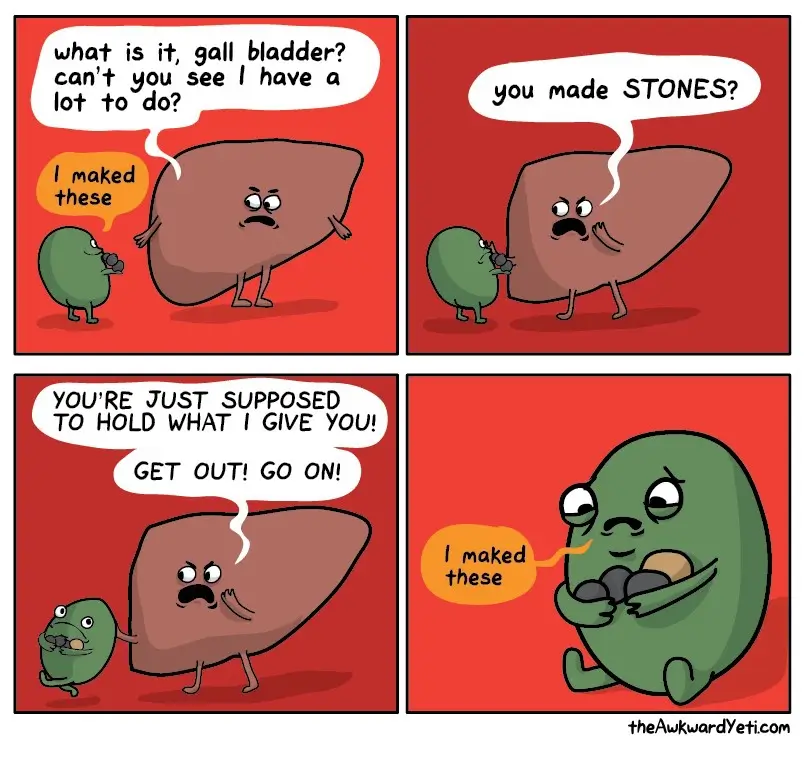
The surreal and brilliant biology comic The Awkward Yeti uses a similar cartoonish aesthetic to anthropomorphise the organs of the human body, with Heart’s large, hopeful eyes countered by Brain’s shrewd, realist, glasses-framed gaze. “Gall Bladder’s Last Day” shows the gall bladder characterised as a hapless, childlike dupe, tricked into producing stones it is then dismissed for making. Though no more than a greenish blob, the gall bladder’s forlorn expression is truly pathetic. Unlike the other comics I have mentioned, The Awkward Yeti does not use outside commentary (either as part of a blog, like Hyperbole and a Half, or as a framing device like xkcd) and in this respect it is particularly notable for its use of font to differentiate tone: each character writes in a slightly different font, with colour and curve denoting inflection.
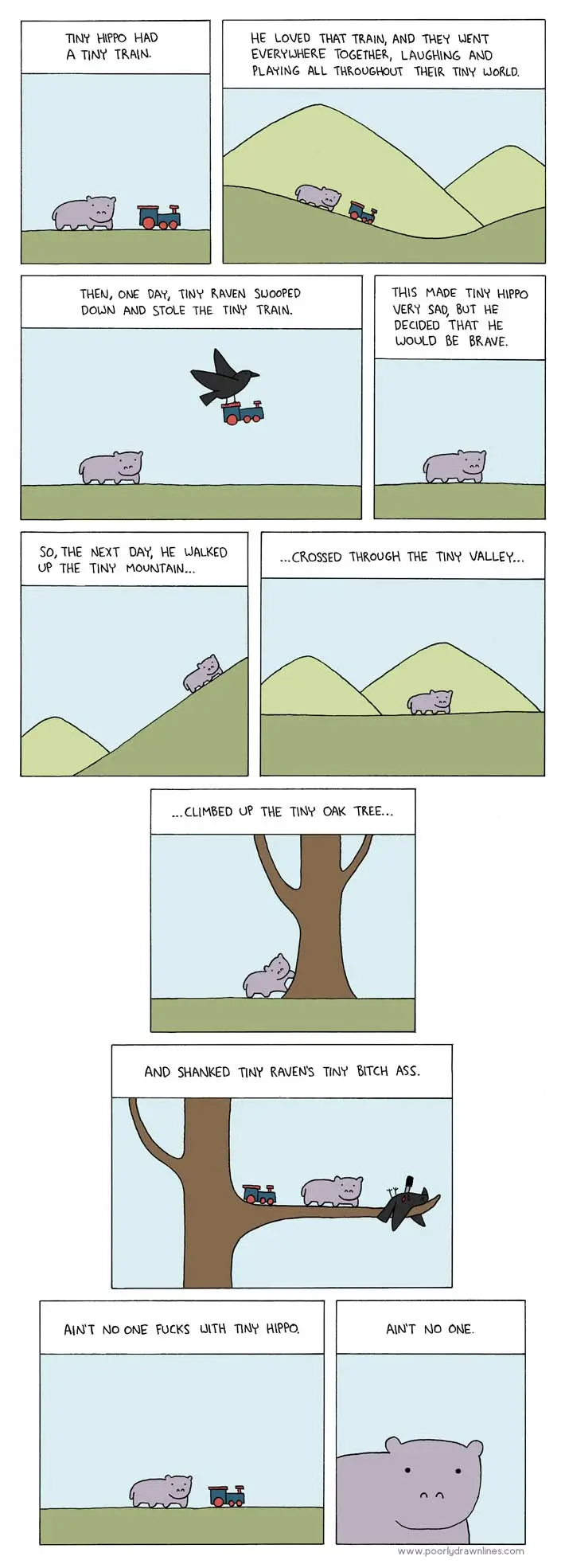
Poorly Drawn Lines issue “Tiny Hippo and Tiny Train”. Using a combination of language and art that explicitly references children’s picture-books, the comic offers a narrative twist into extraordinary violence and profanity. The humour of the piece inheres in the cognitive dissonance between the aesthetic and the ending, which hangs on the reader both reading in the correct order (hence the unusual layout, forcing its own pace on the reader) and understanding the first layer of signalling, which is the evocation of children’s books. Without the awareness that the strip imitates the art and tone of a picture book, the savage subversion at the end is ineffective.
Graphic novels and webcomics are increasingly powerful and pervasive tools of cultural representation, making innovative use of production technologies in both digital and physical arenas. The cross-cultural appeal of the form suggests that the combination of literary and aesthetic cultures may offer a bridging symbolism that either literature or visual art alone may lack, reflecting both an ancient reliance on visual representation and semaphore and a decisively contemporary invocation of global transmissibility. It is particularly interesting, I think, that the broadest appeal seems to reflect a complicated nostalgia for childish colours and forms, their apparent aesthetic simplicity glossing over a sophisticated and complex symbolic exchage that relies on the reader’s structural and semantic literacy. Far from being the preserve of immature writers and readers, it seems clear that graphic novels and comics are an arena of elegant and refined systems of cultural exchange, and that their star shows little sign of decadence.
Clare Hayes-Brady is
a lecturer in American Literature at University College Dublin. Her PhD focused
on communication in the work of David Foster Wallace. Other research interests
include the interaction of literature with film; transatlantic cultural
heritage; performative sexuality (both normative and queer), resistant gender
modes and the history of burlesque; digital humanities and modes of
transmission; adolescence in contemporary fiction, and dystopian narrative.
More work by Clare Hayes-Brady


Tel: 028 7126 6946
Email: hueditor@theverbal.co
Verbal, Stable Lane and Mall Wall, Bishop Street Within, Derry/Londonderry, BT48 6PU
 company
Copyright © 2026 Honest Ulsterman