


The moral trap of meaning

As January marches with its grey, grim regularity, conversations turn alternately to resolutions and to getting through the dreary days until the possibility of spring whispers loud enough to be heard through the wind and drizzle. On the one hand, we snuggle into duvets and keep out the chill with comfort food and wine; on the other hand, the excesses of the festive season weigh on minds and waistlines, and we engage in a bizarre ritual of public fasting, waving away carbohydrates and dairy, feigning horror at the thought of alcohol to which we are in other seasons quite partial. Like its two-faced Roman deity and namesake, January is a month of tension, dichotomy, a kind of existential strife mediated through our perceptions of health. As you might expect of such a contradictory season, the language we use to talk (often, it seems, ad infinitum) about our progress through the long dark tea-time of the year is fraught with assumed value, tying us into moralities we may only be dimly aware of, reinforcing cultural bonds that we question in the next breath. The terms we use, like “detox”, “clean eating”, “transformation” and other, endless words for restriction and shame, change with fashion – this year is replete with “meatless Mondays”, “paleo” and “strong”, and are in themselves often laudable aims. But taken together, this lexicon echoes and reinforces a narrative of virtue and self-containment that rises to deafening pitch as the year turns: new year, new you; resolutions; diets in simultaneous atonement for Christmas pleasures and fearful preparation for the impossibly distant summer and its “bikini bodies”. Chastised and infantilised at every hand’s turn by an endless variety of gyms, food ranges, magazines, television programmes and websites whose profit depends on our capitulation, it is only natural to internalise the persistent, consistent messages of our turpitude and dereliction.
While, as Susie Orbach’s seminal Fat Is A Feminist Issue argued 40 years ago, these cycles are designed to be just that, cycles, the anxiety to perfect the external form – in whatever capacity that perfection may be packaged at a given cultural moment – speaks to a much older preoccupation with the relationship between outward appearance and internal character. Rereading Ovid’s Metamorphoses recently, I am struck by the recurrence of the appropriateness of change; time and again these narratives of transfiguration much more radical than weight loss reaffirm that the new, ultimate form of the changed somehow reflects the internal (usually tumultuous) state. When Lycaon, who has plotted against the gods and served a meal of human flesh, is transformed into a wolf, Ovid notes “His own savage nature showed in his rabid jaws”. Narcissus, turned into a flower after wasting away in worship of his own reflection, planted in place beside the pool with its head inclined to gaze upon its own loveliness for eternity; the ultimate expression, surely, of narcissistic self-absorption. Later, the accordance of appearance and moral character is one of the more complex tenets of Renaissance humanism, with Castiglione’s The Book of the Courtier and Machiavelli’s The Prince both highlighting the vital importance of a trustworthy appearance. It seems that we persist in believing that an appearance in line with contemporary cultural values, whatever they may be, reflects some mythical moral elevation. The language of bodily docility and appropriateness of 2018 revolves around health, strength and imaginary detoxification, but there is an earlier lexicon about beauty and ugliness and its relationship to good and evil, imbibed in infancy with stories of princesses and hags, faces that radiate wickedness and bodies that bend under the strain of mischief. These stories teach us to mistrust what does not appear beautiful to our wide, acculturating child eyes, and so as we grow up and see our faces and bodies diverging from the desired form, the accepted form, the good form, we see not only the undesirable lumps we are taught by the beauty industry to see, but also the villains of our childhood nightmares, witches and dragons and kidnappers. It is no wonder, then, that we should develop a complex and deep-seated ambivalence about our appearance as a moral object. As we mature, this dependence on beauty as a moral guide is gradually reshaped and turned inward to become a desire to control our bodies, to bring them into (often impossible) line with the cultural expectations of the time. Even more strikingly, the thought process that surrounds this desire to govern our corporeality does not seem to move much beyond the childhood narratives of beauty and ugliness, the language of self-management hearkening back to simple binaries that shape our thinking in subtle ways.
Like many women, I am exhausted by the frantic pitch of poisonous self-improvement rhetoric that cranks up the day after St Stephen’s Day and howls through the winter louder than any storm, but this year my interest is not in decrying the late-capitalist shame machine or the impossible standards of beauty to which we are daily subjected. Rather, about midway through this year’s version of January (which has claimed the lives of two of my favourite writers, Jenny Joseph and Ursula Le Guin, and which I therefore eye with suspicion and hostility) I noticed a pattern of language that is strongest at this time of year. On being offered something to eat – a biscuit with a cup of tea, some pizza or toast, the common response is “I won’t, I’m being good”. The specific linguistic association of the value-laden term “good” with a behaviour that is supposedly in the name of health or strength is interesting; this is a stock response, often spoken without real consideration of its import, a rueful self denial and signal of virtue. But why should refusing food in the name of weight-loss or health be a moral act? Even if we do not individually consider it as such, the language associated with health is distinctly moralistic. The word “good” is a particularly significant example, as its context of use often presupposes subscription to an unspoken value system: it is good to deny oneself something one wants, and this good outweighs the social good of accepting an offered delicacy. Indeed, in the denial there is also a simultaneous hint of both gentle censure for the offer and conspiracy in acknowledging the need for self-control. This unreflective use of language, more even than the advertising jargon that informs and shapes it, is the primary means by which social rules replicate themselves: we control and are controlled by each other and our conversation. It is not sinister, particularly, just the bluntness of language as a collective tool. Certain phrases come to have meaning that is not only tangentially related to their component meanings; on the simple constitutive level, the exchange “will you have a biscuit?” “No, I’m being good” makes as little sense as “will you have a biscuit?” “No, the radio is on”, but because of the repetition of the former response as a contextually appropriate one, and combined with the deeply ingrained notion of body shape as moral signifier, the phrase comes to have social meaning, and indeed to be used even when its implicit tonality is antithetical to the speaker’s personal values. Indeed, the refusal is so coded that there are several but limited possible avenues of exchange opened up by it. The refusal may be accepted and admired, which can be signalled by a comparison of the refuser’s willpower to that of the speaker (who may or may not have offered the original enticement). Alternatively, the refusal may be accepted but met with the speaker’s decision to “indulge”, coding a kind of limited disobedience sanctioned by the group. Finally, the refusal may itself be challenged and dropped, resulting in a collective, temporary repudiation of the moral convention of self-denial. On the whole, then, it is not specifically a genuine desire to deny oneself that motivates the original refusal, nor even necessarily a genuine subscription to the belief system that privileges bodily control, but rather the conventions of social conversation, and an unwillingness to disrupt them, that perpetuates the socially desirable behaviour.
There are numerous iterations of this pattern that occur in daily life; when meeting a parent with a young baby, for example, one of the most common questions asked is “is s/he good?” Taking the same angle as on the biscuit exchange above, this is a similarly strange phrase. The imputation of character morality to an infant who is as yet unaware of its own existence in the world is a somewhat bizarre opening gambit, especially to a parent who is likely to be so addled by sleep deprivation that they cannot tell night from day, never mind good from evil, if such a dichotomy were present. On its semantic value, the question is without merit. Thinking more deeply about the socialised meaning of questions, though, the same pattern of layered meaning is perceptible: when people ask whether a baby is “a good baby”, what they are usually asking is whether the baby sleeps. Like the conversation about biscuits, a question framed in this way tends to prescribe certain avenues of answer and proscribe others. Obviously, if asked whether their infant is good, no parent will say no. This is perfectly reasonable, if the parent is answering the question that has been asked. But in the social context within which the question is asked, what is thus prevented is a conversation acknowledging that a child may be finding it difficult to settle to sleep. The very common occurrence of a baby needing frequent soothing, feeding, rocking and so on in order to sleep, or indeed only sleeping when in contact with a parent falls under the category of “no” in answer to the socially constructed question “is s/he good?” The consequence of this conversational convention is twofold: in the first place, the parent is prevented from disclosing – should they wish to – the truth of their child’s sleep, since to do so would require saying, explicitly or otherwise, that their child is not good. Additionally, the association between docility – here signified by sleeping according to social norms, which, like body shape, does not commonly accord with biological ones – and morality is further socially codified and preserved. Again, the individual intention behind the question is not necessarily sinister, but the very commonness of the question sustains and strengthens its contextual meaning. Indeed, so socially ingrained is the question that a parent who has resented this very question may find themselves reaching for the same cliché when speaking to another new parent, simply because it is the question one asks in such situations. Versions of the same question crop up at almost every significant moment in life, from “what do you want to be when you grown up?” (note the heavily capitalist association between career and identity: “be”, not “do”) to “when are you going to give us a day out”, the question beloved of all young unmarried couples.
Arguably, I could be accused of over-reading the inevitability of essentially harmless pleasantries in daily conversation. However, the reproduction of desirable behaviours through social pressure rather than specifically coercive or violent means is hardly a new idea. In Margaret Atwood’s The Handmaid’s Tale, a work of speculative fiction intriguingly composed of “nothing […] that didn’t happen, somewhere”, the women of Gilead are divided into categories. Among them, as we learn in the final pages of the novel, set many years after the main narrative, the group known as “Aunts” are a “crack female control force”, whose existence is based upon the idea that “the best and most cost effective way to control women […] was through women themselves” (Atwood, 320). Atwood is famous for her depiction of female relationships, but the same is visible in groups of men, whose language is similarly contextually circumscribed, except in extreme circumstances. George Saunders, winner of last year’s Booker Prize for his meditation on life and death, Lincoln in the Bardo, has made a career out of investigating the struggles of individuals trapped by the linguistic restrictions of their lives and careers. In the title story of his 2000 collection Pastoralia, the downtrodden narrator is a living exhibit in the Neanderthal exhibit of a sort of historical theme park. He is forbidden from communicating verbally inside the exhibit on the grounds that such behaviour would be “inauthentic”, but meaningful communication is restricted in other ways by the park’s management, including through letters that essentially redesignate the meanings of certain terms: “what is truth? Truth is that thing which makes what we want to happen happen […] Truth is that thing which empowers us to do even better than we are already doing, which by the way is fine” (63). By narrowing, or outright changing, meaning, or by forbidding the use of certain terms, as was reported in the CDC recently in the United States, or by intentionally using vague and convoluted language, as Orwell wrote in “Politics and the English Language”, words “fall upon the facts like soft snow, blurring the outline”. Orwell’s point applies to more than politics; when precise language is not easily available and blunt candour not socially acceptable, the restrictions of small talk are arguably even greater than those of political discourse. Importantly, though, and increasingly in a period where public and private are ever more blurred, the persistence of low-level conventions of speech have a greater effect than we may understand. The persistence of sound-bites and catchphrases hem in nuance both because they discourage length and because they overload specific terms with meaning that often prevent them from being used in sensible ways. “Fake news” and “pro-life” are two of the obvious examples here, both terms that are absurdly value-laden and so disconnected in actual usage from what they purport to stand for, but so embedded in the cultural vocabulary that, like “good” in the more benign contexts I outlined earlier, they cannot be disentangled from their contextual freight.
Language is an enormously powerful thing, for good and ill. Care in choosing our words is laudable, and vital, but even close attention to the terms we choose is not always enough, when the questions asked preclude full response. It is impossible to halt the march of linguistic change entirely (just ask those who cling to the old definition of “literal”) but perhaps in taking account of the social context of small talk, it is possible to wrest back some of that control. And so, while I cannot altogether silence the onslaught of Clean Eating and #fitfam and #detox and the whispering promise of reinvention-by-kale, and while I cannot prevent people from asking after the sleeping patterns of my toddler and the impending second infant whose predicted arrival in midsummer, all going well, will mark the opposite end of the year from miserable, miserly January, I can try to modulate my responses. As winter expands into spring, I reject the call to be less, less noisy, less, demanding, less precise, less fleshy and less present. I choose, instead to work towards an expansion of my own, beyond “good” as a moral code, beyond docility and diminution and self-denial, beyond and beyond. This winter and spring, I will be more, not less, in word and self. This is my resolution for 2018. Happy new year.
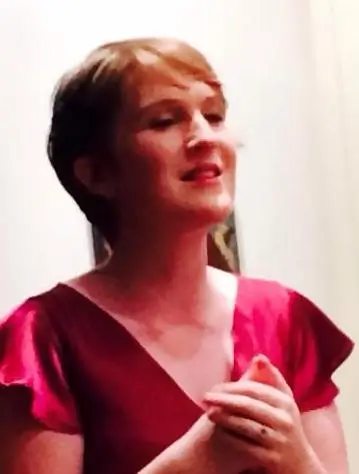
Clare Hayes-Brady is
a lecturer in American Literature at University College Dublin. Her PhD focused
on communication in the work of David Foster Wallace. Other research interests
include the interaction of literature with film; transatlantic cultural
heritage; performative sexuality (both normative and queer), resistant gender
modes and the history of burlesque; digital humanities and modes of
transmission; adolescence in contemporary fiction, and dystopian narrative.
More work by Clare Hayes-Brady


Tel: 028 7126 6946
Email: hueditor@theverbal.co
Verbal, Stable Lane and Mall Wall, Bishop Street Within, Derry/Londonderry, BT48 6PU
 company
Copyright © 2026 Honest Ulsterman