


Death as a historical force in Lincoln in the Bardo

George Saunders’ first novel, Lincoln in the Bardo, was both a roaring critical success – winning the 2018 Man Booker prize – and a radical departure from type for the popular author. Born in 1958 in Texas, Saunders is one of the best known American writers working at the moment. He grew up near Chicago and was an engineer before he became a full-time writer. He has taught creative writing at Syracuse University since 1997, and was awarded a MacArthur Fellowship, commonly known as a “Genius Grant”, in 2006, among many other prizes and awards. Saunders is known as a short story writer, and his work ranges from the epistolary form in “I Can Speak!™” to the phonetic in “Fox8” through the lyrical collection Tenth of December. He has also written essays, including the collection The Brain-Dead Megaphone (2008) as well as publishing writing in magazines including The New Yorker. Lincoln in the Bardo is Saunders’ first novel, and won the Booker Prize in 2017. The novel’s audiobook adaptation, which features a cast of 166 voice actors, including Saunders himself playing the Reverend Everly Thomas, won the Audie prize for best audiobook in 2018.
Strongly associated with the short story form, Saunders is known for his experimental style. His work is often noted for its satirical tone; Saunders writes stories that might be called comic dystopias, in which we encounter a somewhat familiar vision of the technocapitalist future. Unlike most dystopian writers, however, Saunders complicates these future visions in various usually comic ways, sometimes with the mundane administrative and practical challenges of the present, sometimes with bizarre intrusions like ghosts or live garden ornaments. For example, in “CivilwarLand in Bad Decline”, originally published in the Kenyon Review in 1992, a 19th century reenactor in a historical theme park, is haunted by a family of ghosts brutally murdered by the father, whose visitations hamper his professional performance. In “The Semplica Girl Diaries”, a middle-class family struggles to maintain its self-presentation through the display of live women as garden ornaments. The novella The Brief and Frightening Reign of Phil imagines a xenophobic demagogue coming to power in a kind of Lego or Meccano world, a kind of wind-up imaginary of contemporary America. “I Can Speak!™” consists of a letter purportedly written by a customer service representative on his lunch-break to a dissatisfied consumer – a common enough form of communication, sent reeling into strangeness by the product, which is an infant mask and “translator” of baby sounds. Along with the breadth of topics, these narratives necessarily encompass great formal variation, with particularly striking departures in narrative voice, perspective, length and tone. Broadly speaking, his short fiction focuses on the “lived experience of male white working-class US citizens” (Moore, 59), focusing on what Rando calls the “losers” (43) of postmodern American society. Indeed, as Kasia Boddy has noted, Saunders’ short fiction maintains a persistent focus on the American workplace, going so far as to have some of his stories “even adopt the form, as well as the language, of office documents: a letter from a ‘product service representative,’ or a memo from the ‘divisional director’ to his staff” (Boddy, 2-3). Boddy argues that this focus situates Saunders’ short work simultaneously in the context of a recent resurgence of interest in “money, class and the trial and toil of work’”, which she dates to the financial crisis of 2007-9, and in a long tradition of American short fiction that deals with the alienation of the working man, which she dates to Melville’s 1853 story “Bartleby”. Boddy also argues that Saunders’ depiction of work is intimately tied to embodiment, as inescapable as being in the world. There is, she says, “always a ‘job to do’” in Saunders’ short fiction.
Lincoln in the Bardo tells the story of the death of President Lincoln’s eleven-year-old son William Wallace Lincoln in 1862, probably of typhoid, and hinges on death as a kind of common condition. The novel was inspired by a story Saunders heard about President Lincoln returning several times to his son’s grave to hold his body, and the novel is a meditation on loss, grief and the rituals and beliefs about death. Saunders compared the story to the Pietà, Michelangelo’s image of the Madonna and Jesus after his crucifixion, explaining that he had imagined, on hearing the story, “a melding of the Lincoln Memorial and the Pietà” (Guardian, 4 Mar 2017), an image that stayed with him for two decades until he finally wrote the novel. The novel uses death as a structuring concept: death is its situation, its primary thematic concern and its driving narrative impetus. While the story itself is a compelling one, and certainly chimes with Saunders’ tender portrayals of parent-child relationships throughout his writing (interestingly, Saunders often depicts the practical, unsentimental aspects of the relationship between a parent or parent figure and a child who is sick or otherwise in need, as in “Pastoralia” and “I CAN SPEAK!™” and more obliquely through “Bounty”, “Sea Oak” and “Winky”) the novel’s primary feature is its extremely unusual form.
While Lincoln in the Bardo is technically a novel, the book functions more like a symphony, composed of brief passages of quotation, some of dialogue and some from written sources, real and imagined. In most cases, the passage is presented like an epigraph, with the speaker’s name or the source given at the end. The book opens with what seems like a standard first-person narration of a remembered wedding night, without quotation marks, which goes on for two pages until it is interrupted by another voice, at which point the novel’s central structural conceit makes its first appearance:
[…] A sort of sick-box was judged – was judged to be –
hans vollman
Efficacious
roger bevins iii
Efficiacious, yes. Thank you, friend,
hans vollman
The narrative proceeds in this way. Vollman and Bevins are two of the three main narrators in the book, whose dialogue, like this, provides a kind of thread of coherence through the often cacophonous circulation of voices. The Reverend Everly Thomas's voice joins the narrative in Chapter IX, at the same time as young Willie Lincoln. The chapters between I and IX are all composed of short extracts from historical descriptions of the period, specifically of a party at the White House while Willie lay sick with the fever that would kill him. Some of these sources are legitimate historical records, while some, as Saunders put it, are “invented ‘historical’ bits” that he wrote himself. The invented passages are given the same structure as the “real” ones, troubling the notion of historical sources, while the personal narratives of the other bardo inhabitants destabilise the very concept of historiography as well as the conventions of narrative structure. Specifically, the juxtaposition of imagined voices from a place between life and death with real and imagined written sources present all these kinds of voices from the past as equivalent, problematising the idea of truth. In this way the narrative creation of historical narratives is necessarily foregrounded as a structural consideration; the novel’s formal innovation is so total that the reader has no choice but to submit to simply experiencing the polyphonic progression of the narrative.
The novel’s indeterminacy begins with the novel’s title, with several elements that effect uncertainty. Firstly, which Lincoln does the title refer to? The plot of the novel would suggest Willie, the child, who is the root of the novel’s dramatic action and one of its narrators (we hear President Lincoln’s voice but only mediated through other consciousnesses). However, that action is in large part caused by the repeated living presence within the graveyard that constitutes the novel’s setting of the “unkempt” President Lincoln, who returns repeatedly in the novel’s single-night time frame to spend time with his son’s body. As such, it may be President Lincoln who is the Lincoln in the bardo. Secondly, the term bardo is not a common one in English, and is never explained, or even used, in the body of the novel. It is presented as something the reader should understand, but never elaborated, and is therefore an implicit presence in the text. The bardo is a concept that comes from Tibetan Buddhism and refers to a liminal or transitional state between death and rebirth, in which the behaviour of a person during their life is weighed in relation to their next incarnation. Interestingly, in Saunders’ imagination of the space, it takes on a much more strongly Judeo-Christian character, and functions not as a space between death and rebirth, but as a space between death and afterlife. The bardo of Saunders’ novel is a space of limiality, but not of process; it is a place of pure waiting, of resistance to death. The novel is a peculiar beast, emerging from actual historical sources referring to the boy’s death and swelling into an exquisite symphony of 166 contested, competing voices that articulate the most sustained anxieties we have about our own mortality, about control, about eternities of unfinished business.
While the novel’s various narrative voices are historically inflected, the same anxieties about illness and death resonate deeply with contemporary audiences. For instance, the shades, such as we might call them, do not until very late in the text acknowledge their circumstances. Their coffins are referred to as their “sick boxes”, and the pretence is maintained that their existence is some sort of out of body experience that takes place during an illness – they appear to firmly believe that they will recover, despite all evidence to the contrary, including the disagreeable necessity of re-inhabiting their decomposing bodies, called “sick-forms” during daylight. Saunders manages here, as he does in his short fiction, to gently highlight the acrobatics we undertake to evade the question of our own finitude, even in the most extreme circumstances. The language of illness becomes the language of the crypt, ironically deferring the ultimate articulation of the truth. As the novel progresses – as is often the case with Saunders – it is the role of the child to speak truth, forcing a reckoning with death. Children are not supposed to stay in the Bardo, though, and he encourages young Lincoln to move on, but Lincoln is persuaded to stay by the visits of his grieving father. Ultimately the child realises the truth of the Bardo and his revelation of this knowledge changes the other inhabitants (so to speak) of this threshold place. Prior to this, the reverend Everly Thomas, one of those who mentors the boy Lincoln, discloses that he is aware but has not made known that they are in the Bardo, a place between life and death in Tibetan mythology, and that they are not awaiting recovery. Thomas reveals that he has seen the moment of judgement, where one’s deeds in life are weighed and one’s eternal fate is decided. Believing himself to be condemned to an eternity of suffering, Thomas chooses the endless waiting of the Bardo. Because of the novel’s multi-vocal structure, we witness a number of different voices coming to terms with death, acknowledging it and relinquishing their hold on the world.
The bardo as it is represented here, is a fundamentally liminal space, a place outside time, a characterised and animated by indeterminacy. As a consequence of their long sojourns in the space, then, indeterminacy also becomes a feature of the characters themselves. As the tell and retell their stories, features of their narratives become physically visible; the stories of their deaths are written on their bodies in very literal ways. Roger Bevins III, who killed himself over his homosexuality and the loss of a lover, but who changed his mind in the midst of his death and is consumed by regrets at not having experienced the world more fully, grows sensory organs – eyes, noses, hands grasping desperately at a lost world – each time he tells his story. Hans Vollman, whose death was caused by a roof beam falling on him as he went to bed with his new and much younger wife for the first time, is encumbered in death by a grotesquely large erection that he has to carry with him. Each character has a bodily indication of the business that keeps them in the bardo, but even at that, their forms are unfixed. Depending on their attention and their stress levels, their forms wax and wane between resemblance of themselves in life and the wild exaggerations of their corporeal forms in death. Lastly, the novel’s primary formal characteristic further foregrounds the role of indeterminacy, refusing to grant the reader any narrative coherence. As earlier suggested, this strategy works to problematise the idea of history and the illusions of truth and narrative coherence, but it also works to disrupt the narrative at a simple plot level; there is no sense of relaxation in the work. Rather, the reader is placed in the same space of liminality and uncertainty, unable to progress and unable to rest, thus mirroring the endless circular waiting of the characters. As the novel draws to a close, the disparate, kaleidoscopic narratives begin to converge on a single narrative thread – the realisation of their condition, the choice to depart or remain and the final departure of Abraham Lincoln from the cemetery. While the style does not change, the frenetic pace of movement between perspectives is smoothed by a similarity in focus if not a unity of voice.
Of course, a novel about Lincoln’s presidency necessarily engages at some level with the United States’ complex relationship with its own ghosts, especialy the questions of slavery, white supremacism and racial division. Like much of Saunders’ work, Bardo cannot avoid envisaging race as a motive narrative force, but “is less concerned with racial sensitivity or social justice and more focused on the question of what it might mean to unapologetically elide racial, cultural and ethnic difference over a massive historical period”. However, the novel acknowledges the centrality of slavery (not altogether successfully) in its closing, which falls not, as we might expect, with the resolution of Willie Lincoln’s troubling time in the bardo, but with President Lincoln’s final departure from the graveyard, accompanied – or rather inhabited – by Thomas Havens, a slave who speaks fondly of the family that owned him, who he maintains “were like family to me”, a phrase he repeats each time we meet him. Havens’ narrative voice is calm and articulate, with precise spelling and punctuation, contrasting sharply with the revenge-hungry Elson Farwell, who dreams of murdering his former owners, who left him to die. In his cheerful recollections of his life Havens initially seems to offer a depiction of the anti-Abolitionist stereotype of the happy slave. However, elements of even his earliest appearance belie his acquiescence to slavery, including his admission that “Of course, there was always a moment, just as an order was given, when a small, resistant voice would make itself known in the back of my mind.”. It is ultimately Havens whose voice closes the novel, having earlier discovered a kind of “kinship” with President Lincoln when the President passes through him on his way out of the cemetery several chapters before the end. Unlike the remaining shades, Havens chooses to leave the cemetery with Lincoln, who has arrived at the conclusion that the Civil War is necessary to the good of the country, despite his reluctance to lead a side into such bloodshed. The goal of Emancipation is thus closely linked to both Willie’s death and his father’s grief and to the rather heavily drawn common humanity between Lincoln and the dead slave Thomas Havens. Indeed, in a sense, the novel suggests that it is Havens’ presence within Lincoln that animates his Abolitionism; Lincoln has some pages previously decided that the freedom (explicitly white freedom) to forge one’s own destiny made the Civil War worth its price, but Havens insists that Lincoln “endeavor to do something for us, so that we might do something for ourselves”. Saunders’ attempt to use the novel to complicate the history of Lincoln’s presidency is not an unqualified success; the suggestion that Lincoln espoused Emancipation because he was possessed by the ghost of a Black man is at best clumsy and at worst engaged in precisely the kind of magical thinking about racial responsibility Saunders’ work seems keen to undo. The novel never really addresses this, but relies on the men’s commonality of “sorrow” to establish an illusory equality between them. Indeed, Havens’ equality with Lincoln is reiterated strongly in the novel’s closing lines, when he rides out of the cemetery in the President’s body with the words “And we rode forward into the night, past the sleeping houses of our countrymen”. The repetition of “we” attempts to reduce to collapse the boundaries of power between the two characters, but while the integrity of the characterisation manages to avoid jarring, the failure to address Havens’ lingering anger and Lincoln’s own ambivalence is striking.
The whole novel, then, orbits around the concept of death, and more specifically around the fear of the afterlife, the unwillingness or inability to articulate death as a reality and the capacity of language to obfuscate and defer the reality of death. This resistance is represented in the differing vocabularies of various shades, reflecting the different times of their demise, which comes to the fore late in the novel with a tussle over who is President. The experience of time, then, is central to the novel’s engagement with death. The shades live in a kind of endless present, physically trapped in the instant of their deaths and emotionally unable to move on, the recursive now of grief that also entraps the hazy figure of President Lincoln, drawn to a graveyard. This endless present, as I have suggested, works to dehistoricise the novel at one level, but the forward motion of the plot(s) simultaneously creates the sense of an infinitude of pasts converging on a real-world present, making Lincoln’s visits to the grave a turning point in history both within and without the Bardo. The three major points of change in the work, then, all revolve around the acceptance or otherwise of a particular form of death: Willie Lincoln’s death and subsequent articulation of this; Everly’s refusal to countenance his own passing, and Havens’ posthumous discovery of a kind of historic purpose. These individual deaths, then, unbound by time and space, nevertheless work explosively on historical time, each sparking a crisis that spills into the “real” world. Saunders imagines a world in which a story, the simple verbal acknowledgment of an individual truth – “Everyone, we are dead!” – is imbued with the power to change the world.
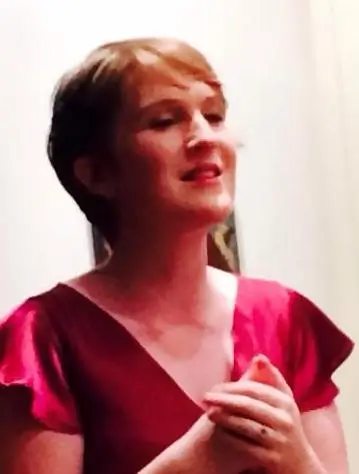
Clare Hayes-Brady is
a lecturer in American Literature at University College Dublin. Her PhD focused
on communication in the work of David Foster Wallace. Other research interests
include the interaction of literature with film; transatlantic cultural
heritage; performative sexuality (both normative and queer), resistant gender
modes and the history of burlesque; digital humanities and modes of
transmission; adolescence in contemporary fiction, and dystopian narrative.
More work by Clare Hayes-Brady


Tel: 028 7126 6946
Email: hueditor@theverbal.co
Verbal, Stable Lane and Mall Wall, Bishop Street Within, Derry/Londonderry, BT48 6PU
 company
Copyright © 2026 Honest Ulsterman