


An Interview
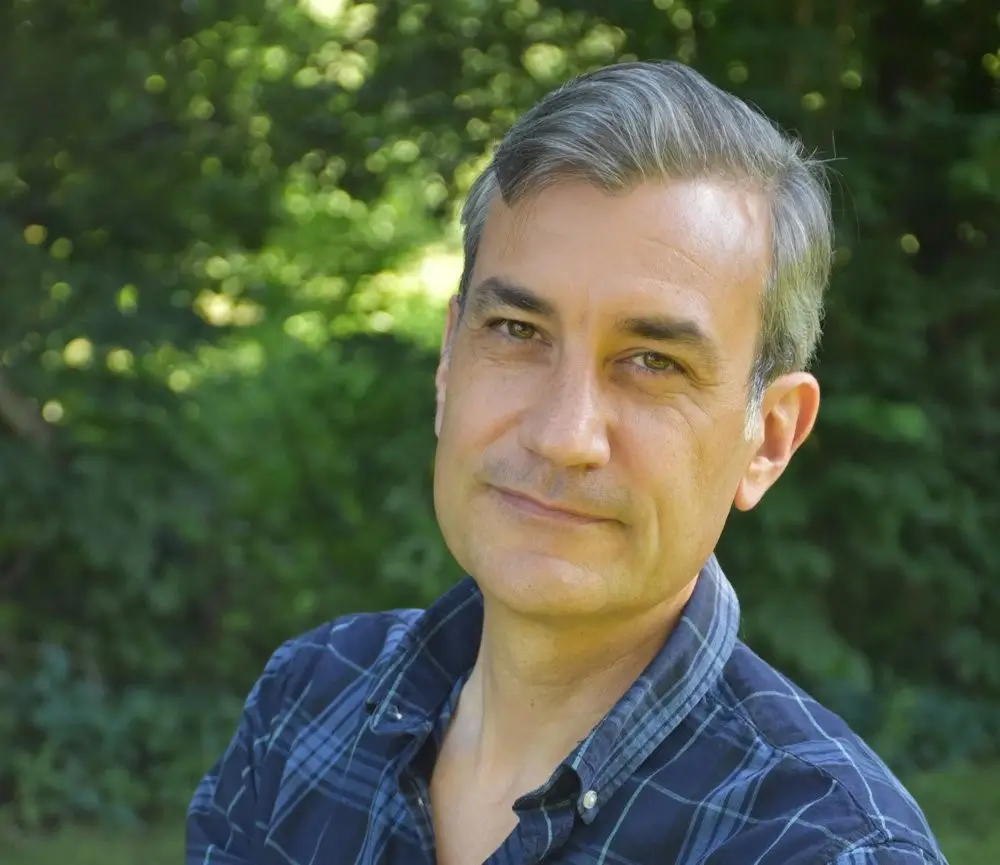
Matt Donovan is the author most recently of The Dug-Up Gun Museum (BOA 2022) and the collection of lyric essays, A Cloud of Unusual Size and Shape: Meditations on Ruin and Redemption (Trinity University Press 2016). He is the recipient of a Whiting Award, a Rome Prize in Literature, a Creative Capital Grant, and an NEA Fellowship in Literature. He serves as Director of the Boutelle-Day Poetry Center at Smith College.
Gerard Beirne: Matt, when we first met in the wilds of Portmuck, you were sitting on a bench outside a near derelict cottage, teaching yourself the harmonica, with a quart of whiskey at your feet. We talked about Hank Williams and cow-tipping. You were writing poems with mackerel skies. The world was surely our oyster. What happened?
Matt Donovan: I love this question, and think back on my year in Northern Ireland, and at the Poets’ House, as such a formative period. I’d just graduated from college, and had deeply romantic ideas about what it would be like to be have a year in Ireland to write. Your question also accurately implies that I’d arrived with a quiver crammed with affectations and the poet tropes I’d deemed essential. I continue to deny any presence of a harmonica, though.
GB: More seriously, how has the progression been as you move through life writing poetry as you go?
MD: This is a big question, and it’s interesting for me to think about both what’s changed and what has remained essentially the same. My year in Northern Ireland was divided almost equally between living in rural Portmuck and then down in Belfast, and was my first window of time in which I had nothing else on my plate beyond the business of poetry. It was incredible to spend hours on end ,and even whole days, doing not much more than wrangling with lines, trying to push poems forward. Given my job and family life, I’m far more likely to grab small snatches of time, but otherwise my process likely hasn’t changed much. Twenty-eight years later, I hope I’ve learned a little more about how poetry works, including how difficult it is to write a poem. During that year in Ireland, I couldn’t have known how hard it can be to maintain a sense of regular creative practice, or how important it can be to treat the act of writing as one of authentic interrogation and exploration, rather than knowing where the piece is going from the outset, which I’m sure was much more of the norm for me when we first met.
GB: Your third book, A Cloud of Unusual Size and Shape, was a collection of lyrical essays. Meditations so to speak. What led you in the direction? What can the lyric essay allow or that the poem perhaps cannot, or do you see the form as an extension of the poem?
MD: It was so exhilarating to discover the lyric essay form! The first lyric essay I ever wrote came out of a visit to the Trinity Site, which is the place where Oppenheimer tested the world’s first nuclear bomb. I was living in New Mexico at the time, and, twice a year, they opened the site to visitors. It was such a baffling, troubling, overwhelming trip—from the boy scout troops cackling away, to the radiation propaganda I was handed in the parking lot, to the fact that there was no trace of any mention of Hiroshima or Nagasaki anywhere on those grounds. As I tried to write about the experience, poetry felt like an inadequate vessel for all of the history, and science, and bizarre anecdotes I wanted to find space for (including the fact—true story!—that during the countdown to the bomb’s detonation, a local radio station crossed bandwidths with the government’s radio transmission, and for a few brief seconds was subsumed by Tchaikovsky’s “Nutcracker Suite.”) Once I shifted to prose, I was no longer constrained by the poetic line, and it was liberating to focus on describing the scene, juggling the various elements of my visit, and asking the questions I wanted to ask. I felt like a dog bounding off its leash! All of that said, I’m less and less interested in genre distinctions, and even when I’m working in prose I’m still just as likely to privilege, say, metaphor and associative leaps in subject matter.
GB: I must talk about your recent collection, The Dug-Up Gun Museum. A timely examination of gun culture in America and its heartbreak. Here, in Ireland, we hear about the tragic consequences of this on a regular basis. So much so that perhaps the shock and horror has been deadened even for us, and of course we grew up surrounded by political violence. Where does the poem fit into all of this? What led you to such a detailed examination of the issue?
MD: It's really interesting to have this question follow your question about genre, since I’d had every intention of writing this book about guns as prose. That project began from a place of grief and fear about America’s gun violence, as well as disgust and incredulity at how normalized it’s all become. From the outset, though, it was important for me to put boots on the ground for this work. I wanted to speak with people who had been affected by gun violence, but I also wanted to have conversations with gun owners, and I spent several years traveling the country, visiting various place and interviewing people. The more people I spoke to, the more questions I had. When the nonfiction book unravelled for a wide variety of reasons, I was left with all of these stories and images that I couldn’t relinquish, and that material gradually developed into a series of poems and short prose that became The Dug-Up Gun Museum. In the end, poetry turned out to be the ideal genre I think through which I could interrogate guns, from our mass shootings to our urban violence to our bombastic fetishizing of firearms.
GB: I know that you studied with one of our great poets, Eamon Grennan, at Vassar College where he was Professor of English. Can you talk a little about that experience and your relationship with him?
MD: Ah, Eamon. I love that man, and still see him on occasion, given that he doesn’t live too far from me here in the States. In my early years at Vassar, I stalked him on campus, hurling unsolicited poems his way, poor guy, but then I took a yearlong verse writing class with him during my senior year. That was my first real encounter with poetry. He had brilliant prompts that started me thinking for the first time about the individual components of poetry—diction, syntax, the line, and metaphor, for instance—but then he also had us writing in received forms. I don’t envy him reading our no-doubt terrible villanelles, but I pounded my way through a sestina about an Edward Hopper painting that I consider the first halfway decent thing I ever wrote. Like everything else I wrote for him, the piece was a Grennan knock-off, and to this day I remain deeply indebted in my own work to his lyricism and keen eye, which sees everything and renders the world back to the readers in the most astonishing and transformative ways.
GB: Have any other Irish writers been significant to you in relation to your work as a writer?
MD: Oh wow—so many. My first exposure to Irish literature likely began at Vassar, when I started reading writers such as Joyce, Beckett, Heaney, and Yeats. But when I arrived in Ireland, I suddenly found myself facing a cascade of stellar contemporary poets whom I had never read before: Paul Durcan, Martin Mooney, Nuala Ní Dhomhnaill, Medbh McGuckian, Michael Longley, and Ciaran Carson, are just some of the first names that come to mind. It was such a thrill to encounter so many new voices all at once!
GB: What’s next? And when do we get to see you in Ireland again? - We still have cows; most homes maintain a picture of Hank Williams on the wall next to the Sacred Heart; and we are partial yet to the lonesome wail of a tremulous harp.
MD: I’ve been collaborating with my wife, the artist Ligia Bouton, on some a visual art and erasure project that has pushed my writing in a completely new direction, and, coming off of The Dug-Up Gun Museum, I’ve also been working on some new poems in which guns are never mentioned, and no one gets shot. In terms of Ireland, I’d love to get back—just say the word! I’d be wonderful to return to Belfast at some point, which I know has really changed from when I was living there in the mid-nineties. When the cease-fire broke in 1996, it made life in the city much more complicated to navigate, and it was gratifying to hear, from other American poets who have recently spent time there at Queens College, that the town is thriving in new ways. I also have such fond memories of hitchhiking up the west coast during a beautiful August. I gather that hitchhiking isn’t as manageable these days, but that was an utterly blissful time. To return to the romance which you conjured from the outset, I remember in particular visiting the southernmost tip of County Cork and lying on some rocks while someone fished and tended to a the hand-crank gramophone he had brought along, and which was blaring Frank Sinatra records all afternoon. There was also a Doolin pub lock-in on the night that County Clare won its first hurling championship in decades, and--true story!--among the many folks dancing on tables that night was Quentin Tarantino.

Gerard Beirne's most recent collection of poems, The Death Poems: Songs, Visions, Meditations was published by Salt Publishing in March. He has published two other collections of poems, three novels, and a collection of short stories. His new novel, The Thickness of Ice, is forthcoming in 2024. A Hennessy New Irish Writer of the Year Award winner, he has been shortlisted for the Danuta Gleed Literary Award, the Bord Gais Irish Book Awards, and Kerry Group Irish Fiction Award. He lectures on the BA Writing and Literature Program at ATU Sligo, Ireland.
More work by Gerard Beirne


Tel: 028 7126 6946
Email: hueditor@theverbal.co
Verbal, Stable Lane and Mall Wall, Bishop Street Within, Derry/Londonderry, BT48 6PU
 company
Copyright © 2026 Honest Ulsterman