


An interview
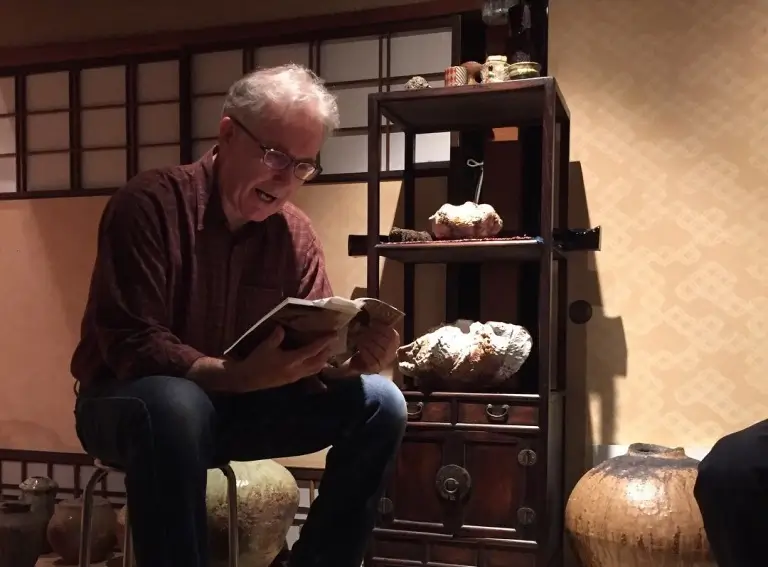
Gregory J. Dunne is the author of two collections of poetry: Fistful of Lotus (2000) and Home Test (Adastra Press, 2009). His most recent book is the critical memoir, Quiet Accomplishment, Remembering Cid Corman (Ekstasis Editions, 2014). A new collection of poetry, Other/Wiseis due out in 2019 with Isobar Press (Tokyo & London). He teaches in the Department of Comparative Culture at Miyazaki International College, Japan.
Gerard Beirne:Greg, you have lived for a long time now in Japan. When did you first move there, what attracted you, and what has held you there since?
Greg Dunne: I was made aware of Japan early in my life as my father was a career U. S. naval officer who had lived for a short time in Japan after WWII. He was stationed in Sasebo which is located on the same island where I live now, Kyushu island. I grew up hearing stories about Japan and the war. Those stories intrigued me as did the Japanese rifle and its bayonet that he had brought home. The rifle had a small chrysanthemum flower, symbol of the imperial family embossed on the gun barrel. Later, in high school I encountered Japanese haiku poetry and was very taken by the pithy sharpness of it. The way it managed to evoke so much in so few words. In college, I encountered Zen Buddhism and began practicing with a Korean teacher in Seattle. All of these events, I believe had me leaning towards Japan. When I graduated from university in biology and had a chance to work aboard fishing boats operating in US territorial waters north of the Aleutian islands, I requested to work aboard Japanese vessels out of my growing interest in Japan, its culture, language, and arts. I figured this would be a good way to learn something more about Japan and I was right. My job aboard the boat was to collect information on the age and structure of the catch, that is, how old were the fish and what kind of fish were being caught.
Back in Seattle, while returning to school to study English and creative writing, I met a Japanese woman who was studying at the university. We began dating a and persisted until she had to return to Japan. After finishing my studies at the University, which took an additional six months, I traveled to Kyoto, Japan to see here and to test, I guess, if there was something real between us. That was 1986. I stayed in Kyoto for four years and returned to the USA in 1990 to pursue an MFA in Poetry. By this time Kae and I had decided to marry after I had finished my studies. In 1992, we got married in Spokane, Washington and returned to Japan, where I began working on a part-time basis in various colleges and universities in the Kyoto area. All tolled I’ve living in Japan about thirty years.
Japan still holds my interest. I enjoy the civility of the Japanese and their sense of aesthetics in the arts, cuisine, design, and poetry. I continue to study the language, which is an endless adventure. I feel quite rooted in Japan now, as I have four children here. The eldest being 24 and the youngest being 14.
GB: In terms of your own writing, how have the eastern and western cultures influenced it, and does one culture dominate more than another? Are the poetic cultural differences antagonistic to one another or compatible?
GD: I don’t find myself reflecting much on how the two traditions contribute to my poetry, but I know they do. I admire the quiet elegance of much of Japanese poetry and art. I like its understatement and its appreciation for the limits of language. The traditional poetry of Japan tended to be spare, efficient, restrained – careful in the use of adjectives and hyperbole. I admire that. I aspire to write poetry that is as equally precise and evocative. But then, I also studied with David Wagoner at the University of Washington, and David was a studentof Theodore Roethke’s. Roethke was steeped in the Western tradition. Wagoner, like Roethke, shared his deep appreciate of the Western tradition with us. It was nothing, for example, to hear Wagoner to recite from memory several poems a day in class, and many of them very long poems. I learned from him to appreciate the importance of the line and the sonic qualities of poetry in English. He loved the music of Yeats and Hardy, for example. If we were discussing anapests and he was warning us of their tendency to be a bit comical he might delight in reciting Louise MacNiece’s “Bagpipe Music” just to show us what a master could do with the line, rhythm and rhyme: “It’s no go the merrygoround, it’s no go the rickshaw,/ All we want is a limousine and a ticket for the peepshow/ . . .”
GB: You completed an MFA at Eastern Washington University and a doctoral degree at the University of Missouri. What role has academia played in your life as a writer?
GD: The MFA program was a rich opportunity to get to know some very committed fellow writers, young folk for the most part, who were finding there way into the writing the life. Those friendships have been pivotal for me throughout my life as a writer and they have deepened over the years as we have grown and pursued our writing. I had opportunities in the MFA program to meet wonderful teachers who taught and inspired me, writers such as John Keeble, Nance Van Winckel, Iim McAuley, Robert Hass, Czelow Milosz, Evan Boland, and Paula Meehan. The program at Eastern Washington State was small and provided genuine opportunity to learn from such writers.
The doctoral program at the Univesity of Missouri gave me an opportunity to work in scholarhsip and creative writing with a few witers, poets, and scholars that I admired. I particulary wanted to study with the Christain poet Scott Cairns whose path into art is directly related to his faith. As a struggling Zen Buddhist Catholic, I was intrigued by his path into both art and faith. My dissertation, Passing Figures, includes both a critical component and a creative component. The critical component traces the history of mixed-form memoir (prose and verse) in the literary traditions of the West, with attention paid to the development and practice of the same in the Japanese tradition, such as Matsuo Basho’s travel journals. The dissertation examines the aesthetic and historical relationship between memoir and verse and theorizes how the poetic functions in contemporary memoir. The creative component of the dissertation is comprised of an original work of creative non-fiction: a mixed-form memoir of prose and verse.
So, all in all, I think the academia offered me a place to learn more about various poetic traditions while being able to spend time with a number of committed artists. I have, for the most part, lived a pretty isolated existance in Japn with few opportunites to attend poetry readings or to learn from other writers. (My meetings with Cid Corman were an exception to this.) Given this type of islation, I think the academy was especially important to me.
GB: Which contemporary Japanese poets do you most admire?
GD: The Japanese poets whose work I have read in translation and admire are Yoshimasu Gozo, Takahashi Mutsuo, Ito Hiromi, and Suga Keiichi. I also admire some Japanese writers who write in English, namely Goro Takano, Yoko Danno, Mariko Nagai, and Masaya Saito.
GB: Cid Corman has played a great role in your life and you are a great champion of his work. Can you talk about his influence upon you and his significance in the world of poetry?
Cid was really the first elder poet who literally invited me into his living room, poured me a cup of tea and spoke with me about poetry and about the vocation of poetry. I was moved by his generous spirit and his belief in poetry as something of essential value and significance. I have written of my coming to know Cid and my subsequent informal studies with him in in Quiet Accomplishment, Remember Cid Corman (Ekstasis Edtions, 2014). Cid came into my life on two critical occasions: once in high school when I was reading an anthology of poetry in a creative writing class. It was a turbulent time in the United States, maybe 1972. We were living in the Viet Nam War period, Bobby Kennedy had been assassinated, and before him, Dr. Martin Luther King. I hit upon Corman’s poem and it struck me immediately. Out of all the chaos around me his voice struck me as sane and soothing. I didn’t realize poetry could sound this way, as direct as this. I think this poem turned me towards poetry.
I read about Cid in the back of the anthology and I saw that he was living in Kyoto, but I didn’t think too much more about it, as there were other American writers in the volume who were listed as living in various parts of the world.
Years later, when I was in Kyoto, my friend, and future wife, Kae, told me that I should try a certain cake shop next to her apartment called CCs. She thought I would enjoy the homemade American ice cream there and the atmosphere. For a long time I rejected her advice, telling here I didn’t come to Kyoto to eat American ice cream, but finally, one rainy day when I needed to be alone, I relented and ducked into the shop. I found poems on the wall and a quiet atmosphere in which to write. As I stood reading the poems on the way, in English, some Cid’s some other’s, the Japanese baker came out to ask me if I know Cid. I told him that I knew “of” Cid but I didn’t know him personally. The baker gave me Cid’s phone number and told me that this was his shop and that I should call him. He would like that. I was too afraid to call but a friend of mine did. Soon, I was meeting with Cid several times a month on Sunday afternoons to talk about poetry.
Cid was absolutely committed to poetry and the life of poetry. I could never be that committed. But when I left his house after four hours of talking about poetry on Sunday afternoons, I could feel the excited charging through my body like an electric current. I knew then that poetry was the truest thing in my life, my deepest desire was to write poetry. And though I knew I would never be as absolute in my commitment to it as Cid was, I also knew that I had met the measure. I knew what a poet was.
Cid’s significance to the world of poetry is large. He worked as an editor, translator, and a poet. In all of these areas he excelled. As an editor, he introduced a remarkable number of gifted young poets to the world in the pages of his Origin Magazine. As a translator, he translated from a great number of languages and from various time periods. As a poet, his magnum opus, of, runs five volumes, eight hundred pages a volume. He has left a great deal of work behind him. That said, he also played a central role in ushering in the New American poetry of the 50s. He did this by engaging in conversations and discussions with many poets on topics related to art and poetics. This is evident in the vast correspondence he maintained with poets as Lorine Niedecker, Louis Zukofsky, Robert Creeley, Charles Olson, Larry Eigner, Gary Snyder, William Bronk, and so many others.
GB: What are you working on at the moment?
GD: Presently, I am finishing a new collection of poetry called Other/Wise. It is due out in 2019 with Isobar Press (Tokyo and London).
GB: Have you engaged much in translating poetry and what are the attributes of translation that you admire or are wary of?
GD: My most sustained work in translation involved collaborating with Goro Takano, whom I mentioned above, in translating the modernist tanka poems of Bokusui Wakayama (1885-1928). We translated some fifty poems and published them over in various literary magazines. Some of these translations are available on the web. We spent about three years on the poems and enjoyed many lively discussions on how best to translate them.
I admire translations that succeed in becoming poems in English. I think that is the measure of a successfully translated poem – what makes for poetry in one language should become poetry in the other. This, I learned from Cid Corman. Corman knew that not every poem in its original language can be made into a poem in English. The translator aims for poetry but will most often fall short of that. I am wary of translations that sacrifice poetry in order to be faithful to form, and that seems to happen a lot in the translation of Japanese traditional poetry because the form is such a dominant aspect of the poetry.
GB: When I think of writing and reading poetry, I often think it is a way of living in the world. How do you view your life as a poet?
GD: Poetry is an essential part of life. It is as natural, basic, and sustaining as a mother singing a lullaby to her child. I feel, as you do, that responding to life with and through song/poetry is a way of living. Life is poetry and poetry is life. It’s what people do whether they are singing the blues, an operatic aria, or writing a poem.
GB: What is it that we can learn from poetry, do you think? What would you say to someone starting out, trying their hand, so to speak, at the construction of poetry?
I tell young writers that the act of writing, of trying to write poetry, will enrich their lives in ways they will understand and feel. I tell them that they must be patient with themselves and learn to develop at their own pace. I encourage them to read as much as possible and find the poems that they love.
Poetry, I think, teaches us how to feel, how to feel what is going on inside our own hearts, minds, and life. Poetry is essential a conversation between the writer and the reader, between the reader and the writer. It goes both ways, and in so doing I believe poetry deepens human connection, compassion, and understanding.

Gerard Beirne's most recent collection of poems, The Death Poems: Songs, Visions, Meditations was published by Salt Publishing in March. He has published two other collections of poems, three novels, and a collection of short stories. His new novel, The Thickness of Ice, is forthcoming in 2024. A Hennessy New Irish Writer of the Year Award winner, he has been shortlisted for the Danuta Gleed Literary Award, the Bord Gais Irish Book Awards, and Kerry Group Irish Fiction Award. He lectures on the BA Writing and Literature Program at ATU Sligo, Ireland.
More work by Gerard Beirne



Tel: 028 7126 6946
Email: hueditor@theverbal.co
Verbal, Stable Lane and Mall Wall, Bishop Street Within, Derry/Londonderry, BT48 6PU
 company
Copyright © 2026 Honest Ulsterman