


An Interview
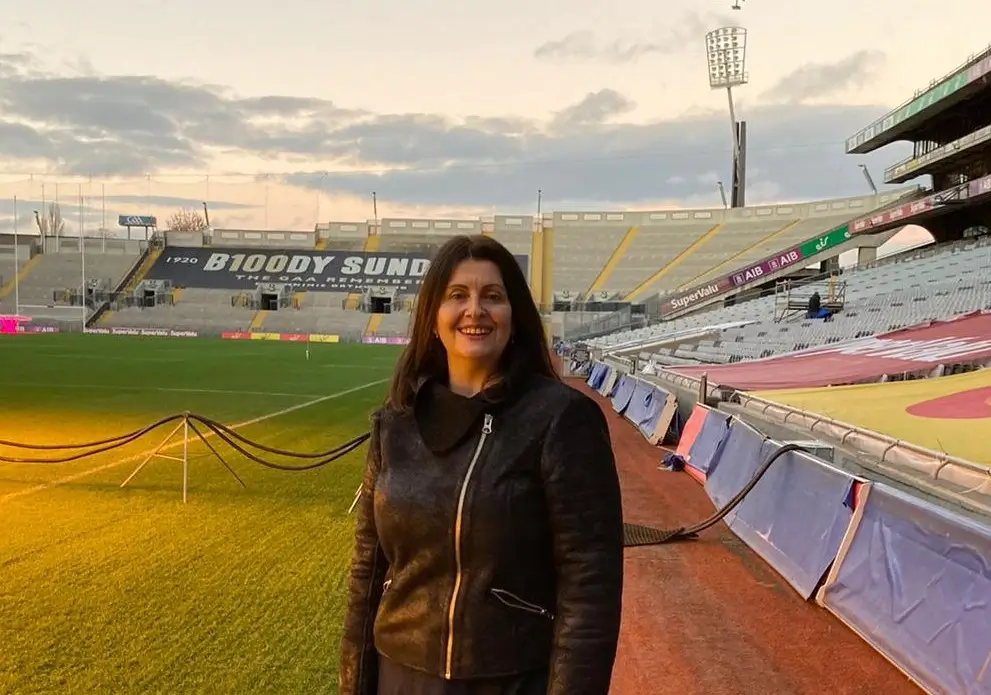
Jo Egan creates work in traditional and non-theatre settings for both professional and community productions. In 2015, along with Fionnuala Kennedy, Jo co-founded MACHA Productions which creates work inspired by and with marginalised or absent voices. Jo was recently commission by the Abbey Theatre, Dublin to create a short play about James Teehan as part of the 14 Voices from the Bloodied Field project which responded to the Bloody Sunday Massacre in Croke Park, 1920. In 2018, Jo was International Theatre Artist in Residence at Derry Playhouse. As part of her residency, she wrote and directed The Crack in Everything based on interviews with the families of six children murdered during the NI Troubles. In the past, she developed the concept, part-directed and produced the Wedding Community Play (1999) – the first large-scale cross-community site-specific play, set in four different locations in contested spaces in Belfast with over 100 participants. As Creative Producer with KABOSH, she produced site-specific work that questioned “what theatre is and where it takes place”. In 2013 she co-wrote, produced and directed Crimea Square, One Hundred Years of Shankill History, with four Shankill residents and a community cast of thirty-five. In May 2014 her play, Sweeties, (Greenshoot Productions) informed by interviews with one woman over seven years, premiered at the Grand Opera House, Belfast and in May 2017, Madame Geneva, using both professional and community actors, told a tale of gin, prostitution and capitalism in 1700’s London. It premiered at the Lyric, Naughton Studio, Belfast. Her plays No Motive and Sweeties, part of the Body Politics project, were cancelled during production week in March 2020 due to the Covid 19 Pandemic. Jo works as a dramaturg and currently teaches playwriting and memoir in adult education. She holds an MFA in Playwriting (TCD, Lir Academy).
Moyra Donaldson: Hi Jo. Thank you for agreeing to talk about Macha Productions and your work in theatre. You are a practitioner with a huge amount of experience, particularly in working with communities. I know that when you set up Macha in 2015, you had a specific ethos in mind. Would you like to talk a little about your motivation and the ideas and values that lie behind the company’s inception?
Jo Egan: I’m passionate about cultural politics – who owns the narratives? Where does the power reside? How do those in power dismiss the narratives of those they deem unimportant? Also, I was tired of the sameness of cultural expressions in novels, theatre, TV and cinema. Many stories revolve around white men in crisis and how they dig, or don’t dig, themselves out of a hole – usually by killing-off someone to clean up the mess or in the case of detective work, by discovering the murderer of some piece of perceived social trash, utterly incidental in the unfolding plot, but we get to revel in the computer- like brilliance of the white male investigator. These repetitive stories were as insidious as Trumps fake truth and are still central to most of our cultural consumption. That’s changing and changing rapidly. But in 2011 when a theatre company dedicated to creating work by and with marginalised voices was calling to me, the white male gaze, as it’s now called, utterly dominated.
As theatre practitioners, we constantly need to question how effectively we facilitate groups to tell their tale – who’s the editor. Is the facilitator the great know-all artist at the heart of a gathering of the unknowing? When working with a community representation how do we create representative stories without further marginalising? In 1998, while writing the training programme underpinning the Wedding Play (1999) a necessary process to access funding, I attempted to identify the core machine at the heart of a community process and came up with; exploring, recognising and valuing what it is we (the community) know. This ethos has the capacity to embrace multiple narratives, perspectives and insights. Not placing experiential insights into a hierarchy but layering insight and opening up multiple meanings.
By 2015 another theatre activist, Fionnuala Kennedy, who shared the same passion towards cultural politics, came on board and we set up MACHA Productions. With oodles of ambition and no money, we created the company document on a charities commission template for a company limited by guarantee and were formally registered by 29 May 2015. Later that summer Fionnuala Kennedy wrote, directed and produced the first piece: Womens’ Been Doing It Since Eve, a play about childbirth and poverty, which she followed in 2017 with Entitled – about welfare reform quickly followed by my own Madame Geneva.
MD: You mention Madame Geneva which was produced to critical acclaim in the Lyric Theatre in Belfast. This play draws together a lot of threads - the arrival of gin into London, the politics of the time and the establishment of the first Magdalene Penitentiary in London in 1758. What was the genesis of this idea and how does it speak to a modern audience? The production also mixed a professional and community cast. Did this bring any difficulties and what do you see as the benefits of doing this?
JE: Madame Geneva was a response to my experiences in a Mother & Baby home in Bessboro, Cork when I was 17. I didn’t give my daughter, Rachel, up for adoption but since the mid 1990’s the tide had been turning on Irish society’s dirty little secrets; rampant paedophilia both facilitated by the Catholic Church and in the family home, Magdalen Asylums and Mother & Baby homes, so this location of secrecy and shame was now being questioned as I was progressing as an adult. I attempted to write about it and at the start of the millennium went back to find my close companions from Bessboro. I sat with the experience for a while to think through an approach. During my research, I remembered I had grown up in Streatham, London, child of Irish immigrants from Connaught, beside a Magdalen Asylum and I began researching the history – why in 1758 did society suddenly feel it had to address the problem of loose women and set up the first penitentiary for prostitutes? What was going on? Madame Geneva was that exploration. The tale began with the birth of the London we know, the gin craze and birth of the middle class in the second half of the century. It was impossible to tell that tale without people. The play was a series of short scenes interspersed with large peopled scenes involving prostitutes, river dwellers, the house of Lords, soldiers and Londoners. This sense of a city brimming with citizens would have been impossible without the full complement of our community cast. For over two years, twelve people attended training in performance with practitioners such as Patrick O’Reilly and Alison McCrudden, vocal work with Ross Anderson and Peter Balance, choreography with Oona Doherty. Regular theatre workshops also examined and practiced the work of Brazilian theatre practitioner and political activist, Augusto Boal. The last six months of training encompassed the productions Entitled and Madame Geneva.
MD: The Crack in Everything, commissioned by Derry Playhouse and the Peacebuilding Academy in 2018, looks at the stories of six families who experienced the killing of a child as a result of the ‘troubles’. You interviewed over twenty people to gather the material for this play. How difficult was this for you and what was it like for the families? In 2020 you were commissioned by the Abbey Theatre in Dublin to write a piece for 14 Voices From the Bloodied Field, a production that gave voice to the men, women and children who were killed in Croke Park in 1920. You obviously feel it important that voices like these and those of the families in the Derry production are heard. Would you say a little about this?
JE: I don’t find interviewing difficult even when participants hit emotional moments, often because those who choose to bring their story to a project are clear about what they want and, I as a theatre maker have made it clear what I’m attempting to provide. With The Crack in Everything, the families wanted justice for the murder of their sibling and the piece of theatre Derry Playhouse was producing was another opportunity to invite the public to bear witness. As Gandhi says, this bearing witness is in itself a revolutionary act. So even though interviewees might get upset, the main objective framed the interaction. An artist’s job is to further frame the work in such a way that the audience can meaningfully hear what the families are desperately trying to communicate. With the Abbey piece, it was about naming people who had been lost in the politics of the War of Independence. It was about putting flesh on the bones of people who had been lumped into a heap of bodies at the centre of Bloody Sunday 1920. Shockingly, very few of us really knew the stories at the heart of that day of bloodshed, brilliantly researched by Michael Foley in his book, The Bloodied Field. Its important that we examine these stories not just because the recent Troubles were in many ways a continuation of the War of Independence and Civil War but if we really don’t wish to get sucked back into tit-for-tat social disintegration we’ll use the stories to show the social desolation they portray and not as weapons to incite further antagonism.
MD:The latest Macha Productions project, Body Politics, was to go on stage in the MAC in March 2020, but had to be cancelled due to the virus. What is it about and how was it developed? Do you hope to be able to reschedule? How has the company been able to respond to the current restrictions? Are there opportunities for people to become involved with the company?
JE: Fionnuala Kennedy’s daughter, Joanne, was in P7, wearing shorts in the playground and was told she had to change back into her school skirt. She pleaded her case saying she was turning cartwheels and handstands in the playground but was still chastised. She was a plucky 11-year-old so she took her complaint to the headmistress. My daughters are all grown up so I was completely unaware that there were still such archaic practices taking place in girl’s schools. It’s a perfect example of how we are taught to be women. Who are we really outside of our physical manifestation? What is a woman? What is it to be feminine? Is it a merely a response to the requirements of masculinity? Beyond the theories of Judith Butler, what do women and those identifying as women really feel about this? A contentious issue for sure, but then, thankfully the Northern Irish public aren’t ones for shying away from a good debate, or so we hoped. We worked with three groups of women to gather stories and experiences of what it is to be a woman now and throughout the Troubles, what it is to be an emigrant coming into Northern Ireland and how our perceptions of ourselves as women had changed or not. Participants responded by creating either pieces of writing or choreographed movement and the work was curated into a small exhibition accompanying the production of two one-act plays that comprised Body Politics. We rehearsed the plays for four weeks, scheduled post-show debates following each performance when all collapsed into lockdown. MACHA has responded to the Covid19 pandemic by providing a series of online workshops, for people struggling in isolation looking to creativity for solace, in Memoir, Poetry and Artist Journey workshops inspired by the Artists Way. As my good friend Gerri Moriarty once said, “It never fails. I’m always wonderfully surprised but it never ever fails”. She was talking about the magic that is unleashed when someone connects with their creativity, whether it is something lost or being found for the first time. It is this magic unleashed that is the drug which keeps many of us fighting the current of impossibility upstream into the face of unlikelihood.

Moyra Donaldson is a poet and creative writing facilitator from Co Down. She has published nine collections of poetry, including a limited edition publication of artwork and poems, Blood Horses, in collaboration with artist Paddy Lennon. Her most recent collection is Carnivorous, Doire Press, 2019. In 2019, she received a Major Individual Artist award from the Arts Council NI. Her new collection, Bone House, published by Doire Press was launched in April 2021
More work by Moyra Donaldson


Tel: 028 7126 6946
Email: hueditor@theverbal.co
Verbal, Stable Lane and Mall Wall, Bishop Street Within, Derry/Londonderry, BT48 6PU
 company
Copyright © 2026 Honest Ulsterman