


An Interview
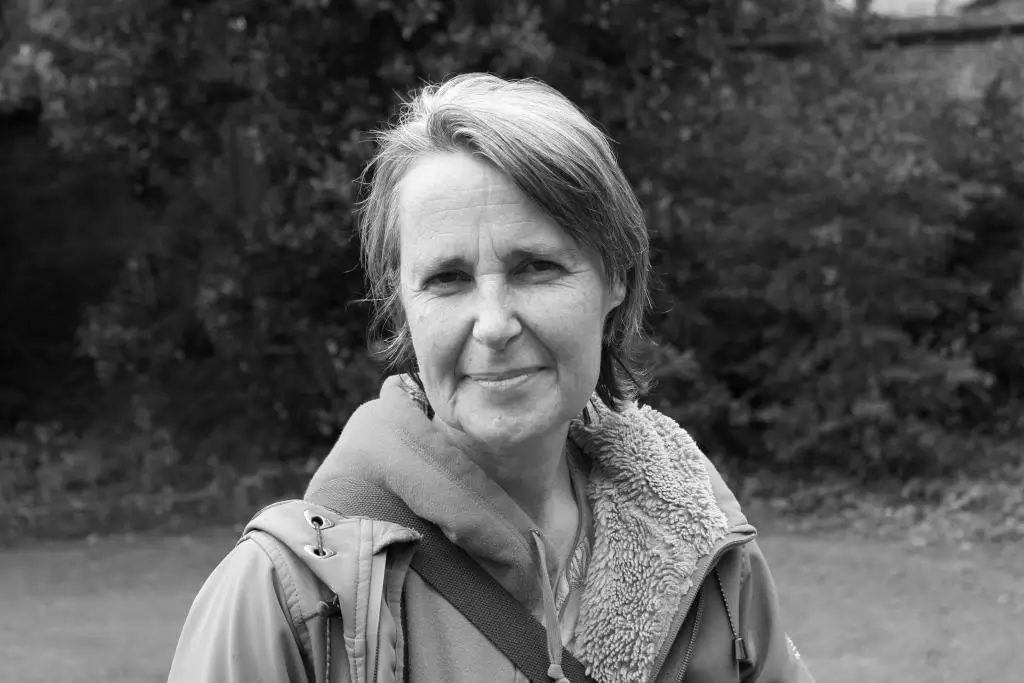
Fióna Bolger is a poet, writer and facilitator who has lived mainly in Ireland and India. Her first collection, a compound of words was published by Yoda Press, Delhi in 2019. Her poems have appeared in The Brown Critique, Poetry Ireland Review, Poetry Bus, Chattahoochee Review among others. Her next collection is due out from Salmon Press, Ennistymon in 2022. She often facilitates workshops with Irish Writers Centre, Dublin and Yoda Press, Delhi. She is interested in plurilingualism as a strategy to cross borders and create new spaces for playing and thinking in words. So much of what controls our lives and our movement in the world is written in language she hopes a shift in language can bring change. More about her: www.fionabolgerpoetry.com
Moyra Donaldson: Hi Fiona – thank you for agreeing to this interview. One of the reasons I wanted to talk to you about your work is a shared interest in questions of identity, home and belonging. Your poetry questions borders and seems to me to be constantly exploring the concept of in-betweenness. I’ve always been a bit of a stay at home, but you have lived between Ireland and India and this has informed your work and thinking in many varied and exciting ways. Lucy Collins said that you have changed our understanding of what a poem written by an Irish woman can look like, and as a result, troubled the boundaries of our tradition. Would you talk a little about what your travels have brought to your poems and how they have affected your understanding of what a poem can be. Maybe you could also say something about the parallels between the two countries, where borders have such significance.
Fiona Bolger: Dear Moyra, thank you for such thoughtful questions. I love how you read us both sharing questions of identity and home and belonging. I think though I will have to disagree that my travel and your rootedness differentiate us. I have always thought that as the earth is a sphere, you can remain on the surface and travel or stay put and you will never really get close to the heart of things. On the other hand if you burrow deep from any place (your home of birth or a distant home) you will reach the centre, the heart of the matter. I know this is a crazy idea geologically but as a poet I can break those rules and say if we go deep enough from any point on the surface we will meet the shared heart of humanity. I think/hope that is where you and I meet!
What Lucy says is so reassuring. At first I was not even sure I was writing poetry, then I was not sure it would ever be accepted in Ireland. I was first published in India in the Brown Critique and my first collection came out in India in 2019. I do love being on the edge of our tradition on this island though, maybe many of us are stretching those boundaries all the time.
What you say of India and Ireland having a shared history of a border being created at the foundation of independence and of communities who have so much common history together and yet find themselves pulled apart by some elements is true. However it is dangerous to slip any easy model over a situation and say ‘same, same’.
Living in Allahabad and Chennai, as a young woman I learned so much. I had never myself studied in a religiously mixed school. In one school I worked in, each day a different religious tradition’s holy texts were used for the assembly. On my day I was asked to speak about Buddhism and I learned about the eight simple rules for living an ethical life. I learned about language, that it is a tool. If two people meet they will try to find a way to communicate. If there is no common language people will try a mishmash of languages to be understood. Many people I met who were educated only a little or not at all formally, spoke 3 or 4 languages. But the thing I learned most was the kindness of strangers. Delivering my child was complicated and the entire hospital rowed in to take care of me, because ‘your family are so far away, we are responsible for you’. I saw in Savita Halappanavar’s death a very different attitude from medical personnel here. It was awful to think if we had swapped places and she had an entire hospital trying to mind her as she was far from home, how she might have survived.
MD: I know you have always been active in encouraging other voices and writers; your work with the Dublin Writers’ Forum, your workshops on writing plurilingually and your championing of diversity. You are a poet who engages with the social and the political. What are the advantages and disadvantages in this approach for you personally as a writer?
FB: I felt so discouraged as a young woman in university. There were times when it felt we were second class citizens. I think that sense that nothing I said mattered was so disheartening that I hope I never sit in a room where I am silencing someone. But it is not always easy to create safe spaces. I am always learning more and trying to be a better facilitator. DWF was an incredible experience. I learned so much from Anne Tannam (co-founder with Liz McSkeane) and the hundreds of people who came and shared their work that I feel incredibly lucky to have been part of it. Right now I am being mentored under The Arts Council Funded Agility Award by Dr. Rosaleen McDonagh and Dr. Divya Victor in my effort to become a better facilitator, able to create anti-racist, trauma informed, safe spaces which bring diverse voices to the fore.
I have dreams and a world where we can all live in peace with enough for our good health, comfort and creative lives sums them up. Some people enter politics, do scientific research, teach in schools/universities, work in the legal/ medical field but my life has brought me here to writing and for now I want to hear the voices of all those around me. I am surprised when people say ‘activist’ to me as I feel I am scribbling and teaching instead of marching and protesting.
MD: How important is academic and critical thinking to you as a poet?
FB: For me poetry is a way of thinking. When I write I find out what I am thinking, what I love. Michael Ondaatje says he is a blind lover, never knows what he loves until he writes it down. If ‘academic’ means a welcoming bunch of friends sitting in a garden chatting about life and art and how to live ethically and gently in this world then yes, I love thinking with people I respect, either in person or through their writings. If critical thinking means finding faults or problems with conventional ways of doing things, I hope that is to be found in my work. If critical thinking is being alert to danger and raising alarms, I hope that is also there.
MD: There is a strong feminist urge in your work and I know you have spoken about the importance to you of the strength of other women and their support at critical times in your life. Could you say a little more about this and how it informs your poetry.
FB: I am a proud feminist. I have wonderful women in my life and I have thrived with the support of incredible women older and younger who have helped me through tough patches and encouraged me to keep going. I must mention the wonderful feminist men who have supported me also and that support has been essential too. I am saddened by any version of feminism that seeks to exclude people who support a world where our hopes and dreams are not defined by our bodies.
I think poetry is a somatic experience, in the writing, in the performing, in the reading, in the hearing. The words enter our bodies and in the best case scenario change us even a little bit. I try to write my body, as honestly and truthfully as I can in the hope of reaching others.
Feminism challenges gender stereotypes and my poetry which reflects, I hope, lived and observed experience challenges those notions, colours outside the lines, redraws the shapes and sometimes just throws paint everywhere.
MD: You have a new collection forthcoming from Salmon Press and I’m really looking forward to reading it. What are its themes and when can we expect it on the shelves?
FB: My new book, a long time coming, is called Love in the Original Language. The Greeks had many words for love, from agape to eros and on.In English we pack all of these meanings into one small word.I think the poems address love in all its forms, from love of your neighbour, the person far away in a terrible situation, to child love, to romantic love to sexual desire. My question is what is the original language of love? I am not sure of the answer but if anyone knows do tell!
I hope you can buy it from June 2022, from the wonderful Salmon Poetry in Co Clare.
Thank you for giving me an opportunity to consider these fascinating questions Moyra. You are one of those wonderful women who keep me going. Warm wishes.

Moyra Donaldson is a poet and creative writing facilitator from Co Down. She has published nine collections of poetry, including a limited edition publication of artwork and poems, Blood Horses, in collaboration with artist Paddy Lennon. Her most recent collection is Carnivorous, Doire Press, 2019. In 2019, she received a Major Individual Artist award from the Arts Council NI. Her new collection, Bone House, published by Doire Press was launched in April 2021
More work by Moyra Donaldson


Tel: 028 7126 6946
Email: hueditor@theverbal.co
Verbal, Stable Lane and Mall Wall, Bishop Street Within, Derry/Londonderry, BT48 6PU
 company
Copyright © 2026 Honest Ulsterman