


An Interview
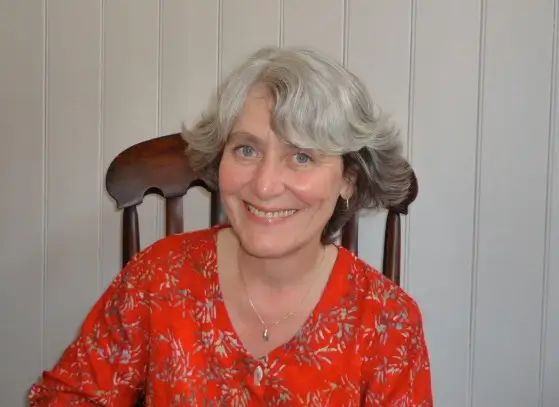
Rebecca Bilkau was born in the north west of England before regional accents were fashionable. She has degrees from Oxford and Lancaster and after an otherwise slightly wiggly career, taught in several universities. She had a scholarship to the Poets House in Northern Ireland where she also learned a great deal from the peace movements. The latter, combined with a marriage to her German Boy, resulted in The Book of Plans Hopes and Dreams, a project which combined memorials of the First World War with aspirations for the future and won the Grundtvig Award from the European Association for the Education of Adults in 2014. She is co-founder and co-ordinator of Beautiful Dragons Collaborative press. She has published four collections of poetry and one cantata. The latest, Sunday’s Child, is available from Wayleave Press. Outside plague times, she divides her time between Lower Saxony and Cumbria.
Moyra Donaldson: Hi Rebecca – thank you for the opportunity to have this chat about your work. There are aspects of your career that I find fascinating and am glad to have the opportunity to ask you about them.
Rebecca Bilkau: Thanks very much for inviting Moyra, it's great to be here.
MD: I read that you wrote an award winning poem, imagining yourself as a bird when you were nine years old, so it would seem that poetry was something that appealed to you even as a child. When you were growing up, did you envision yourself as a writer? Have you written the whole way through your life to date?
RB: My first office was a swing, where I made up songs which spooled into each other. My Nanna was delighted: it kept me out of trouble. But I didn’t scribble much down as a child because at my 3Rs primary school in Cheshire we had to write out our spelling mistakes three times. For me this was a geometric progression of error, so I stuck to cats on mats. It’s thanks to a ‘laxer’ school in London that I began to try again. It’s there too that I threw a pink wobbly when my headmistress tried to edit the later-to-be-award-winning bird poem. I mention this now because although the basics are important to writers, far more crucial is what they want to articulate. If I’d stayed in that traditional school I honestly think poetry wouldn’t have been an option, but a sticky end might.
Still, I didn’t see myself as a writer, I just wrote. When I was ten, Dad nicked a series of my poems about granny’s dog and had them typed up: seeing them like that was a thrill, but woah, an antiquated one these days! When I was 13 a love poem, based on absolutely no experience, caught me a talking-to from mum when it was published: for once she thought I knew what I was talking about! A school pantomime in rhyming couplets was thankfully less controversial.
So in my teens, I was writing all the time, in special hard-backed exercise books (show me a poet, I’ll show you a paper fetishist). One, from when I was about 20, contains a bodice-heave of relief that I can write again! after a few months fallow. A sonnet, as you will have guessed. It was a sign of patterns to come. Reading English Lang and Lit at Oxford was a pretty good way to put a break on anyone’s ego, so in my twenties I turned to prose for a bit.
Interesting, isn’t it, the notion that I was in some kind of comparison with the greats of the past? But it was a good training for later. Poetry can be a competitive business, though we don’t mention that in polite circles. Maybe that’s why, eventually, when I dared to go back to poetry, to be serially unpublished, that I stopped writing altogether. The joy had gone out of it, as had the sense of writing because there was something that seemed to need saying. A friend remembers me telling her — not in a happy way — that just because I could write, it didn’t mean I must.
MD: I know that you spent some time at the Poet’s House in Portmuck. Can you say a little about that experience? On the back of your collection Instructions for a quiet life, it describes you as ‘turning peacenik in Northern Ireland’ and in that book, there are poems that explore the duality of your own situation, living between England and Germany, an English woman married to a German man. I was particularly struck by poems such as On the 70th anniversary of the bombing of Braunschweig and On not going to Bergen Belsen. I’m interested in how these poems might speak to the divided North of Ireland. Could you talk a little about these strands in your work?
RB: It was during my time in Belfast that I again came back to poetry. I loved the place, still do, but I learned pretty fast that whatever I thought I knew, I knew nothing. Particularly I learned that language was even more potent than I guessed: the choice of proper noun, for example, signalled alignment or alienation, belonging or be-gone. With no handy lexicon, not knowing the effect of language became fascinating; a gaudy Picture House of unguessed significance.
At the Poet’s House, I started to explore that not knowing. Gingerly, mind, keeping issues at arm’s length: you’d need magic glasses to know what some of the pieces were about. Jimmy Simmons told me, with an avuncular smile, that my work was technically ok but emotionally dishonest. It hurt like stink and I’ve never stopped thanking him.
It encouraged me to reconsider (again) why anyone would write. I was well over thirty so it was high time. And I don’t want to slide into relativism and post-modernism and evaluations of non/absolute truth as those a treacherous shores to navigate. But I started to perceive that if, in my work, I allow myself to be an honest witness to my experience, it might stand by pieces from others in the field, and be part of a more complex and telling whole. OK, maybe I should have just stuck to postmodernism, with a sentence like that.
If I could give an example of why this is important it would be this: on one specific day, when I was peace-nicking [1] around, I went to visit a friend from one community, who told me their story with passion and conviction, but no intent to win me over. I was persuaded of their point of view. That same afternoon, I met up with a friend from the ‘other’ community. Absolutely the same experience for me, similar passion, conviction, and eventually persuasion. It was an amazing afternoon: to have two people be so open and honest. I didn’t then and I don’t know see it as an illustration of an impasse. It was more the beginning of an understanding: seems to me that only by a full disclosure of the apparent irreconcilability of two sides can a solution start to be felt for.
Yeah, I missed my calling in the diplomatic corps, hey? But I really mean it. It’s small wonder I still hold the time in Belfast and Portmuck very dear.
Living in Germany has presented similar crooks of perception. In my teens, of course, I read the First World War poets, and they catapulted me towards my Buddhist practice. WW2, the Shoa, were a different story. Somewhere, somehow, there was an Us and Them still in me. But, possibly like others, I was capable of making magnanimous exceptions to a deep, firmly fixed rule. I did of course marry a German, move here, and make fast friends with people.
Slowly, slowly, I started to re-examine my lazy assumptions. For a start, the memorial culture in Germany is stunning, unmissable. Nobody here is going to forget what was done in the Nazi era. All over our town there are brass capped cobbles in front of houses where Jewish people once lived, detailing their dates and fates, many concluding with word murdered. Not all are for the Jewish victims. One commemorates a man killed because he was caught listening to Allied radio broadcasts. They are called ‘stumbling stones’, they’re supposed to trip you up, change your path, make you think. Another near memorial is a shed in a prison where political prisoners were beheaded. It’s a designated memorial now. These things are impossible to miss. The great Willy Brandt eventually described the incoming Allies as liberators of the German people themselves.
As my German improved people here started to tell me their stories. Recently my friend Ulrike, born after the war was over, recalled visiting a town in Poland with some similarly blond Dutch people. An old man came up and greeted them: at first he’d thought they were German, and would have rather spat, but the Dutch, he unconditionally liked them. The 19 year old Ulrike said nothing, she was used to being accused and ashamed, she’d been brought up with it. Gabi, another mate who has also felt guilty all her life, mourned that in her well-post-war girlhood, she and her contemporaries had not learned about the riches of their culture because the atrocities of the recent past bleached anything else out. And they talked, as my husband has done, of the last months of the war, when in their view, the Allied bombing was ruthless: it was clear that Germany had already lost. Please note, all these people spoke within the context of being horrified about the Nazi period, utterly and completely and irrevocably.
So where does the little (secretly bigoted) incoming writer stand and grapple? Inherited shame is not foreign to me. I’ve sat at breakfast in Dublin and been handed the can for 800 years (more or less, the maths is yours) of oppression at the hands of ‘my’ forebears. When I recovered from the shock — I was trying to keep my post-colonial guilt to manageable proportions — I eventually recalled that my real forebears were either too busy being exploited down mines to have the energy for much apart from their tea, or Celts firmly under the cosh themselves. Me sounding like Lady Blah doesn’t mean we’re related.
To articulate that twenty years ago took more courage than you might imagine, and I find I’m a bit scared repeating it now. But this is what I mean: when as a writer I can put my truth by someone-else’s it adds a different layer to the story. We might individually, never meeting, become part of a whole re-writing. Even start to be slightly altered people.
Does that answer, albeit-round-the-houses, how I hope my work addresses divisions? It’s to listen and absorb and hear the other point of view and be informed. Place your experience next to what you’ve heard. See if it stands up. Be honest. Remain aware of your reader, include them on the trip. You may start writing only … now.
MD: Really interesting to hear your thoughts on division, thank you. Your latest collection, Sunday’s Child, is an account of illegitimacy and its effects on both parent and child. I found it deeply moving and ultimately life affirming. Were these difficult poems to write? How do you see the link between memoir and poetry?
RB: Yep, it was difficult as hell, writing those poems! What kept me going was recalling that a stranger wrote about a fore-runner to this series, where I imagined my conception: two kids on a summer night messing about without a care in the world, reckless, randy and essentially innocent. The writer, who was also illegitimate, was relieved to read it. Relieved.
The other driver was now. For years illegitimacy has been less of a stigma (though judging by the responses to Sunday’s Child, it’s hardly disappeared). But there’s a swing to the right which usually means the enforcement of whatever the new moral mode; women and children are seldom winners in that scenario. So, I wanted to record the effects of a normative system on people who have not done any wrong. My mum was a fighter, she kept me, and by the time she was dying from cancer she’d become such a stunning presence that she was asked for her autograph in a restaurant because she must be famous. She married the man I call Dad, another star who, remained my fab dad even after their divorce. Plus my birth father is now a dear and valued friend.
Talk about lucky. My mum’s friend, as detailed in work did kill herself, because she couldn’t overcome the backlash for having an illegitimate child. The embargo on my own early history remained intact for years: it was a closed secret, created to protect all concerned. But not being able to talk about experiences reinforces taboos that shouldn’t have been there in the first place. What kind of a concept is a not-legal child? For heaven’s sake, it’s a baby, no right-er or wrong-er than any other. Legality/illegality in this case are constructs of law and economics. That does not make them good, compassionate, or justified.
As for the relationship between memoir and poetry, for me that’s deceptively simple to answer: it’s a matter of craft. Experience is crucial, an opinion about experience similarly so. But if I don’t work with curiosity and diligence, as I would with any other piece, it won’t be a poem. Punkt.
MD: You are co-founder and managing editor of Beautiful Dragons Poetry Collaboration, publishing beautiful themed anthologies. This enterprise seems to me to work in a unique manner, very different to most conventional publishing. What was your motivation for setting it up and how do you find it works?
RB: That’s a lovely thing to say, thank you! It started when my friend, the poet Sarah Hymas, decided that to distract me from raging homesickness that nobbled my first months in Germany; we should each write a poem about the coming super-moon and swop them the next day. It was a terrific — a little edgy because of the time restriction but still cosy because we were doing it together. We enjoyed it so much we decided to invite some people to join us. A few weeks later, on the longest day, 24 poets took an hour each and wrote a poem in real time. (Well, we’ll trust them…) They reported that it felt like a poetic relay race where they handed on or took up a baton as the hour changed. For me the challenge was to learn how to make a manuscript into a book. Patience, luck and quite a lot of cake turned out to be the answer.
When Sarah went on to do other things, with her blessing I took the project further. Inviting poets was key; it took the anxiety out of submission. If a poet accepted the invitation, they were in, simple as that. Quality control, as it were, was initially ensured by a snowball system. The first twenty four invited people who they rated, and so it went on. I knew we were onto something good when the members of this growing collective started calling themselves Dragons.
Pretty soon, known Dragons were asked to bring in people who had maybe not been published, but should be. I knew there was work out there that was great, but dispiritedly for the poet, not fashionable. I knew too that being published once can keep you going when else you might give up. Sometimes, several emails were sometimes exchanged before the poet and I both were both happy with the poem. I felt that we needed to keep the standard high to justify the ethic, I guess. Mostly it worked a treat, though the youngest poet we ever had threw a magnificent hissy fit and asked ‘what right do you even have to so-called close-read my work like this?’ The only answer was that I’ve found often found a fresh pair of eyes on my work really useful. Oh yes, and I’m the editor, a responsibility I didn’t really take on to start with.
There’s been roughly one Beautiful Dragon anthology a year since 2012. 2016 was the exception. Whatever project we were on was dead lining when the result of the Brexit poll came through. Collapse of schedule. People were too enervated to think about anything else. A Bees Breakfast was launched to harness that energy. The name reflected the state of the union: a mix between the bee’s knees and a dog’s breakfast. It also happened to sound a bit like Brexit.
The creativity from both sides of the dividing line (it was always clear that both should be represented) was funny, fizzy and sad. It was all going pretty well until the 45th President of the US acquired office, which meant another outbreak of deadline missing. Noble Dissent was born, a nudge to capture the bolshiness of some of the greatest Enough’s-Enoughers of all time and direct it into a poem. The anthology is ornery as you like, I’m proud to say.
Being a quiet, slightly ditzy enterprise allows Beautiful Dragons loads of freedoms. Profitability isn’t one of them. We thought about calling the outfit Break-even Press but knew that was silly-ly optimistic. It’s funded as people would fund a hobby. I don’t play tennis or golf or go to nail studios. I make books for people who should be in them.
MD: What’s next for you? What are you working on at the moment?
RB: With my husband Michael, I’ve been translating the work of Joachim Esberg, a young Jewish poet who lived round the corner, and was murdered in Auschwitz. His handwritten work came to light just a few years ago, and the exercise book is in Herzog August Bibliothek here, along with other priceless manuscripts. Leather-covered, with gold-edged pages, it’s where Joachim transcribed his work with utmost care: there’s hardly a correction on it. As his weeks pass, his writing is notably more hurried; this is a poet writing his testament knowing it won’t be published in his lifetime.
My task was originally to make Michael’s linear translation into something more poetic. As I worked, though, Joachim’s use of traditional form at a time when expressionism was in full swing intrigued me. I felt that this was his way of exercising some personal power, when most had been stolen from him. So I decided to follow his verse pattern to honour that. Michael reached for liquid sustenance: German speech falls differently to English. All 40-odd poems are done though, including one where the last six lines are all rhymed together. We have a sponsor to take things further, but who knows what Corona has planned? I remain determined that Joachim’s work will have an English publication; it is a clear example of the importance of bearing witness, even if you expect to be killed imminently, and accept that you maybe not read, ever. A simple love poem where a young man dares not love becomes a quiet anthem against totalitarianism, when the reason for his silence is the anticipation of extermination. Joachim’s helped me to understand that poets shouldn’t stop hollering that from their own rooftop, in whatever form they choose.
Other than that, there’s a libretto for a chamber opera to finish, and a sequence based on the life of a magnate turned philanthropist. Poetry doesn’t talk too much about money. But it’s very probably time that we did for sooooo very many reasons. Not that democracy is at stake, or anything.
Covid over, I’ll be heading over to Fermanagh soon as possible; I’ve stood the Lakelands up too long. Will you give me a cuppa on the way?
MD: You’d be very welcome, Rebecca, thank you for this really interesting chat.
[1] I should say here that, just in case this phrase sounds flip, it does not refer to the Peace Movement, it refers to my own very tangential involvement with some fantastic, brave people, most notably Eileen Bell and Seamus Lynch, but many others whose courage I don’t think I properly appreciated at the time.

Moyra Donaldson is a poet and creative writing facilitator from Co Down. She has published nine collections of poetry, including a limited edition publication of artwork and poems, Blood Horses, in collaboration with artist Paddy Lennon. Her most recent collection is Carnivorous, Doire Press, 2019. In 2019, she received a Major Individual Artist award from the Arts Council NI. Her new collection, Bone House, published by Doire Press was launched in April 2021
More work by Moyra Donaldson


Tel: 028 7126 6946
Email: hueditor@theverbal.co
Verbal, Stable Lane and Mall Wall, Bishop Street Within, Derry/Londonderry, BT48 6PU
 company
Copyright © 2026 Honest Ulsterman