


An Exploration

The two page short story 'Love's Young Dream' by Irish nationalist politician, journalist, author, and barrister Timothy Michael Healy appeared in the weekly publication 'Young Ireland: An Irish Magazine Of Entertainment And Instruction' in March 1876. The story is narrated by a young man, fairly down on his luck. This narrator reads a small advertisement in the local press by a wealthy widow who is looking for replies from any reputable fiance, and he decides to seek a new well-funded lifestyle through sending in his reply. The short two-page story is designed to be no more than an amusing quick read, and manages to be unremarkable on many levels. However, if read as a refraction of our contemporary digital-image-obsessed social media cultures, the short story from 1876 has some key elements of interest - it centres around the process, circulation and reception of photographic representation of the self.
The small advertisment at the centre of the story reads:
"Matrimony. - a young widow, of great attractions, possessing a considerable fortune, wishes to correspond with a young man, with a view to above. He must be tall and handsome. Address, - sending carte" &c. &c.”
The narrator upon reading this advertisement in the newspaper one morning goes straight to his mirror in his room and regards and appreciates his reflection in it - apart from a large pimple that has appeared right upon the end of his nose. He then sends a short note as an initial response to the advertisement in the afternoon's post, noting his interest in the position as reputable fiancee, and stating that his carte (de visite) will follow in the next morning's post – remember this was the era of frequent postal communication, with several postal collections and deliveries each day. The carte requested is a carte de visite, which was the first massively popular medium for photographic portraiture, available from the mid nineteenth-century: a small business-card sized photographic portrait which was produced in the first commercial photographic studios in multiple copies of 6, 8 or 10 for the portrait sitter, then shared amongst friends and companions and collected in albums.
The narrator of 'Love's Young Dream' considers the pros and cons of several photographers’ studios, 'wondering which would be most likely to produce a well-taken copy of my prepossessing features' and resolves to choose a famous photographer and enters his studio. After some discussion with the photographer regarding his pimple and the choice of the best type of portrait, face-on or side-on, to minimise its visibility, the narrator and the photographer resolve on a 'profile' portrait shot from the side. Once posed and photographed the narrator asks to see the glass plate negative - an 'unusual request' the photographer notes but understands due to the purpose of the carte de visite. Upon looking at the glass plate negative the narrator is concerned that his pimple is overtly visible in the profile shot and the photographer offers an additional 'face-on' portrait at half price.
That night the young narrator has a restless night's sleep full of 'extraordinary dreams (which) haunted me, full of monstrous cameras (which) loomed upon my sight, from the mouth of which, as from some immense cannon, were belched forth all sort of horrible portraits' featuring grotesque exaggerated pimples. The ante is upped the following morning when a brief note of reply to his first letter arrives from the widow, writing that any future matrimony would involve a commitment to emigrate with her - and in response the young man is even more delighted at that opportunity. Now he returns to the photographer's studio and collects his two printed portraits and has to face the choice as to which carte to send along with his reply to the widow. Unable to decide which portrait view, face-on or profile, least draws attention to his pimple, he closes his eyes and chooses at random. Then the selected carte de visite - the profile view - is sent, and the following morning in a short rhyming verse his corespondent the widow finally refuses his advances, writing 'How could you be so simple - whose carte is there, looking its best, and its nose broad, bearing a pimple, embowered and at rest.'
This slight, amusing text indicates that by 1876 in Ireland, the practice of studio portrait photography and the circulation of contemporary the artefacts of photographic portraiture such as the carte de visite were such accepted factors of everyday life that they could be joked with at the centre of a slight, amusing text in a national magazine. The story indicates that by this date:
· a photographic carte (de visite) portrait was an accepted, almost an expected, vehicle for social identification, in common circulation;
· the processes and instruments of portrait photography - the camera - and the sense of being captured in an photographic image and having one's identity expressed by it - could be reasonably narrated as playing a part in the unconscious dreams of the era;
· in an urban centre, photographic studios were commonplace enough to the degree that one could consider the pros and cons of several before deciding on which to select;
· the processes of having a studio photographic portrait taken by a photographer in in their commercial studio was by now neither unknown nor alienating; and in fact although an 'unusual' request, the negative could itself be looked at, discussed and debated upon by both photographer and subject;
· photographic portraits / cartes de visite were devices functioning within the discourses of social mobility and social relationships in the late nineteenth century; and these photographic portraits could be engaged with in as ruthless a manner as the swipe left/swipe right responses in the contemporary twenty-first century digital discourses of social media and Tinder etc.
In fact in the last decades of the nineteenth century at least some 150 studios were active in the north of Ireland alone (information based on appendix in the book on early Ulster photography, Century in Focus). James Glass was one of Ulster’s early photographers, working in Derry firstly as apprentice to photographer Alexander Ayton, then as a partner to photographers Coghlan and Young, and then running his own studio. Glass had significant social status himself within his local Presbyterian church community, reflected in his roles there as Superintendent of the Sabbath School and as a Senior Elder. As noted by an account and portrait photograph of Glass included in the church's own centenary publication, he played an important role in establishing the new church buildings on Carlisle Road in the city, in fact just opposite the location of his own studio. In his role as a Senior Elder of the church, James Glass would have had the:
duty to have an eye of inspection and care over all the members of the congregation; and, for this purpose, to cultivate a universal and intimate acquaintance, as far as may be, with every family in the flock of which they are made "overseers". (Samauel Miller (1842), An essay on the warrant, nature, and duties of the office of the ruling elder in the Presbyterian Church, Edinburgh)


A contemporaneous Ulster photographer, although an 'amateur' not commercial photographer, was William Fee McKinney of Sentry Hill, Carnmoney. Although he did not have the same "overseer" role in his religious community as did James Glass (in fact his father had this role within his church community) as an antiquarian William Fee McKinney had recorded the genealogy of many Carnmoney families, kept antiquarian and local history records of events in the area, and was Secretary of his local Carnmoney Presbyterian Church for over 60 years, keeping detailed minutes of each church meeting. This service by McKinney was marked by his local Presbyterian church community through their commissioning an act of portraiture of McKinney:
Like your honoured father, who for over forty years discharged most efficiently and faithfully the duties of the eldership, particularly towards the poor and the children of the sabbath school, so you, in a different department of church work, have a long and honourable record, and as a token of our appreciation of your Christian character and service to the congregation we ask your acceptance of this address and an oil painting of yourself. (Address to William McKinney on the occasion of the special presentation to him by the Presbyterian congregation on 19 September 1905)
This portrait was in turn itself photographed by William Fee McKinney and the photograph retained by him as part of his collection:
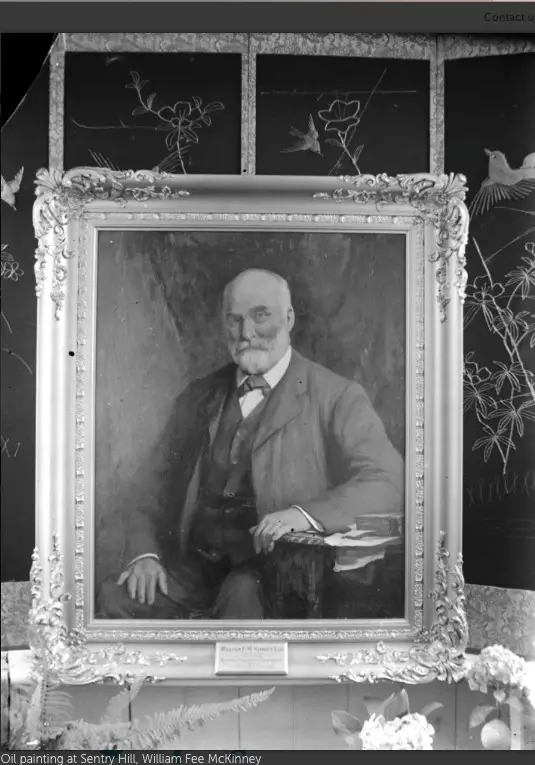
Oil painting at Sentry Hill, William Fee McKinney (photograph; glass plate negative) NMNI
Although the photographer James Glass, unlike McKinney, was not, to our knowledge, himself the subject of a commissioned portrait, with his senior position in his church community he was likely part of a significant process of commissioning a portrait within his local church community. The Derry Standard of 30 March 1888 reported that:
A social meeting of the congregation of Carlisle-Road Presbyterian Church was held last evening (Thursday) in the lecture hall adjoining the church for the purpose of giving an opportunity to the ladies of the congregation of making a presentation to their Pastor, Rev Robert Ross, of a portrait of himself, a splendid oil picture, executed by Mr Hooke of Manchester, as a recognition of the faithful discharge of his ministerial duties for a period of nearly forty years., and as a token of their warm love and esteem for him as their Pastor...


At the scale of a local Presbyterian Church community in Ulster, this was a significant commission: the painter Richard Hooke (who significantly, according to Wlater Strickland’s Dictionary of Irish Artists published 1913, had used photography within his own portrait painting - perhaps the photograph on the left above) was originally from County Down and had by the 1880s settled in Manchester where he had 'established a considerable reputation, painting many of (that) city's leading figures'. In Ulster in the 1870s Hooke had painted a series of portraits of the councillors and mayors of Belfast. (Eileen Black: Paintings, sculptures and bronzes in the collection of the Belfast Harbour Commission, Belfast 1983, p23)
Louise Purbrick, in her text The Bourgeois Body: Civic Portraiture, Public Men and the Appearance of Class Power in Manchester, 1838–50 argues that such commissioned acts of civic painted portraiture were constitutive, rather than reflexive, of middle class power. They circulated within a matrix of relations of social, cultural and political capital. They were performative acts situating the legitimacy of elites: such as William Fee McKinney, himself an amateur portrait photographer, as a senior figure within a church community being a ‘worthy’ object of a portrait commission, and then in turn McKinney himself recording that painted portrait within his photographic practice and including it within his own frameworks of display; or James Glass, himself a commercial portrait photographer, as a senior elder within a church community which commissioned a portrait by the established Ulster/Manchester portrait painter Richard Hooke, who used photography in his portraiture, a practice of portraiture which was part of:
the endless portraits of the local nobility and dignitaries in countless provincial museums and town halls (John Berger's 1967 essay The changing view of man in the portrait)
Berger's essay can in fact indicate a position to which the argument so far has led us – a view upon the framework for portraiture amongst a middle-class in the nineteenth century, and how the location and function of photography can be argued within that. Berger writes:
The function of portrait painting was to underwrite and idealize a chosen social role of the sitter. It was not to present him as ‘an individual’ but, rather, as an individual monarch, bishop, landowner, merchant and so on. Each role had its accepted qualities and its acceptable limit of discrepancy. ... The satisfaction of having one’s portrait painted was the satisfaction of being personally recognized and confirmed in one’s position: it had nothing to do with the modern lonely desire to be recognized ‘for what one really is. ... (excerpt from: John Berger's 1967 essay The changing view of man in the portrait).
Berger further outlines how photography itself displaced painted portraiture, and that the new technology of the photograph opened access to portraiture to a broader spectrum of society. The portrait was no longer the privilege of an elite, as either object or as collector. As Peter Hamilton in his essay for National Portrait Gallery, 2001 exhibition The Beautiful and the Damned notes:
enterprising photographers and publishers exploited the market for part-works through the assembly of portraits of the leading figures of the day in titles such as 'Men of Mark' (1875-83).
For Wlliam Fee McKinney, photography also opened the potential of making and owning his own photographic versions of existing portraiture of figures whose social roles had a significance for him. Wiliam Charles Nixon (1813-1878), an artist from Dublin working in Belfast in his early years ( as noted in the 1913 A Dictionary of Irish Artists by Walter Stickland), made a portrait of James Hope (1764-1847), an Antrim-born United Irishman. This portrait of James Hope was then the subject of an engraving featured in a series of engravings of prominent leaders of the United Irishmen, produced for a book by Richard Madden on the subject published in the 1840’s. McKinney photographed this engraving of the portrait and stored that photograph within his own personal albums at his home in Sentry Hill, within a cultural framework wherein photograph albums served to contextualise the individual within genealogical, cultural, and familial histories (Nicole Coffineau, 2017), thereby situating McKinney, his kith and kin featuring in the surrounding images in the album, within the framework of an affiliation for James Hope and his United Irishmen ideology.
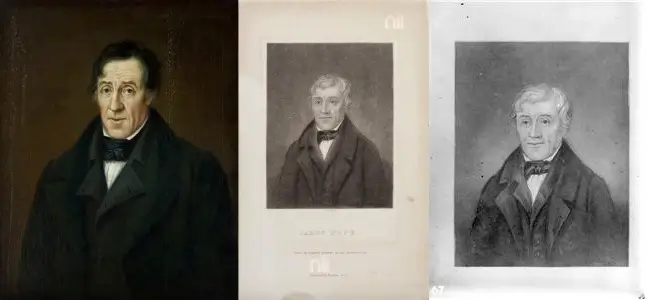
Such an act of affiliation through the collection / collation / curation and circulation of photographic representation by McKinney is a parallel to another means by which the mid-nineteenth century bourgeoisie across Europe were engaging with the new technology of photography. Liberal middle classes across Europe in this period were seeking for a greater participation and status within the power relations of their states, with the monarchies of Europe thereby needing to cultivate popular support in response to such threats to their status. Photographic portraiture was one means by which royals in this period represented themselves as affiliated to middle class lives, families and ideologies, via the mass sales in millions of cartes de visit that featured multiple versions of royal photographic portraits. Peter Hamilton’s 2001 National Portrait Gallery exhibition and text The Beautiful and the Damned outlines how published nineteenth century collections of photographic portraits such as 'Men of Mark' (1875-83) which featured portraiture of royals, statesmen etc were part of a broader cultural framework of the collection / collation / curation and circulation of photographic portraits which had developed from the previous culture of published 'part-work' illustrated portrait biographies, with mezzotint engravings as their medium, that had taken root in Britain in the eighteenth century.
The processes of collection / collation / curation and circulation for these published ‘mass market’ carte des visite portraits demanded a suitable medium for the task, and thus with such portraits came the secondary market of albums, manufactured with pre-cut slots in which to insert the selected cartes. Their heavy tooled leather covers and and solid brass clasps deliberately mimicked the design of the bible and the hymnal. The established tradition of recording the births, deaths and marriages of successive generations on the fly leaf of the family bible evolved into the family photographic album. This new visual genealogy was designed for posterity and functioned as a cherished heirloom to be passed down through the generations. (Hamilton) The mediation of such collections of the portrait photograph among their audiences developed amongst these 'collectors' their own parallel processes of collation, curation and display. Such processes of collation, curation and display amongst audiences bith contributed to and derived a framework from what Hamilton has termed as the broader nineteenth-century fascination with social classification and order - related to scientific developments such as Darwinism, and perceived changes to the social order through factors such as rapid urbanisation and industrialisation.
Whilst many may respond with instictive scepticism, cynicism, guilt or even be near to moral panic regarding our contempoary ‘selfie’ cultures of social media such as Instagram, Facebook, Snapchat or a communication medium such as Tinder in the 21st century, we can instead reach for and interrogate some historic precedents in order to establish a more nuanced approach to our contemporary perspectives on image cultures.
Declan Sheehan is a curator, currently surveying James Glass, William Fee McKinney and their photograph album cultures of nineteenth-cenury Ulster in a PhD at Ulster University.
Declan Sheehan is a curator and photography researcher, currently developing projects with Ulster University, the Nerve Centre, and the Gallery of Photography.


Tel: 028 7126 6946
Email: hueditor@theverbal.co
Verbal, Stable Lane and Mall Wall, Bishop Street Within, Derry/Londonderry, BT48 6PU
 company
Copyright © 2026 Honest Ulsterman