


An exploration of radicalism and William Fee McKinney’s photography
Bernadette Devlin has that rare skill of expressing a complexity of thought with the utmost clarity. Having recently seen Devlin introduce and lead a discussion with Yanis Varoufakis at Derry’s Guildhall in January 2018, as part of this year’s Bloody Sunday Commemoration events, I was reminded of her capacity for expressing the most provocative and the most productive perspective on the politics and history of Northern Ireland.
As an example, in Leila Doolan’s documentary from 2012, 'Bernadette: Notes on a Political Journey', Devlin made perhaps the most efficient, cogent and suitably complex commentary on Northen Ireland’s history of violence:
"If there were areas under attack would I have taken up a gun to defend them? I never had to make that decision because someone else always did … the fact that there is no blood on my hands is because the blood on my hands is on theirs ... we are protected from taking decisions by the fact we let other people do the killing for us. So I don't have a problem with being seen 'In the shadow of a gunman'".
And while researching 1968, civil rights and NI, and against the background of what seems to be a scrabbling for retrospective position and status amongst politicians, parties and commentators in this year of the 50th anniversary of the 1968/69 Civil Right movements of the North, I have been reading the interview with Devlin and other People’s Democracy leaders in the New Left Review of May 1969. Devlin was answering a question on whether the nascent civil rights grouping People’s Democracy had been able to ‘break the grip’ of sectarianism in its campaign for civil rights in NI. She had just been elected in April 1969 as MP for Mid-Ulster - in an election that saw the highest turnout in any Westminster by-election since universal suffrage, with 91.5% of the electorate voting – and she gave the interviewer this response:
I found myself that I did get through to Protestants while fighting this election. I had letters of support from Protestants, who still had the mentality of apologising for the fact, starting off ‘I am a Protestant but as a socialist I agree with everything you say.’ Our real difficulty is the support we get from people who are opposed to the Unionist party, not because it is capitalist, but because they associate it with having oppressed them because they are Catholics. Despite the fact that we are socialist we still get a lot of support from Catholic capitalists and bigots. I think that the Protestants may be the best of our supporters because they are the more radical people, and that their socialism is more radical as they have worked out their positions. The basis on which we can communicate with the Protestants is by being honestly socialist.
That is a typically ‘Devlinesque’ perspective - a complex, provocative, and profoundly useful notion - that with regard to those active within the civil rights movements of the time that Protestants were the more radical people, people, and that their socialism (was) more radical as they (had) worked out their positions. In the year to come, 2018, as the multiple 50th commemorations of 1968 vie for status for their own contemporary perspective on history, Devlin’s comment of the time should be remembered.
In other research that I am conducting into a late 19th / early 20th century amateur photographer from one Presbyterian community of Ulster, the area of Sentry Hill and Carnmoney in south County Antrim, this relation to the history of radicalism within Ulster’s Presbyterian community has proven to be one of the most provocative strands of the project to date. The photographer is William Fee McKinney (1835 – 1917), a prosperous farmer and meticulous collector of farming, church and other records and artefacts, and a keen amateur photographer, a member of the Linen Hall Library and the Belfast Natural History and Philosophical Society, secretary of Carnmoney Presbyterian Church for 62 years, and in his time he developed the family farm of Sentry Hill and his land holdings in the area to some 100 acres; in all, a position perhaps summed up best as ‘eminent Presbyterian gentleman-farming stock’ of the time. I have been trying to indicate themes and directions within McKinney’s amateur photographic practice, in photographs in his albums from the 1880s to 1917, now held in the collection of the NMNI and at the Sentry Hill Museum. As an example from the NMNI website:
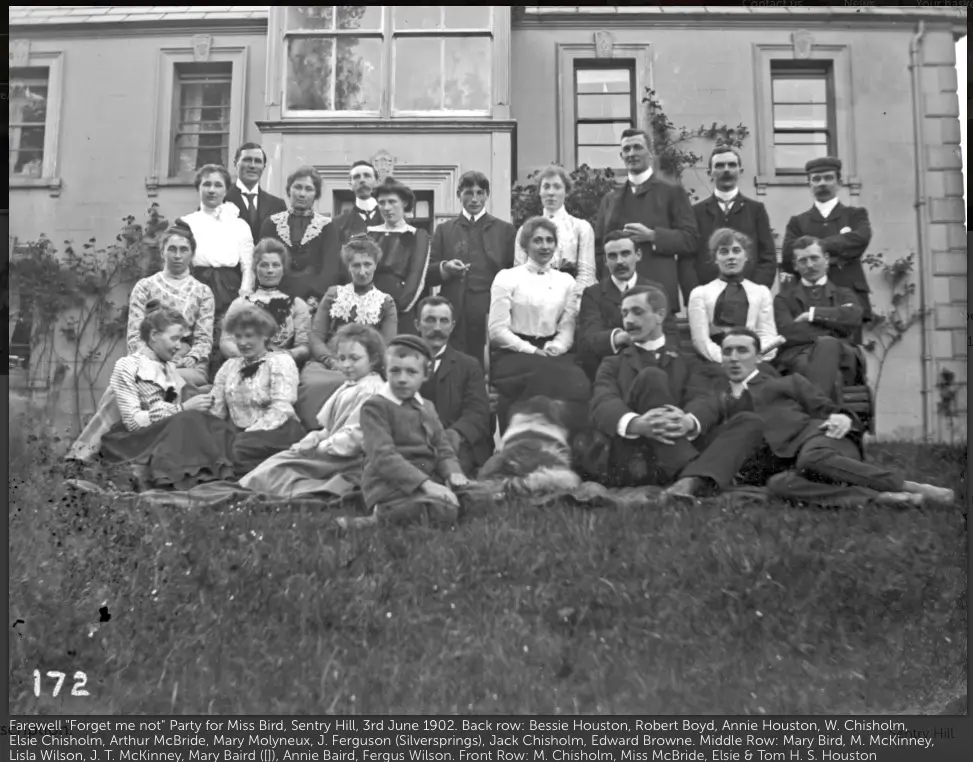
(https://www.nmni.com/collections/history/photographs/dundee--mckinney-collection/hoyfmdundee172)
The photograph above has been described elsewhere as:
During the early years of the new century parties were often held at sentry hill. The photograph was taken by William McKinney on one such occasion in June 1902. Present were all members of all the leading Carnmoney families. (My emphasis.) They included substantial farming families such as the Chisolms and the Houstons and also those like the McBrides, Wilsons, and Boyds who owned local industries. (i)
This image may seem to bear little relation to radcalism, in fact I would argue that both this photographic portrait and this act of photographic portraiture function within what has been described as the informal socialization of elite groups (ii), determining McKinney - as gentleman farmer of some 100 acres - as kith and kin within the wealth and status, within the social, political and cultural capital of Ulster’s Presbyterian mercantile aristocracy of the time - determining with some satisfaction his own social, political and cultural capital. However, whilst this reading stands, the image is more complex - it could also be argued that within this William Fee McKinney photograph of a social gathering at Sentry Hill in County Antrim there may the refraction of a central visual trope of place/home/family that functioned across late nineteenth-century Ulster and Ireland (iii), visible at one extreme in the eviction / land war imagery of the time:

https://theempireofthesenses.files.wordpress.com/2018/01/the-gweedore-hunt-hw-massingham-p11.webp
and at the further extreme also visible here in McKinney’s photograph, refracted across Ulster from West to East, identifying thecentral trinity of place/home/family for an Ulster Presbyterian community in the era of the Land War, displaying their own secured connection to their place for an Ulster Presbyterian community in the era of the Home Rule crisis.
In exploring McKinney’s photography of an Ulster Presbyterian community of the late 1800’s /early 1900’s, there may also be displayed the traces of radical discourses that reach beyond Ireland’s boundaries, that engage with radical ideas and events with transnational influence. As historian Nini Rodgers (writing on anti-slavery activism amongst Ulster presbyterians in the late 1700s and 1800s) has noted:
It was the revolutions in America and France that encouraged the political activities and ambitions of the Ulster Presbyterians … (with the revolution in France) … leading the world toward Liberty, Equality and Fraternity, signifying the end to autocracy and the domination of aristocracy and priesthood. (iv)
Both William Fee McKinneys’s own direct family lineage and the broader Presbyterian community around Sentry Hill, Carnmoney and County Antrim were not remote or distant from the influence of such radical ideas. They were only some few miles from the centre of radical events and radical debate: the Society of United Irishmen, who sought to plant these reforming and revolutionary ideas in Ireland, was formed by radical Ulster Presbyterians in nearby Belfast in October 1791, seeking the end to perceived injustices in social and legal conditions in Ireland, among them the submission to a Church of Ireland aristocracy and any demand for tithes to such institutions – such as the tithe demanded by the local Church of Ireland aristocracy from the McKinney’s own family farm.
There is evidence of the reach of such radical ideas within the family of William Fee McKinney: there is a McKinney family heirloom which was photographed by him, and which featured within his photgraphic album collections, and with the heirloom still kept physically present and on display within the McKinney collection of artefacts and family heirlooms at Sentry Hill. The object marks and celebrates late 18th century revolutionary events and the radical political discourse across Europe at the time: it is a commemorative jug which celebrated the fall of the Bastille in the French Revolution of 1789, which was presented to William’s grandfather’s brother James McKinney in County Antrim in the 1790s:

(https://www.nmni.com/collections/history/photographs/dundee--mckinney-collection/hoyfmdundee148)
Furthermore William
McKinney’s own writings reflect upon how both his grandparents joined the
United Irishmen who at first united only on reforms being made in the existing
government without any intention of fighting…. (v)
And in the United Irishmen’s rebellion, in June 1798 William Fee McKinney’s grandfather carried the signal for local United Irishmen to rise and march on Antrim Town. William’s great-uncle, Samuel George, was killed fighting for the United Irishmen at the Battle of Antrim, a battle that was still being commemorated visually within the period of William Fee McKinney’s own adult years:

by respectable figures such as the artist Reverend JW Carey of County Down, who in 1899, set up a business in Belfast (Carey & Thomson) specializing in high quality illuminated addresses, presentation albums, and book plates ( and we can only speculate and research further any connection between Carey’s business as a nearby source for McKinney’s own photographic albums).
There is a perspective that would propose that any primary reading of William Fee McKinney’s adult years could recognise no role or influence for such radical ideas, as any engagement with radical causes within his familial or social milieu simply ceased after the 1798 rebellion. For example, it is recorded that in 1800 McKinney’s grandfather John McKinney, as a freehold voter, had signed a petition in favour of the Act of Union between England and Ireland. But in opposition to such an argument, we can note that the defeat of the United Irishmen, did not mean the end of their ideals, and Dr William Drennan, coiner of the principles of the United Irishmen, was a founder in 1810 of the Belfast Academical Institution, among whose aims was demonstrably the continuation of revolution by other, educational, means as articulated in Drennan’s wish that: ‘ a new turn might be given to the national character and habits’ … (vi) and that it is therefore noteworthy that subsequently, for three generations, the McKinneys selected this Belfast Academical Institution as the primary educational influence upon most of the young sons within the McKinney family, with two of William Fee Mckinney’s brothers and all of his own sons and several of his grandsons being taught there.
Of course across a century from the late 1790s onward, the urgency and visual primacy of such radicalism did diminish but it could be argued – despite the fact that in 1831 the school the Belfast Academical Institution accepted the title of ‘Royal’ preferred by King William IV (and as is argued on the Institute’s website, this was a process engaged in less out of loyalty, than the need to appropriately distance the institution, in the later nineteenth century, from its radical-republican origins and to secure a government grant to maintain the collegiate department (vii) ) – that the role of the Royal Belfast Academical Institution within the family lineage of the McKinneys, through the shared relation within the lineage of the school and the McKinneys to 1798, the United Irishmen and allied radical, reformist and revolutionary ideas, functions at least as trace of this radical lineage.
So can the strands of the radical, reformist and revolutionary within the history of Ulster Presbyterianism perhaps be traced within the photographic practice of William Fee McKinney himself? Until further research proves otherwise, and perhaps for now as an act of curatorial sleight of hand, it could be proposed that we can speculate that the photographs by William Fee Mckinney below, of his grandchildren Thomas McKinney and Jack Dundee, may feature them wearing the school uniform - or at least the school cap – of this Royal Belfast Academical Institute:
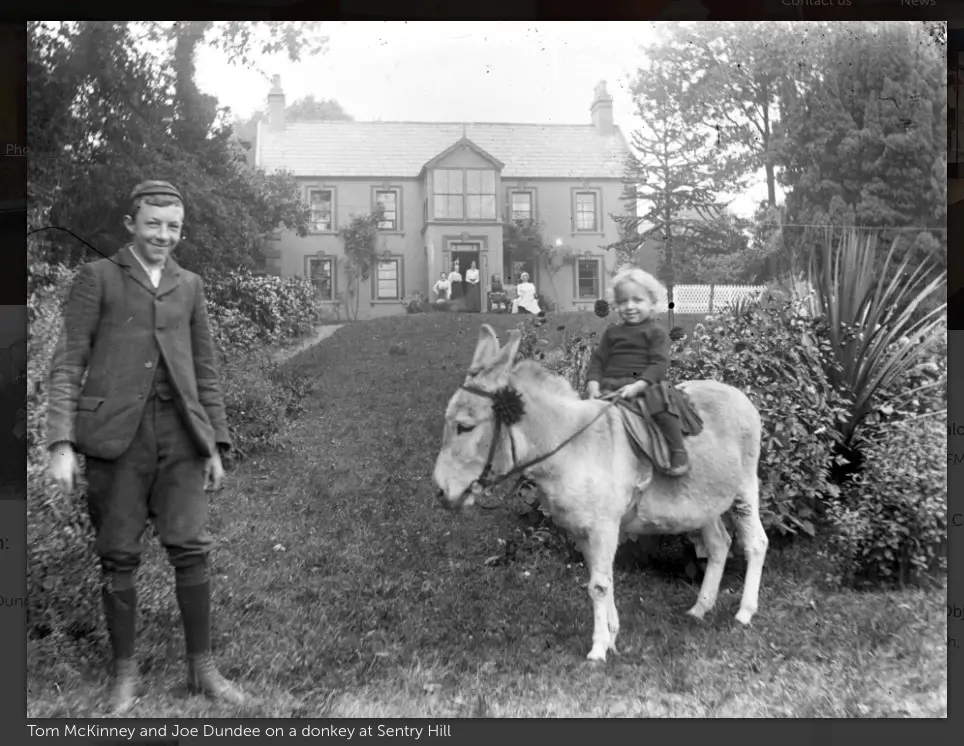
(https://www.nmni.com/collections/history/photographs/dundee--mckinney-collection/hoyfmdundee105)

(https://www.nmni.com/collections/history/photographs/dundee--mckinney-collection/hoyfmdundee319)
We may be able to indicate, from such traces being identified and made visible within the photographic practice of William Fee McKinney, the progressive elision of the radical, the reformist and the revolutionary from Ulster’s Presbyterian community within which the McKinneys of Sentry Hill worked and lived. As the United Irishmen had the radical aim of uniting ‘Protestant, Catholic and Dissenter’ we can perhaps characterise this as the regressive elision of dissent from the dissenter. But we can argue against this visual elision developing into a complete erasure of any radical dissent, through this process of indicating the signs of this radical lineage where any are displayed within the photographic practice of McKinney. Furthermore, we can can expand this argument beyond the specificities of the framework solely of Ulster and Ireland.
For the McKinney family, the period of their relationship to Sentry Hill across the 1790s to the 1880s commenced with John McKinney (William McKinney’s grandfather) acquiring a 31 year lease on a 20 acre property – and with both of William Fee McKinney’s grandfathers being engaged with radicalism and reform, with the French revolutionary ideals of Liberty, Legality, Fraternity, and with the rebellion of the United Irishmen. And the period ended with William Fee McKinney having by the 1880’s acquited the full (non-leasehold) ownership of almost 100 acres, and with him acting as a minor landlord of farming land and of built property, so accumulating financial capital allied to an accumulation of social and cultural capital, such as a developing influence within the respectable bodies and institutions of his local community around Sentry Hill and developing affiliations with respected Belfast societies, such as the Linen Hall Library and the Belfast Natural History and Philosophical Society.
So we can outline a gradual process across this period within which any agency as radical or dissenter within the McKinney lineage was being eclipsed by agency as a secure part of the bourgeoisie.
The historian Marc Mulholland’s Bourgeois Liberty And The Politics Of Fear can be used to indicate one perspective on reading such a process, by letting us survey this developing ‘radical to bourgeois’ status for the McKinneys at Sentry Hill through a broader perspective on the contemporaneous history of Europe’s bourgeoisie. Within the development of the bourgeoisie across this late 18th to late 19th century period, the parallels with the development of the McKinneys at Sentry Hill are striking:
In the eighteenth and nineteenth centuries, they (the bourgeoisie) set themselves apart from the world of aristocratic privilege, unrestricted absolutism, and religious orthodoxy;
– within this argument we could situate the McKinney’s allegiance in the 1790s to radicalism, rebellion and reform, the French revolutionary ideals of Liberty, Legality, Fraternity, and the United Irishmen and participation in rebellion –
And in the nineteenth and twentieth centuries… ( they (the bourgeoisie) set themselves apart) … from those below them, the lower strata, the people, the working class… the different sections of the bourgeoisie shared a common culture, defined by a specific type of family life and unequal gender relations, respect for work and education, and emphasis on personal autonomy, achievement and success; and by a specific view of the world and a typical style of life in which clubs, associations, and urban communication played an important role. (viii)
Mulholland’s analysis continues to survey a social framework which is an equivalent to that of William Fee McKinney of Sentry Hill, as displayed within this photographic practice:
The point about bourgeois civil society, with its foundation of association, family, education, and assets of inherited property and wealth, is that it prepares its members to actualise their market potential not just through formal education, but also childhood socialisation into habits of self-confidence, communication skills, and attunement with the dominant culture of success. Bourgeois ‘habitus’, as Pierre Bourdieu put it, generates valuable ‘social capital’ and ‘cultural capital’, which in turn leverages ‘real’ capital… (ix)

(https://www.nmni.com/collections/history/photographs/dundee--mckinney-collection/hoyfmdundee367)
The lineages of the radical activists from the Northern Irish Protestant community withiin civil rights campaigns in 1968, the lineages of revolutionaries and rebels from the Ulster Presbyterian community in the United Irishmen in 1798, and the lineages of reformers from the Ulster Presbyterian community establishing the radical founding culture of institutions such as the Royal Belfast Academical Institution, may not seem visible within the contemporary social and political climate of Northern Ireland. But the traces of this radical lineage that do remain can be identified within written histories, visual histories, and institutional histories, and, to return to the 1968 argument of Bernadette Devlin, can perhaps even prove to be an asset to radical and progressive arguments within contemporary Ireland, both north and south.
Declan Sheehan is a curator and photography researcher, recently developing projects with Ulster University, Nerve Visual Gallery, Gallery of Photography, Fondation Gilles Caron and others. The William Fee McKinney photographic research project identified above is ongoing at Ulster University and traces of it can be followed at theempireofthesenses.com
(i) Brian Walker, Sentry Hill: An Ulster Farm And Family, Dundonald, Blackstaff, 2001
(ii) one of the most important considerations in historical sociology has been the question of social capital, social status and the informal socialization of elite groups. this is a feature of the work of bourdieu… in Ciarain O’Neill, ed. Irish Elites In The Nineteenth Century, Dublin, Four Courts Press, 2013
(iii) haunted by the ubiquity of displacement and family disintegration, the Irish popular mentality nurtured as a counterpoise a fierce sense of place, home, family. Any forces which threatened this trinity destabilised the equanimity of the popular imagination. Kevin Whelan, Eviction, in ed. WJ Mccormack , The Blackwell Companion To Modern Irish Literature, Oxford, 1999 Quoted In L. Perry Curtis, The Depiction Of Eviction In Ireland 1845-1910, Dublin, UCD Press, 2011, p24
(iv) Nini Rodgers, “Transatlantic Family Journeys”, in Faith And Slavery In The Presbyterian Diaspora, ed. William Harrison Taylor, Peter C. Messer, Rowman & Little Field, 1988
(v) Brian Walker, Sentry Hill: An Ulster Farm And Family, Dundonald, Blackstaff, 2001
(vi) David Cairns & Shaun Richards, Writing Ireland: Colonialism, Nationalism, and Culture, Manchester, Manchester University Press, 1988, p22
(vii) http://www.rbai.org.uk/index.phpoption=com_content&view=article&id=3&Itemid=362
(viii) & (ix) Marc Mulholland, Bourgeois Liberty and The Politics Of Fear: From Absolutism To Neoconservatism, Oxford, Oxford University Press, 2012, p4, p7
Declan Sheehan is a curator and photography researcher, currently developing projects with Ulster University, the Nerve Centre, and the Gallery of Photography.


Tel: 028 7126 6946
Email: hueditor@theverbal.co
Verbal, Stable Lane and Mall Wall, Bishop Street Within, Derry/Londonderry, BT48 6PU
 company
Copyright © 2026 Honest Ulsterman