


Posted in: February 2019 Edition
who, what, when, where, how, looking, making, meaning
Declan SheehanAn investigation
If we see an image of a real-life scene made look miniature, almost as if we are looking at a diorama, with real objects and real people that look now like fake miniatures and replicas, what does it do to how we read the image? This technique at its most pure is called tilt-shift, a stylistic device used widely across photography and moving-image that makes a scene seem almost as if you are looking at a model set or toytown. As a technique it brings a new and a complex objectivity to a scene. Because the image depicts the scene as apparently less human, apparently more fake, apparently constructed of miniature replicas and toy-town figures, it removes the sense of subjective agency from anyone featured in the image. If represented as toy-town figurines in a toy-town scene, we imagine the individuals or objects displayed as no more than automata in a machine, as figures that we can lift, possess, control and re-situate at will. Recent work by Donegal-born, Derry-based artist Darran McGlynn is evocative of this stylistic device.

Fig 1. Darran McGlynn, Peers exhibition at Artlink Fort Dunree, installation shot. Includes on right: Pedalo, (2019) (faux fur, steel, softwood, inkjet print on backlit photo film, plate glass, light fittings)
Across his practice there are several examples: Pedalo (2019) is a work that features at its centre the image of two figures on a pedalo upon the Mediterranean sea. This is in fact a found image/object seen under extreme close-up in a macro lens, so its effect resembles that of a tilt-shift image. This extreme close-up crops the image of the pedalo figures from the original found image/object, which was the kitsch cover of a 1970s LP of Costa-del Sol favourites, with the package-holiday classic of the first Spanish recording of Y Viva Espana appearing on disc for the first time. With its technicolour blue sea background as false and lurid as a John Hinde sunset, McGlynn’s Pedalo (2019) captures all the commodity allure of package tourist imagery. In some respects, the effect - and the effect of tilt-shift in general - also resembles the power of what in advertising is called the pack-shot photograph, where in a close-up picture of the advertised product in its packaging, the object, the commodity is removed from its context, put against an abstracted background, and in our attempt at reading the image in the face of this contrast of focus and abstraction the seductive force of the commodity is accentuated.
A similar reading can occur in the work of a photo-collage, where rather than against an abstracted background, images of central figures are re-situated in a composite image, as a constructed unity of diverse elements. This act of reconfiguration generates its own agency, its own meanings and it can in turn also foreground, exaggerate or manipulate the agency for each originary element that together make up the new composite image.
In an ingenious twist, McGlynn’s work Here/There (2019) collapses the image manipulations of collage and tilt-shift in a single work. Here/There (2019) displayed another apparent tilt-shift effect image of a Mediterranean package-holiday beach scene as a window vinyl across one half of a window in the Donegal tourist site of Fort Dunree, facing onto a small rocky outcrop immediately outside the window, with the horizon line of Donegal rock matching the horizon line of the Mediterranean.
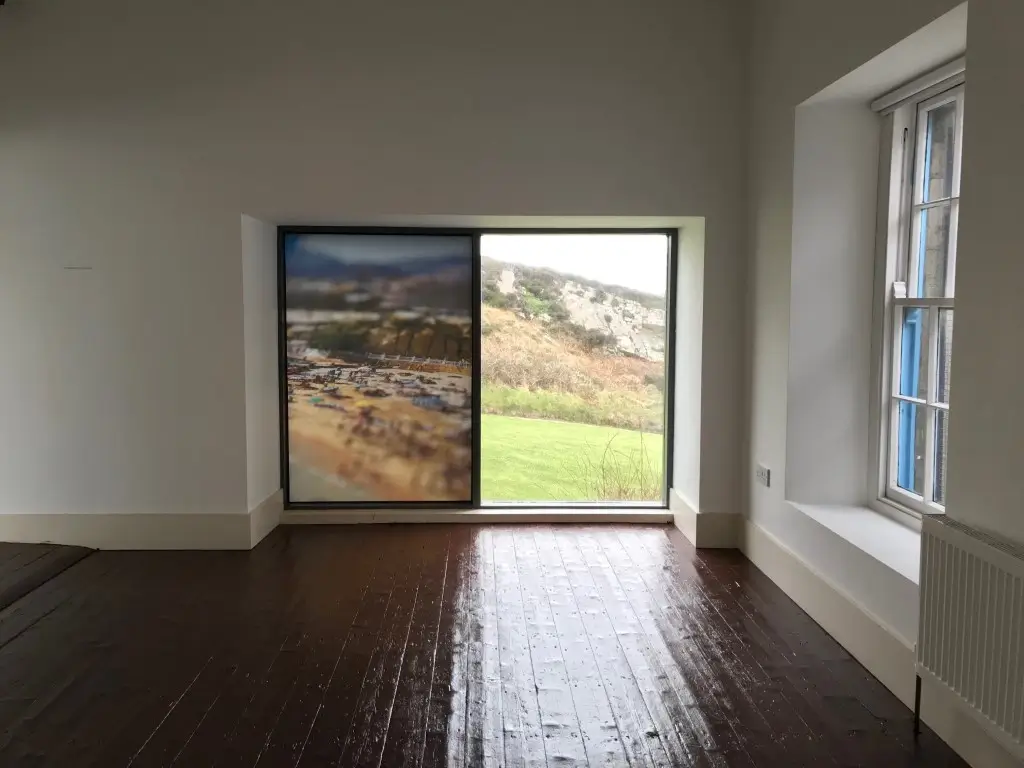
Fig 2: Darran McGlynn, Peers exhibition at Artlink Fort Dunree, installation shot. Includes: Here/There, (2019) (photograph on vinyl installation)
Stylistic devices of photomontage, extreme angles, extreme close-ups, extreme cropping, all were developed in the visual language of the photographers of the Bauhaus and the movements of the 1930s that became known as Neues Sehen (New Vision or Neue Optik) and New Objectivity. These stylistic devices had an agency beyond style. Artist photographers such as August Sander, Alexander Rodchenko and the Bauhaus teachers László Moholy-Nagy and Lucia Moholy developed what has been described as a whole new domain of looking, in which Lucia Moholy recognized the new technical, ideological and formal capacities of photography in her age. Photography’s technical, ideological and formal ability to represent the encounter between a people with their world made new, seeing and experiencing the modern and the urban. These artists made photographs that used these new languages to oscillate between representation and abstraction, making part-objects and micro-worlds visible. But it was not pure style, it was intended as radical, with an agency committed to lifting the scales of constrained subjectivity, habit and history, so that, as Moholy-Nagy wrote, ''everyone will be compelled to see that which is optically true, is explicable in its own terms, is objective, before he can arrive at any possible subjective position.” These artists were contemporaries of photomontage artist John Heartfield. Heartfield had developed his photomontage practice in the Germany of the 1930s as a savagely satirical tool of political resistance to the rise of the far right and its nihilistically destructive imperial fantasy. (A context that in 2019 may also sound eerily familiar.) The language of Heartfield’s photomontages was one of several stylistic and conceptual approaches that consciously situated photography as a visual language of resistance to the cultural hegemony of the far right. Heartfield’s photomontages were feared so much that apparently the artist was number-five on the Gestapo's Most Wanted List. Even the very different visual language of the Bauhaus was itself labeled "un-German" and a front for communists and social liberals, and criticized and suppressed by Nazis for its modernism. The cut and paste reconfigurations of image elements emblematic of power and resistance signal overtly that there is an ideological intent in the photomontages of Heartfield. Similarly, Sean Hillen’s 1983-1993 Troubles era photocollages reconfigured image elements emblematic of power and resistance in a time and a context closer to our own today. Hillen’s Troubles era photocollages featured in the Picturing Derry project, which was part of the Derry~Londonderry UK City of Culture 2013. As a curator on the project, it was an unusual cultural moment which facilitated a broad sense of audience engagement with work such as Hillen’s. In the 2013 UK City of Culture the city did seem full of potential, the first moment in a generation when even the moniker of UK could be tacitly accepted across a broadly nationalist city like Derry - at the worst as a little annoyance, and at best just as a harmless statement of the obvious. Although the odd insult of ‘partitionist’ was thrown by some at the time, it was barely heard at all.
Jump-cut to today, six years later and the city of Derry and its border zones are now the chosen subject of roving Guardian special correspondents, Newsnight and C4 News reporters, and local journalists having a shot at a national and international profiles, from Al Jazeera to CNN, all talking of the choices of hard border and a reassertion of partition, or of a border poll and Irish unification, and all with an underlying threat of potential future violence. And all quite justifiable.
It’s darkly comic that the last time that Derry featured so widely on the UK and ROI and international media was during the all-inclusive, vibrant and internationalist 2013 UK City of Culture itself. At that time the notion of a return to the ‘Troubles’ was absurd. So, the Picturing Derry project of that year, which featured an exhibition bringing together thirty years of photojournalism of the Troubles in the city, alongside community and artist responses to this image, seemed somehow fitting. With its images of marches, protests, riots, house raids, plastic baton rounds, it seemed to act as both as a space both for a remembrance of the kind of community solidarity that many had felt at the time of the Troubles, as well as being a space for many to remember and discuss their shared traumas from the time. As the project’s curator I’ll fess up that of course, some of it did become a kind of Troubles nostalgia - but still it felt valuable and seemed well-appreciated.
The context of 2013 fitted these works by Hillen, darkly and incisively comic, featuring juxtapositions that would, for example, collide picture-postcard-perfect Beefeaters with the black and white battle-hardened stare to camera of Derry’s rioters, all on a gritty brick road to the colour-picture-postcard skylines of imperial London:
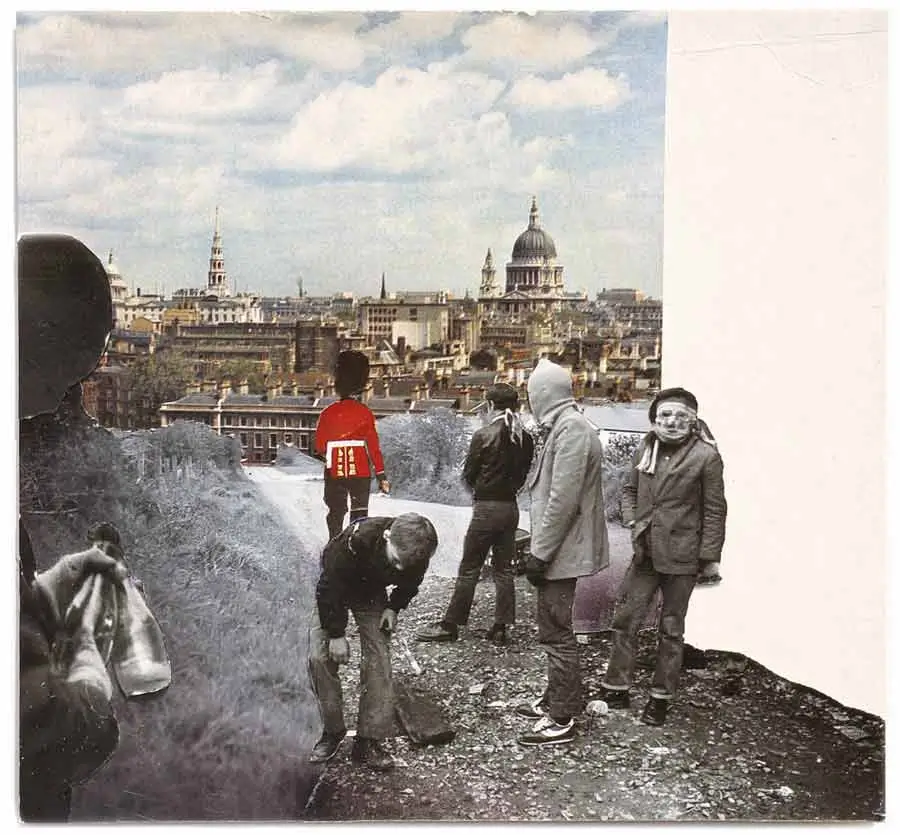
Fig 3. Sean Hillen, Four Ideas for a New Town #1, 1982.

Fig 4. Sean Hillen, Newry Gargarin #7. 1992.
If in 2013 Derry could appreciate Hillen’s genius juxtapositions of London’s Whitehall with the Professionals' 'Doyle' with a photo from Derry’s Bogside taken behind Army lines of a soldier trying to stamp out the flames of a petrol-bomb, it’s perhaps because in 2013 the city’s eyes seemed fresh, with a sense that the perhaps imperfect but still ongoing peace had lifted the scales of dread from the field of vision. In Derry in 2013 spending time in a gallery appreciating Hillen’s Four Ideas for a New Town #1, 1982 felt right, the work being read at that moment as a brilliant summation of the violent duality of colony and resistance, and a dreaded historic inevitability that the city had survived through for thirty years and seen gone. Looking in 2013 at Hillen’s cutting-and-pasting of the imperial centre and the resistance to it, the collaged composite seemed exactly right and super-eminently readable from a sense of - albeit immediate – historic distance.
Jump-cut to six years later - today. And as a curator, I’d have to consider that exhibiting Sean Hillen’s Troubles era photo-collages now in Derry in 2019 would prompt a whole new reaction. Hillen’s Four Ideas for a New Town #1, 1982 would in 2019 again feel the perfect work for the present moment, but now to be read as a great summation of the potential of future violence in a colony and the resistance to it, a duality and a historic inevitability that the city now fears as its future. Dread of an impending imperialist fantasy Brexit, its hard border, and the ‘nothing more certain’, to quote Eamonn McCann, of a return to violence in response.
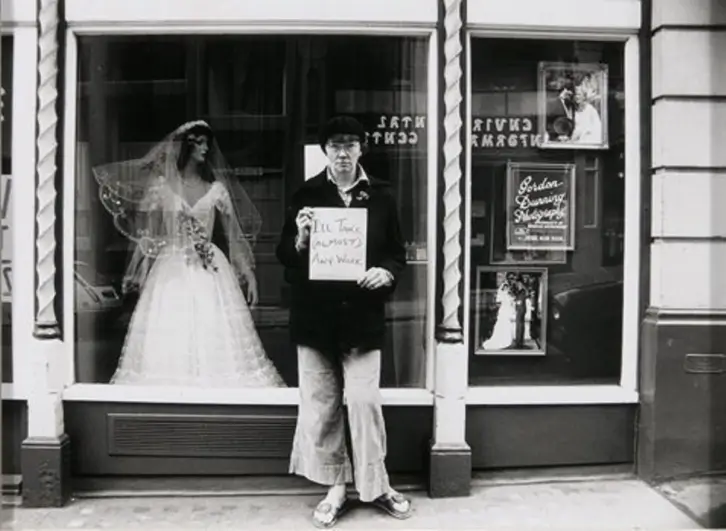
To borrow from, misquote, and adapt the genius of 1980s photographer and photo-collagist Jo Spence (who wrote Ever since I’ve been creating images I’ve tried to get them used in different contexts so that it becomes clear that they don’t have fixed meaning … nothing is sacred and you can make your images mean what you want to depending on where you place them), you can make your images mean what you want to depending on when you place them.
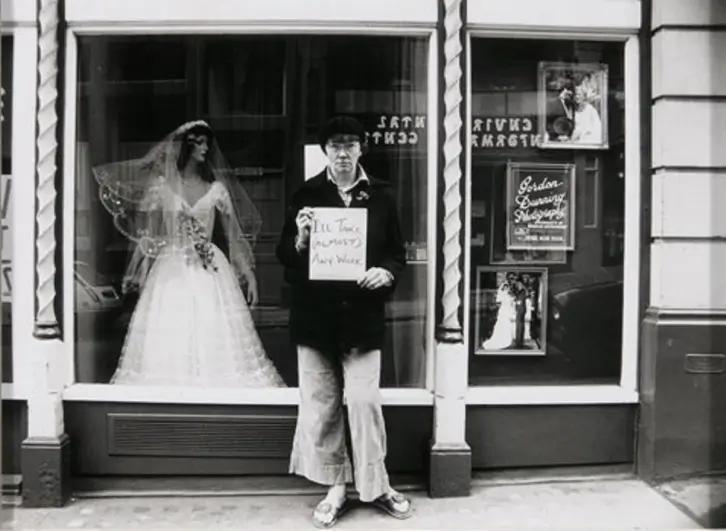
Fig 5. Jo Spence, The Highest Product of Capitalism, (After John Heartfield), 1979.
Declan Sheehan is a curator and photography researcher, currently developing projects with Ulster University, the Nerve Centre, and the Gallery of Photography.


Tel: 028 7126 6946
Email: hueditor@theverbal.co
Verbal, Stable Lane and Mall Wall, Bishop Street Within, Derry/Londonderry, BT48 6PU
 company
Copyright © 2026 Honest Ulsterman