


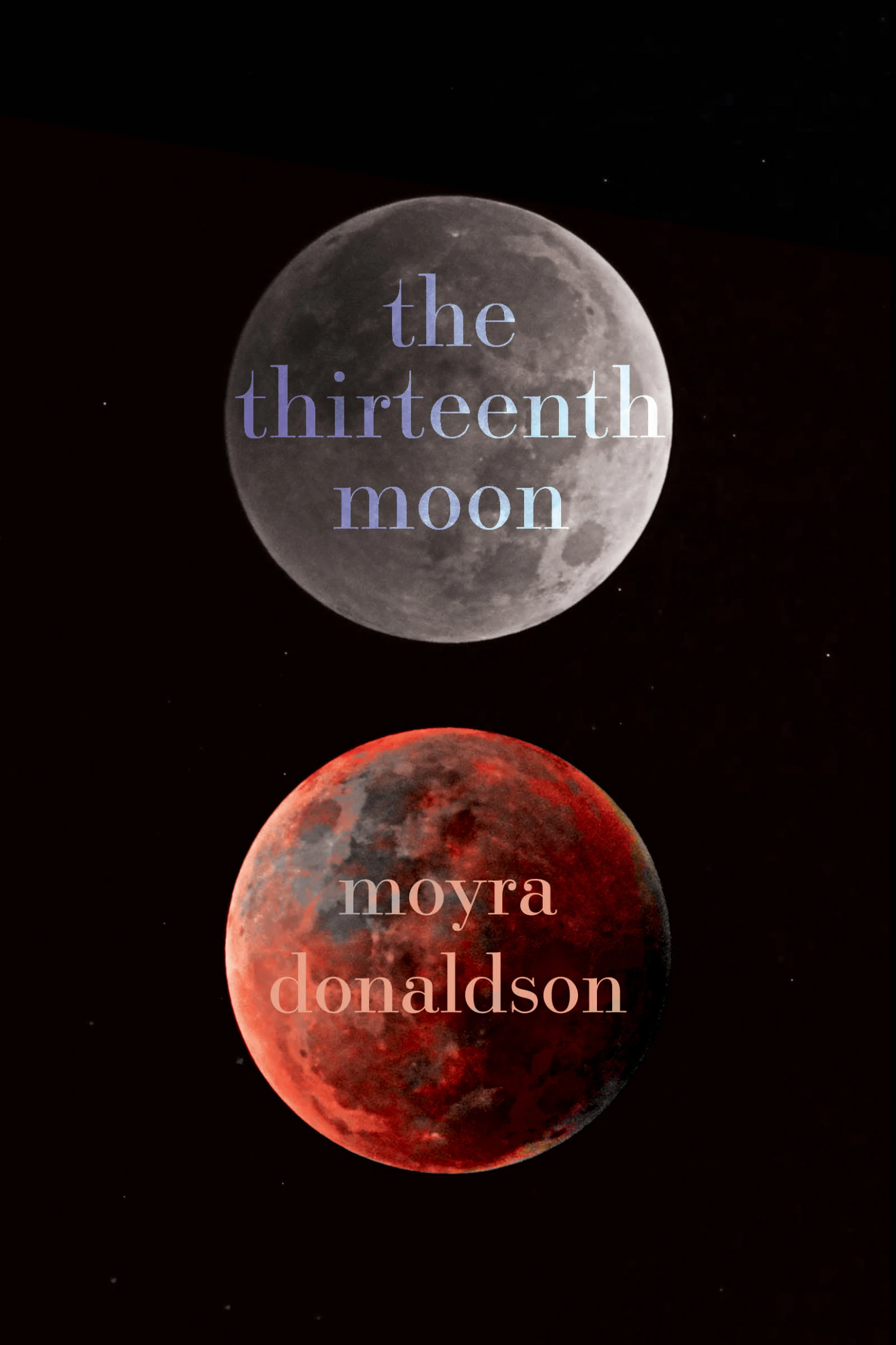
Following the release of her latest poetry collection, The Thirteenth Moon, poet Moyra Donaldson talks to Damian Smyth about her new collection and her career to date.

Photo: Rachel McCarthy
Interviewed by Damian Smyth
Damian Smyth: The last word in your new collection The Thirteenth Moon, is given to a prophetess by the name of Crone, who provides a strange truncated commentary in radically minimalist style to the themes not only of this book but of earlier collections. As you have it "Crone Has Had // a really good time". Is that how you would summarise a celebrated literary career reaching now over 4 and a half decades?
Moyra Donaldson: Crone’s last word is really an acknowledgement of all good things, of how being alive is a miracle in itself. It is a word of gratitude for life, for having been able to experience this mad, perplexing rollercoaster of being.
Reading and writing poetry has always been part of the ride for me and it gives me quiet personal satisfaction to have kept going with it over all the years, to have kept hold of it no matter what else has been happening.
DS: We forget that you began writing in the 80s and 90s when there really were very few women at work in literature in N Ireland, certainly very few with longevity, no matriarchs as such. How conscious were you of that absence?
MD: I have spoken a lot about the lack of female role models when I went to university to study English in the late seventies. Alex Pryce writes about it in her excellent paper, Ambiguous Silences, which when I read it many years later, reassured me that it was not just my own lack of bravery, tenacity and intellect that held me back and silenced me for many years during and after university. I was able to see myself in the historical context of the time. My own essay, The Influence of Absences, addresses this. During my time at university, where I went wanting to be a writer, there was no one to look to, no women poets that I could find as contemporary references in NI. There was no sense from anyone I spoke to that a woman could be a serious poet. I felt it was stupid of me to have thought I could. I left university and went on to do postgrad in a completely different field. Of course at that time, all of NI society was male dominated, not just the literary scene. It was a place that silenced women, that held them in very low regard. All of this was complicated further for me by my being a Protestant. At the time everything seemed to be telling me that what I had to say was not only unfashionable and unwelcome, but also of no relevance. I was in the wrong by dint of birth. For a long time I didn’t know who I was. I had no clear identity. One of my earliest poems, Exile, talked about this and was a declaration of intent, a promise to myself to find my voice, even if it came from the ‘desert’.
DS: Your early collections in the early 90s up to Beneath the Ice in 2001, are full of poems still fresh and engaging - much anthologised pieces also. Snakeskin Stilettos will be forever a winner, as a poem and a book ... but these already dealt with topics which impact women, concealment, image, and the undertow of risk and danger which runs through all your work.
MD: The lack of female role models was one thing, but the other barrier for me was the influence of my deeply religious and conservative upbringing. I was brought up in a household where emotional honesty was not seen as a good thing, and we were taught as children to be private, to keep family matters within the family. To keep things hidden. An intensely Presbyterian/Calvinistic approach to life. It was a challenge to break those taboos. I came back to writing when I didn’t get the promotion in work that I was absolutely sure was mine. Once I’d picked myself up from that disappointment, I decided that I had wanted to be a writer, so I was going to revisit that ambition and put my energy there. It was a small act of courage to just go ahead and do it. To say things. A lot of poems in those early collections were a testing of myself, to see what I could say and how I might say it. How I might write about difficult things, step into the undertow you mention. I am forever grateful to those who held a space for me to do that. They were people who came not from an academic setting, but from their own belief that every artistic voice is valuable. Joan Newmann, Dennis Greig, Máirtín Crawford, Pat Ramsey, to name a few. When I returned to writing poetry after years of silence, that alternative community sustained me. The Belfast Writers Group, and Ards Writers where I was lucky enough to be tutored by Damian Gorman and Martin Mooney. This support and encouragement enabled me to find a place to stand. It is why throughout my career I have always been passionate about supporting those for whom access to the literary scene is not automatic or easy. It was important to me to support marginalised voices which is why I became involved with community arts and helped to set up the Creative Writer’s Network.
DS: Moyra, the poems of The Horse's Nest, Miracle Fruit, The Goose Tree, represent a kind of middle period I think, where you struck on serious metaphors for your life and work. If I were to say the words 'death', 'freaks', 'love' and 'horses', those may be the triggers (!) but the myths and impulses those collections invoke are the stuff of significant poetry, something reflected in their reception.
MD: Looking back now I think these collections reflected a growth in confidence, where I was starting to believe in the validity of my voice. Those ‘middle period’ books were where I was able to experiment more on ways to talk about those themes that lie beneath, that you identify. I don’t really have a favourite child among the collections, but Miracle Fruit would be up there. It was a pleasure to write. A lot of research went into the book, which I found very satisfying and thought provoking. The Arts Council funding to enable me to do the research was invaluable, not only financially but as an affirmation of worth. To write about love and death and alienation by exploring the eighteenth century concept of enlightenment. To talk about outsiders and the dispossessed. These themes are a constant no matter the century, and the stories of the circus freak, the anatomist John Hunter, the Great Irish Giant, the victims of Burke and Hare, the poor used as fodder for the machine of progress and science are still entirely relevant even now. It was a way to write about these things by setting the poems in the past. As I mentioned earlier, I was brought up to never speak of difficult things, to swallow down difficult conversations, so setting those themes in a historical context was another way to get past that psychological roadblock, that tongue tie.
DS: Your first selected poems and a change of publisher heralded a new daring I think, a new confidence which allowed for formal economy over narrative - I need to talk about Ciaran Carson and 'Red' which for me is another pivotal moment in your work. This poem in The Goose Tree sets something free and that extended exchange with Carson seems to me to have been a truly liberating connect.
MD: I think you are right. In The Goose Tree and particularly with the poem Red, something had shifted and conversations with Ciaran Carson allowed that to happen. As a child and teenager, I came to love poetry via the ballad, the narrative poem and the lyric poem. At this stage in my writing, I felt freed a little from the lyrical imperative and that opened the possibility of a different, a more direct way of speaking. I still love the sound of words and the music that a poem can make, but I realised that it doesn’t always have to sound like a string quartet! That allowed me to experiment and was the beginning of new ways of expression. Discussion with other poets has always been really useful to me and I appreciated the generosity of spirit that Ciaran brought to the table.
DS:The other major project was and is the special edition collection Blood Horses (2018) - a big imaginative partnership between yourself and the artist Paddy Lennon, which really did fill out a whole myth for you, which subsequent books and poems have explored thrillingly. (These are real horses also - the myth cannot be divorced from the physical animality of the animal itself.)
MD: Well as you know, horses are a constant theme in my work. I think of them as my totem animal. I have been around horses my entire life. One of my earliest memories is my mother reading a chapter of Black Beauty to me every night – a book as much about empathy as it is about a horse. When I was a small child, I was given a little brown pony called Judy that we kept in the back garden of the bungalow where we lived. Judy had been used to pull a cart and when I would try to ride her up and down the road, she would simply swerve into neighbours’ gardens and munch on their tidy lawns and flower beds. My mother would have to come and rescue me and lead us home.
I am fascinated by the relationship between people and horses. It seems to me almost as if there is some strange ancient contract between the two species - where horses always get the raw side of the deal. We admire their beauty and power and we slaughter them for food or in war. We work them to death. We still watch them crash and break legs on race courses and somehow justify this to ourselves. We love them and we use them without mercy. Yet they still trust us and give us their all.
A friend told me about Paddy Lennon’s horse paintings and when I first saw them in a gallery I fell in love with them. I got in touch with Paddy to ask if he would like to collaborate with me on a book that combined words and images and the whole thing took off from there. Horses were also an integral part of Paddy’s life and it was an opportunity for both of us to explore what they meant to us. The Thoroughbred horse is for me the most beautiful of the breeds and it has a fascinating history, including the fact that one of the founding stallions of the breed was captured at the battle of Buda and later ridden into battle by Captain Robert Byerly at the Boyne in 1690. The whole project was a personal exploration of my own relationship with horses and almost an act of devotion for me. I also always love a collaboration with a visual artist – how it widens perspectives.
DS: This brings us I think to the latest spread of collections - each one distinct and self-sustaining, but dealing more now with the wounds of life - Carnivorous, Bone House and now The Thirteenth Moon. Increasingly chilling, fearsome and fearless collections which show a distillation of style and vocabulary. There are still memorable images of course, but the mood has darkened.
"at my kitchen table I sat down and wept/in fact/I howled/bereft", you say; you also say "today the bees // are throwing themselves into the dark stamened hearts / of the oriental poppies / in a frenzied humming" - the collections, particularly this latest, are elegiac in tone, but angry, hurt and sustaining losses of friends and memory and shared things. These themes have demanded new formulas from you and they are not easy reads.
MD: I think over recent years I have become less fearful of saying the ‘wrong’ thing, of saying too much, of telling the emotional truth. As I get older, I find I have less time for anything that feels superfluous and life feels sharper and even more intense. A while ago I was at a concert where pianist Ruth McGinley was playing the music of Ryuichi Sakamoto, probably best known for the score of the film Merry Christmas Mr Lawrence. Ruth talked about how in his later works, Sakamoto shifted towards minimalist soundtracks, utilising silence and sparse piano notes. In some ways I think this is the direction in which I have been moving. Cutting away anything that feels unnecessary, arriving at The Thirteenth Moon. I wanted to find ways to express loss, hurts and griefs both old and new. I wanted to explore the interplay between silence and voice, between Heimlich and unheimlich. The complexities of aging. In this latest collection, similarly to all the others, there are poems that speak of nature, of our relationship to the natural world. A relationship that is central for me. Take, the first section of the book, is very much about the determination to appreciate the small moments, the beauty to be found in the ordinary.
You say they are not easy reads. I think as I’ve got older, I’ve lost some of my resilience, my ability to absorb the blows. Climate change, war and genocide, personal loss – all make us feel less anchored, more fearful. What seemed permanent now feels transitory. How do we grieve the loss of so much? Poetry is the activism of the human spirit and has always been a sustaining force for me. For me, the poems in these collections, and in The Thirteenth Moon in particular, reflect my belief that it is through the power of creation, the power of our art, that we can navigate a way to live in the present.
DS: The Dorrians, the Princess Victoria and poems which have an elegiac intent and a public movement, are in fact more expansive and broader in reach than individual mourning. Can you say a little about how you view poetry as public speech or record.
MD: I grew up with the story of the sinking of the Princess Victoria and as a child I paddled in the sea within sight of where the boat went down. What affected me most, was the detail of what it must have been like for the ordinary people involved, passengers and crew - their experience. As a child, we lived very near to the Six Road Ends, where Betsy Gray lived at the time of the 1798 rebellion. It was almost as if she was a neighbour. We visited St Cooey’s Wells where Irish monks were slaughtered by Vikings, and I felt as if I could sense the fear, panic and confusion in the air. When faith proves to be no defence.
When Lisa Dorrian disappeared, I was mother to two similarly aged girls. I wanted to acknowledge the awful pain of a mother whose daughter has been taken and could not be found.
I think I have always been aware that the stories of place, of where we were born and where we live, the stories that we grew up with and the stories that happen around us, are part of who we are. They are woven into our understanding of ourselves. These poems and others like them, are an acknowledgement of that, and of how events and people, both contemporary and historical, touch us and stay with us. Although they are all public events I don’t see my poetry as public speech, rather as the stories of the individuals involved. I want to keep them in memory, to honour their lives and see what they might have to say to us.
DS: You have kept up a commentary on private life over 40 years, which I can’t see anyone else has done – marriage, sex, motherhood, right into maturity and being a grandmother. A history of the body over that time. Are you surprised by how strong that narrative is?
MD: That’s a really interesting observation. I have been thinking a lot recently about the concept of embodiment. Growing up, I was taught that the body is a source of sin. I saw my body as a thing separate to ‘soul’. I can remember fervently wishing to be spirit only, to be rid of the heavy, demanding animal of flesh that I carried around. Over time I began to realise (as Cohen sang) that your body’s really you - and to appreciate the integration of spirit and mind with physical presence and lived experience. To celebrate the felt experience of the body, sensory, emotional and physical.
At every stage of my life, I embody who I am. To write about the body is to write about the self; and to seek to understand the self. I am my body, so that’s why it is always in my work.
DS: The reception of your work has been positive throughout - even with the usually very low impact rate of poetry collections in reviewers lists of priorities. You had lovely success in the US with CavanKerry and the Keillor Almanac - amazingly demonstrating right off how your idiom translates across the Atlantic, winning readers and reputation.
The accolades have come, Moyra, which must be satisfying, including the National Women’s Poetry Award, Allingham Award, Cúirt New Writing, the respect of peers, bursaries and residencies from both ACNI and the Irish Writers Centre and, in 2019, a Major Individual Artist award from the Arts Council of Northern Ireland. Do the ancestors feel vindicated yet??
MD: It is always lovely to win a prize and I’m grateful for the awards that came my way, they meant a lot to me, but over the last number of years I haven’t felt the need to enter competitions. Maybe because I’m happy with my voice and how it has developed. I don’t think I want it ‘judged’. Of course, I want my poems to be the best that I can make them and of course I want readers to find something in them that they can connect to. All writers want readers. I have trusted poet friends that I meet with to discuss our poetry and we push each other’s work through feedback and shared insights. Though if anybody would like to give me a significant prize, I’m not going to turn it down - in fact I’d be very grateful!
I do want to acknowledge how important it was to me to receive Arts Council awards and bursaries. They enabled me to buy time off work to write, to take up residencies, to have time to immerse myself in completing collections, or travel to do research. They were a very practical help when I was juggling my day job and bringing up children, with writing poems, but they were also affirmations all through my career that what I was doing was valid. The Major Individual Artist award was very special, it felt like a recognition of the many years of persistence, as well as the work itself. It has also spurred me on into the future.
I love to think of my poems out there in the world, where some stranger might come across them. It was a great surprise to discover poems picked up by Keillor and hear them read in his mellifluous drawl on American radio. As far as the ancestors are concerned, I imagine they would be just as appalled as members of my extended family currently are. As far as they are concerned, I have broken the code of silence. Said things I shouldn’t have.
DS: Where does this go? It seems a far cry from the baroque constructions of Miracle Fruit, which was your great political statement I think - the poems of the outcast, the specimen, the pointed-at and derided, also of course the exceptional. But there is the tiny seed of the future even in The Thirteenth Moon - Granddaughter - who hands you back 'the tired world, all new again', in the word 'rain'.
MD: There is always for me a fallow period after the completion of each collection, sometimes to the extent that I think I may never write another. So far the words and the desire have always come back, and I keep going. Already now I can feel the stirrings of new ideas and a need to write on into the future, whatever that may be. Each of my collections have reflected what’s been going on in my life and around me at the time they were written and my granddaughter has indeed brought a new perspective and a different energy to my life.
This time of course there is also an increased awareness of time’s wingéd chariot, hurrying ever nearer! The baroque, the grotesque and the gothic still all hold an appeal, so you never know, they might well feature in the future.
As I’ve been answering these questions I have felt a little like Crone, looking for a narrative arc. In reality, life is more random than that. We make up our story by looking back – so I’ll move forward and see what happens.
_________________________________________________________________________________
Moyra Donaldson is an award-winning poet and creative writing facilitator living on the Ards Peninsula in Co Down. Her latest collection, The Thirteenth Moon, is published by Doire Press, Galway. (April 2026) She has published ten previous collections of poetry, and in 2025 an online pamphlet, Abridged 0-112 Don’t Speak To Strangers was commissioned. She has also had work commissioned for a variety of projects and has been involved in artistic collaborations, most recently with Wexford artist Paddy Lennon resulting in the limited-edition publication of artwork and poems, Blood Horses. She has read at festivals nationally and internationally and her work has been anthologised and broadcast. In 2019, Moyra received a Major Artist Award from the Arts Council of Northern Ireland.
Thirteenth Moon is available now from Doire Press https://www.doirepress.com/books/poetry/the-thirteenth-moon
Read more of Moyra's work here: https://humag.co/author/moyra-donaldson
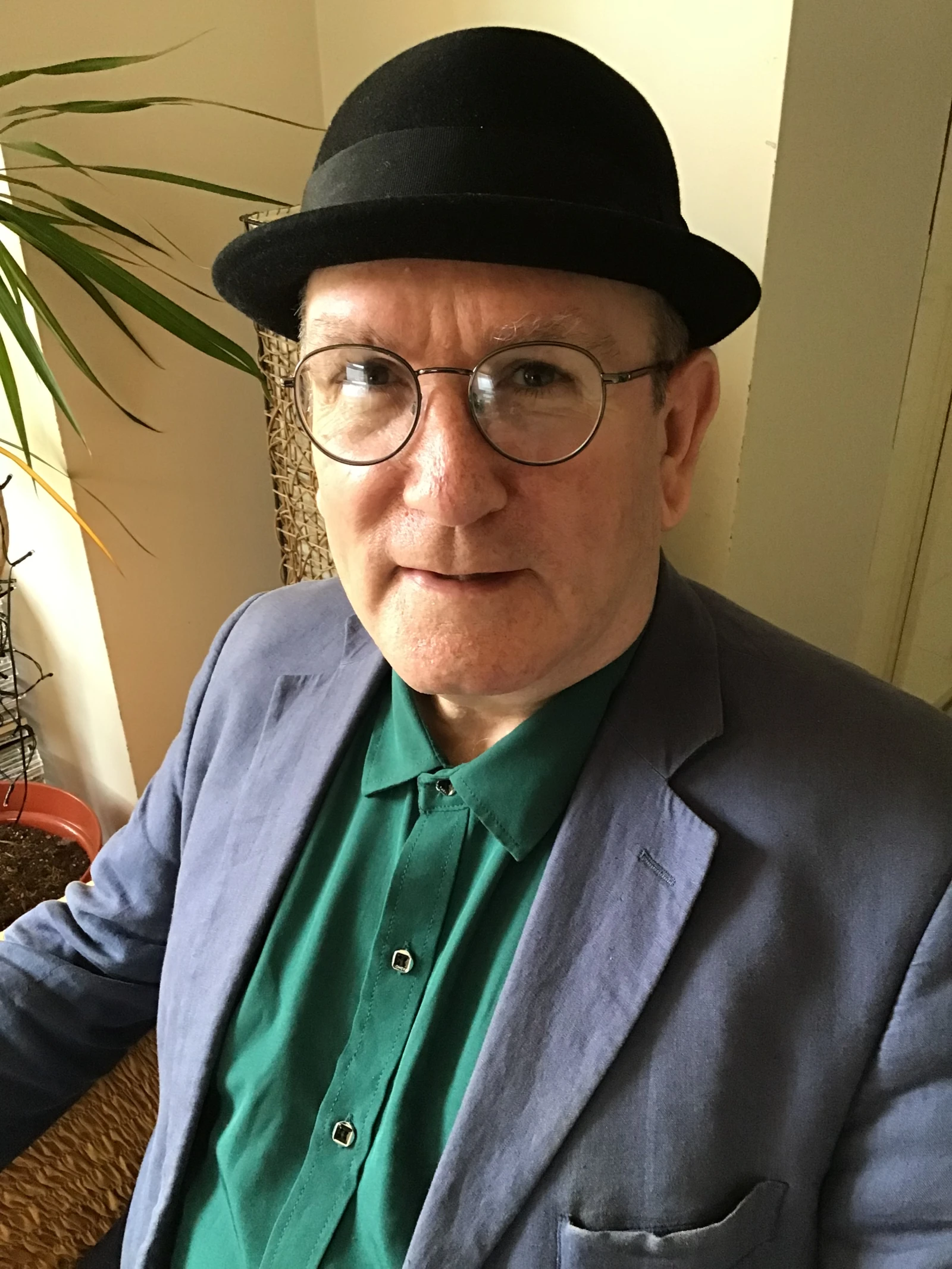
Damian Smyth is Head of Literature and Drama at the Arts Council of Northern Ireland. He is also a writer.
More work by Damian Smyth


Tel: 028 7126 6946
Email: hueditor@theverbal.co
Verbal, Stable Lane and Mall Wall, Bishop Street Within, Derry/Londonderry, BT48 6PU
 company
Copyright © 2026 Honest Ulsterman