


Tracing a trauma narrative in the Braid Scotch poetry of James Orr (1770-1816)
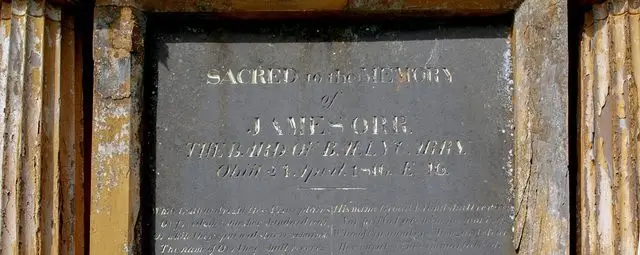
James Orr was a Presbyterian
weaver of Scots descent from the County Antrim village of Ballycarry, and an accomplished
poet in the Scots vernacular, or Braid Scotch. His work, and that of many other
so-called ‘weaver poets’, was recovered by the Ulster regionalist poet John
Hewitt when he was researching his M.A. thesis in the mid-twentieth century. [1]
Orr lived in a period when, following the successful revolutions in America and
France, many hoped greater democracy might be achieved for Ireland. The Society
of United Irishmen formed in Belfast in 1791, a year which had seen a great
parade in Belfast celebrating the anniversary of the fall of the Bastille. Their specific
aims included Catholic emancipation, reform of representation in the Irish
Parliament, and greater independence in its legislative powers: ‘In the present
great era of reform, when unjust governments are falling in every quarter of
Europe … we have no national government – we are ruled by Englishmen and the
servants of Englishmen.’ [2]
Unsurprisingly the London government, which from 1793 was prosecuting a war with revolutionary France, reacted with suspicion to reformers who appeared to hold French sympathies. Tough measures and prosecutions of several leading members followed until the United Irishmen were forced underground where, as a well-known Irish historian has argued, they became ‘a secret, oath-bound organisation, working to establish a republican style of government in an independent Ireland’. [3]
In this atmosphere James Orr became radicalised as a young man, and supported the agenda of the United Irishmen. Intelligent, self-taught, with a poetic gift and a temperament to match, he was angry about the poverty and insecurity he observed in rural Ulster. He also deplored the injustices and marginalisation suffered by the Presbyterian and Catholic communities in Ireland, in particular the levying of the tithe, a tax paid to the Anglican church, on non-Anglicans. A network of reading societies that existed throughout Ulster, and which were open to members of the labouring classes, put him in touch with the works of Tom Paine, author of The Rights of Man. [4] He read John Locke (1632-1704), an enlightened philosopher who believed the people had the right to challenge, and if necessary to replace, unjust rulers. Also significant in his development was the writers’ circle that met at the home of Samuel Thomson (1766-1816), near Templepatrick. Here he shared and developed his political opinions in a company that included other radicals, some from the middle and professional classes, as well as fellow weavers. [5]
By the time he was 21 Orr was contributing articulate, firebrand pieces to the United Irishmen’s Belfast newspaper, the Northern Star, and developing into an active revolutionary. When rebellion broke out in 1798 he led a troop of men from Ballycarry to join with the forces of Henry Joy McCracken (1767-98) at the Battle of Antrim on 7th June. The story of the United Irishmen’s bloody and tragic encounter on that day with a well-armed force of redcoats has been told often in story and song, and documented by historians. [6]
McCracken’s men were beaten back from Antrim in disarray and scattered throughout the countryside. He and a small band of supporters, including the proto-socialist weaver Jemmy Hope (1764-1847) and the poet-weaver James Orr, hid for several weeks in the Slemish district and other parts of County Antrim. Orr himself, according to local tradition and to hints in his poetry, may have remained a fugitive throughout the autumn and winter of 1798-9, after which, believing himself still wanted by the authorities and aware that McCracken and many other rebel leaders had been hanged, he escaped on an emigrant ship to America. While some of his compatriots made their fortunes and their names in the New World, Orr’s time there appears to have been marked only by wretchedness and disappointment. Certainly, he was relieved to be able to return to Ballycarry under the terms of an amnesty just a few months after his departure. It is to his experiences before and during the Battle of Antrim, and to his time on the run and as a forced migrant, that we shall now turn in greater detail. Orr’s own account of what happened to him and of what he felt in the course of these events strongly signals that he suffered what might now be diagnosed as trauma.
In psychiatry, trauma has been defined as ‘the personal experience of an event that involves actual or threatened death or serious injury, or other threat to one’s physical integrity … the person’s response to the event must involve intense fear, helplessness, or horror.’ [7] But the concept of trauma, and theories of trauma related to the importance of bearing witness to extreme personal or community suffering, have in recent decades aroused much interest in literary studies. As one leading scholar of trauma theory has expressed it: ‘trauma is always the story of a wound that cries out, that addresses us in the attempt to tell us of a reality or truth that is not otherwise available’. [8] Literature – telling stories in verse, drama or prose – may enable an individual to find the means of expressing that ‘crying out’ of wounds to his or her psyche which have been inflicted through appalling and brutalising experiences.
Orr, aged twenty-eight, idealistic and committed to a democratic Ireland of Protestant, Catholic and Dissenter, marched at the head of a troop to a battle in which he knew loss of life was a distinct possibility; on Donegore Hill he watched while as many as half the force who had sworn their loyalty to the United Irish cause abandoned the fight in panic before it had properly begun. Local reports credit him with having intervened to prevent atrocities, [9] and he endured proximity to prolonged, bloody violence before spending months on the run from the authorities, often in the worst Irish weather and half-starving, after learning that his leader McCracken had been hanged. Finally he was pitched into enforced exile for a period, suffering the terrors of a trans-Atlantic voyage by wooden sailing ship, deep homesickness, and disillusionment with the American Republic. The return to Ireland and to his own people must have seemed bitter-sweet, given that he arrived on the eve of the Act of Union (1801) to find many of his comrades dead or exiled, and idealistic hopes for an independent republic in Ireland shattered.
At Antrim in 1798, and through the repeated assaults on his body and spirit before and after the Battle, Orr undoubtedly suffered an extended series of traumatic experiences. Exposure to armed conflict, even for seasoned military personnel, is understood as a possible cause of post-traumatic stress disorder, characterised by anxiety and depression, and even guilt for having survived when others did not. [10] The present discussion has been informed by the investigations of writers and researchers from both literary and medical or psychiatric backgrounds. Particularly pertinent are discussions of trauma narratives in literature from the period of the English Civil War, and the observations of some of the therapists and clinicians working with victims of the recent Ulster Troubles .[11] Trauma can severely disrupt a person’s sense of self, causing division, fracture or fragmentation within. Indicators of trauma include intrusive, deeply disturbing symptoms such as flashbacks, nightmares or insomnia over which the sufferer has little control. [12] Some people cope by holding the memories at bay, managing to function at surface level while inwardly breaking down. Such repression of true feelings may lead to searching for relief in alcohol, which in turn may result in dependence. There is evidence in Orr’s life and writing that he was afflicted with all such symptoms. Yet without the benefits of scientific knowledge, clinical diagnosis or counselling he appears to have managed to undertake some of the therapeutic processes now recognised as necessary for the recovery and re-integration of the self. However it also appears that he was only partially successful.
Psychiatrists, trauma theorists, specialists in history and memory as well as literary scholars often emphasise the importance of constructing a narrative of a traumatic experience if it is to be properly assimilated, or ‘owned’, thus freeing the survivor from its tormenting, paralysing power. [13] Within his 1804 volume of verse, under the deceptively bland title Poems on Various Subjects,Orr creates such a narrative in a series of poems which reconstruct his experiences of 1798-9 before, during and after the failed rebellion. [14] While these may be extrapolated, in the volume they are not presented in sequential order. All but one is expressed in the Scots vernacular which was Orr’s native tongue, the normal speech of his community, thus very much in his own voice.
Orr begins his process of remembering by establishing the context within which his actions, and sufferings may be understood. His poem ‘To the Potatoe’[sic] explains his motivation as a social radical. [15] It deplores the condition of the rural poor who existed on a basic, starvation diet, conscious of the ever-present threat of eviction from their rented cottages:
What wad poor deels on bogs an’ braes, [devils, hills
Whase dear cot-tacks nae meal can raise; [cottage leases
Wha ne’er tase butter, beef or cheese, [taste
Nor pit new clais on; [clothes
While a’ they mak’ can har’ly please
Some rack-rent messon. [rack-renting upstart
The poem’s message expresses a powerful challenge to the church and state authorities who permit such circumstances, and in it Orr openly calls for direct, though non-violent, resistance.
Next is ‘A Prayer’, set on the eve of ‘the unfortunate 7th of June’, the night before the Battle of Antrim. [16] Here Orr addresses God respectfully, employing a standard English register and using a verse structure similar to that of the Scottish metrical psalms with which as a Presbyterian he would have been very familiar. He depicts an intense personal struggle, showing how he wrestled with his Christian conscience over the issue of taking up arms against his fellow man, and admitting that he feared lingering agony and death in battle:
How dare I ask thy bolts to throw?
Whose mandate’s ‘do not kill.’…
Let not this frame, whose fleshless bones
These summer suns may bleach,
Lie writhing long; …
The third phase of Orr’s narrative remembers and mourns the trauma event itself. Three poems convey its extreme aspects and reflect on its meaning: ‘Donegore Hill’, ‘The Wanderer’ and ‘The Passengers’ [17] are urgent, passionate works which recall in turn his experience of brutal conflict; his abject, perilous state as a wanted fugitive; and the misery of forced migration. He also voices his grief at the loss of family and country.
A close look at a short portion of the ‘Donegore Hill’ text must suffice to demonstrate something of how Orr’s work fits the model of trauma survivor memories. This poem is an unsparing account of the march to the mustering ground before the Battle of Antrim, and of what occurred on the hill when Orr’s troop from Ballycarry joined with the greater part of Henry Joy McCracken’s force gathered up from Belfast, and from the villages and hamlets of the Six Mile Water valley. It offers an excoriating critique of the behaviour of many of the men who turned out, and brims with both farce and philosophy.
Traumatic memories reveal the grip that unresolved grief and horror in the past can retain on a survivor in the present. In fact as some leading scholars have argued, ‘Emotional stress’ can actually ‘enhance memory’. [18] The recollection of a trauma can be intense and vivid enough to incorporate sensory impressions such as sounds and smells as well as images, as if the individual has genuinely been transported back in time to the moment of anguish. It is well attested that traumatic incidents can become engraved in the mind, and that memories intrude on the consciousness of trauma survivors in the form of flashbacks and nightmares. In ‘Donegore Hill’ Orr deliberately incorporates flashbacks, disciplining them within the framework of his poetic technique to intensify the power of his account, and to assert control over some of the most disturbing recollections. The following extract from this fourteen-stanza work recalls the moment when the United Irish troop from Ballycarry (locally named Braid-islan’) arrived on Donegore Hill to join the rebel force. There, the noise of the crowd and the anticipation of an imminent ferocious and potentially fatal encounter with the military proved deeply unsettling, breaking the nerves of at least one man in the brigade and causing him to misinterpret the evidence of his own eyes. Glimpsing fields of colourful weeds in the distance he took them for the distinctive redcoat forces commanded by Major-General Nugent, and gave the alarm which sent half the troop running off in panic back to their homes:
When to the tap o’ Donegore [top
Braid-islan’ corps cam’ postin’, [tramping
The red-wud, warpin, wild uproar, [fearful-mad, head-turning
Was like a bee scap castin’; [swarming
For ******* ***** [19] took ragweed farms, [farmland lying fallow in colourful weeds
(Fears e’e has ay the jaundice) [eye
For Nugent’s red-coats, bright in arms,
An’ rush! the pale-fac’d randies [ruffians
ook leg, that day. [ran off
The passage shows how this betrayal is seared into Orr’s memory. He records it, ordering and crafting the detail to fit the tight rhyme scheme and strict rhythmical pattern, further enhancing its effect. He is relieving his feelings, as well as reliving what he felt. The description is multi-sensory, encompassing what he sees and what he hears. He piles on adjectives and employs alliteration to emphasise the noise, adding a simile which evokes the ominous sound of bees swarming.The account exploits stark, bold references to colour, showing the significant role it played in prompting panic and disorder when distant colourful weeds were mistaken for the redcoats. By contrast the ‘randies’ (a contemptuous term) have turned white with fear, having lost their own blood-red manliness. The pejorative ‘yellow’ for cowardice is implied in Orr’s withering aside: ‘Fear’s e’e has aye the jaundice’. At this point in the poem’s crafting he seizes the opportunity to re-empower himself by ‘fingering’ the man whose fright caused the mass desertion. He represents his Christian name and surname of seven and five letters with two sets of asterisks. This ‘code’ will be interpreted by people in his own village, and will ensure the offender knows Orr holds him responsible.
The account modulates into the present tense, maintaining the flashback effect. Orr, the unhappy and furious survivor sees and lists, as if they are actually before his eyes, the mundane objects scattered in the wake of his fleeing, dread-stricken comrades:
The camp’s brak up. Owre braes, an bogs, [broken
The patriots seek their sections;
Arms, ammunition, bread-bags, brogues, [heavy shoes
Lye skail’d in a’ directions: [scattered
Direct speech and reflections in free direct thought augment the memory further, underscoring the sense of its vivid, present reality:
Come back, ye dastards! – Can ye ought [anything
Expect at your returnin’,
But wives an’ weans stript, cattle hought, [children, hamstrung
An’ cots, an’ claughin’s burnin’? [hamlets
Na, haste ye hame; ye ken ye’ll scape, [home, know, escape
Cause martial worth ye’re clear o’; [you’re empty of military worth
The nine-tail’d cat, or choakin’ rape, [rope
Is maistly for some hero, [mostly
On sic a day. [such
Here, as if back in the very moment of abandonment, he yells after his bolting men, pitching at them a coarse imperative, a rhetorical question and then a scathing evaluation of their battle-worthiness and characters. Instantly this triggers a reflection on the likely comfortable fate of the runaways, contrasted with the brutal treatment soon to be meted out to those he regards as true heroes. Orr’s personal values are implicit in his declaration; those who stand and fight, remaining true to their United Irish oath despite the odds, have all his respect. He has only contempt for spineless quitters. And he abhors the brutal state punishment system of the era. Denied the chance of articulating these thoughts to the absconders immediately after the desertion, he takes the opportunity in print to set down his personal uncompromising version of the truth.
The verse form Orr chose for this account is a Scots stanza known as the Christis Kirk, traditionally used for long, rollicking stories of buffoonery and violence told by a narrator who remains detached. Here, however, Orr deliberately breaks with genre conventions. Far from detached, the speaker appears one with the author – remembering, speaking and judging in a poem that absolutely throbs with anger but moves towards a conclusion that suggests he has achieved a measure of resignation, and even, perhaps, forgiveness of those who betrayed both him and the ideals to which they had committed themselves:
Thae warks pat skill, tho’ in my min’ [Those events put knowledge, mind
That ne’er was in’t before, mon, [man
In tryin’ times, maist folk, you’ll fin’ [find
Will act like Donegore men
On onie day. [any
The final poem in Orr’s narrative of 1798-9, the ‘Epistle to S. Thomson’, is written to his former friend and mentor, the poet Sam Thomson with whom he had quarrelled. Its purpose is to restore their relationship and to make clear that as a survivor he has now acquired a sense of vocation that permits him to be true to his past even in a vastly changed world. He intends to celebrate Ireland’s lovely landscape in verse and in this way will achieve a kind of ownership over it on behalf of himself, and of the common people. Here the jaunty rhythm, short lines and internal rhymes show robust cheerfulness, and some of his old defiance:
Tho’ vain folk disdain folk,
We’se sing the burns, an bow’rs, [We’ll
O AIRLAN’, our fair lan’ – [Ireland
Deel tak her faes an’ ours! [20] [Devil take her foes
Having worked through his trauma narrative Orr now appears to have the confidence to face the future. Certainly, he managed to work as a weaver again. The 1804 volume of poetry was funded and published through a process of raising subscriptions in advance, showing he had many admirers. For several years afterwards his poetry and essays were regularly printed in Belfast newspapers and journals, allowing him to comment on national and global affairs throughout the era of the Napoleonic conflict. [21] Following his death in 1816 a further volume, The Posthumous Works of James Orr was published. [22] Yet it was not a uniformly happy ending, despite the measure of peace, success and security Orr achieved for a time. Even his closest friends admitted that he had a problematic relationship with alcohol for years towards the end of his life, while his later poems often convey searing loneliness, alienation and an empathy with suicides and the mentally ill.
All of this contributes to making him an effective Romantic era poet, who evokes the appearance of the countryside, the landscape and its moods with imagination and emotion. Furthermore, his sensitivity to the sufferings of others regularly prompted him to continue speaking up for the poor and oppressed. In ‘Toussaint’s Farewell to St. Domingo’ he wrote a vigorous protest poem deploring the inhumanity of slavery. [23] He continued to call for Catholic emancipation when the London government stalled on its promises, and many of his works demonstrate compassion and respect for women, especially of the labouring classes. Yet the impression persists of an incompleteness in his recovery from trauma, suggesting that he may have lived for some time in a state of dissociation – outwardly coping, inwardly deeply troubled. For there are gaps and silences in his testimony. Though he created a safe space for his audacious and disturbing verse tale, fragmenting and randomising it among the many works on ‘various subjects’ in his book, he does not tell the whole story. We never learn, for example, exactly what he did at the Battle of Antrim. ‘Donegore Hill’ sidesteps the hours-long bloody confrontation itself with its gruelling hand to hand combat and musket fire – bloodshed he witnessed at least in part and to which he may have felt he had contributed before joining McCracken, Hope and the others on their flight to Slemish. Perhaps he was unable or unwilling to voice so much. And there would have been an enforced silence. Political conditions in the Union era following the suppression of the revolt and of Robert Emmet’s rebellion of 1803 were, naturally, unsympathetic to insurgent-survivors however much they may have needed to talk about what they had suffered or committed in pursuit of their lost cause.
A verse from a poem that appeared in Orr’s Posthumous Works may serve here asa postscript to the story of 1798-9 in his earlier volume. ‘The Irish Cottier’s Death and Burial’ is probably his greatest work, showing he continued to write in support of social justice, but expressing his pessimism about the survival of his own impoverished rural community, and by extension, all such communities. [24] It was not published in his lifetime. The poem’s mood is forlorn: its final images at a graveside focus on the inadequacy of language, and the inevitability of complete disintegration of community and of the self. It is Orr at his most desolate, resigned and magnificent:
An’ while the sexton earth’d his poor remains,
The circling crowd contemplatively stood,
An’ mark’d the empty sculls, an jointless banes, [bones
That, cast at random, lay like cloven wood:
Some stept outbye, an’ read the gravestanes rude, [rough
That only tald the inmates’ years an’ names; [recorded
An’ ithers, kneeling, stream’d a saut, saut flood, [others, salt
On the dear dust that held their kinsfolks’ frames …
The poetic narrative of James Orr has survived, disclosing to us something of the trauma he suffered at a violent, defining moment in Ireland’s history. It offers insights into our past and into wounds that still require healing, but it is also a superbly crafted sequence of poems in local language which addresses national and global concerns. It deserves to be much better known.
[1] ‘Ulster Poets 1800-1870’,QUB, 1951. Later published as Rhyming Weavers, and other country poets of Antrim and Down (Belfast: Blackstaff Press, 1974).
[2] Joy, H. (Jr.), Historical Collections Relative to the Town of Belfast (Belfast, 1817), p. 358.
[3] Bartlett, Tom, http://www.bbc.co.uk/history/british/empire_seapower/irish_reb_01.shtml] Accessed 7 January, 2020.
[4] Published in two parts in1791 and 1792.
[5] See, Jennifer Orr (ed.), The correspondence of Samuel Thomson (1766-1816): Fostering an Irish writers’ circle, (Dublin: Four Courts Press, 2012).
[6] E.g. the traditional song, ‘An Ulsterman I’m proud to be, from the Antrim glens I come’; McCaughran, Tom, In Search of the Liberty Tree, (Dublin: Anvil Books, 1994); Stewart, A.T.Q, The Summer Soldiers, (Belfast: Blackstaff Press, 1995)
[7] The Diagnostic and Statistical Manual of Mental Disorders, 4th edition, Text Revision (DSM-IV-TR; American Psychiatric Association [APA], 2000), p. 463. Quoted in Briere, John N. and Catherine Scott, Principles of Trauma Theory: A Guide to Symptoms, Evaluation and Treatment (London: Sage Publications, 2015), p. 9.
[8] Caruth, Cathy, Unclaimed Experience: Trauma, Narrative, and History, (Baltimore: Johns Hopkins University Press, 1996), p. 4.
[9] Baraniuk, Carol, James Orr, Poet and Irish Radical (London: Pickering and Chatto, 2014), p. 39.
[10] My previous discussions of Orr’s 1798 sequence examine the poems through close reading, and within their literary and historical contexts. See e.g. Baraniuk, C. James Orr Poet and Irish Radical, (London: Pickering and Chatto, 2014). This essay is a new discussion, informed by theories of trauma.I wish here to express thanks to a colleague who discussed clinical definitions and symptoms of trauma with me and guided me towards some of the relevant literature while this essay was in preparation.
[11] See, Peters, Erin, ‘Trauma Narratives of the English Civil War’, Journal for Early Modern Cultural Studies, Vol. 16:1, Winter 2016, pp. 78-94.There have been a number of very informative studies of trauma experienced during the Ulster Troubles including, Campbell, Kate, Trauma, Alcohol and Drug Comorbidity: An investigation into the issues associated with post-traumatic stress disorder in terms of individual trauma, agency responses and community involvement in Northern Ireland, Eastern Trauma Advisory Panel report.
[12] See also Bittner, Jobst, Breaking the Veil of Silence, (Tubingen:TOS Publishing, 2013), pp. 110-11, which lists effects and symptoms often suffered by survivors of the Holocaust.
[13] Peters, ‘Trauma Narratives’, pp. 80-1.
[14] Book available in digitised format at http://www.arts.ulster.ac.uk/ulsterscotspoetry/collection.html Accessed Jan. 2021.
[15] Orr, James, Collected Poems, (Belfast: Wm. Mullan & Son, 1936), pp. 56-9.
[16] Ibid., pp. 47-8.
[17] Ibid., pp. 33-7, 170, 135-41.
[18] Pederson, Joshua on the work of Richard McNally, in Pederson, J., ‘Speak, Trauma: Toward a Revised Understanding of Literary Trauma Theory’, Narrative, Vol. 22:3, October 2014, pp. 333-353.
[19] For publication Orr represented the name and surname with two sets of asterisks.
[20] Orr, Collected Poems, pp. 122-5
[21] The Belfast News-letter; the Belfast Commercial Chronicle; the Belfast Monthly Magazine.
[22] Available at http://www.arts.ulster.ac.uk/ulsterscotspoetry/collection.html
[23] Orr, Collected Works, pp. 225-7
[24] Ibid., pp. 260-6.
Carol Baraniuk has previously had short stories published in Poetry Now, Ireland’s Own and the Honest Ulsterman. She has lectured, broadcast and published in Ireland, Scotland and further afield on Irish and Scottish literary traditions. Her book, James Orr, Poet and Irish Radical, about the Presbyterian poet and United Irishman James Orr of Ballycarry, was published in 2014 and launched at the Linen Hall Library. She has also contributed an essay to The Contemporary Irish Detective Novel (Palgrave, 2016) and is preparing an essay on Scottish crime fiction for the forthcoming Blackwell Companion to Scottish Literature. Carol is a Research Associate in Robert Burns Studies at the University of Glasgow. She has written creatively throughout her life and has recently finished her first novel – a family saga set in Scotland, Antrim and Down.
More work by Carol Baraniuk


Tel: 028 7126 6946
Email: hueditor@theverbal.co
Verbal, Stable Lane and Mall Wall, Bishop Street Within, Derry/Londonderry, BT48 6PU
 company
Copyright © 2026 Honest Ulsterman