


Prelude
At the tip of a bleak headland in the far north of Norway sits a tiny village. Its few rows of brightly painted wooden houses seem to have been swept up by waves and wind into the curve of a tiny bay where the land rises steeply as it recedes from the shore. It is a place of extremes and, quite literally, the end of the road. For months in winter there is no respite from the darkness, except for the shimmering purple aura raised by the moon’s beams from vast frosted snowfields. On summer evenings the west pinks and beckons, but the sun refuses to leave the sky. Nothing lies between this village and the Pole itself except the louring grey waters of the Barents Sea, stretching away to lap the fringes of the earth’s frozen northern cap.
* * * *
Belfast, late 1990s
Jane Austen records that her heroine Emma Woodhouse had lived twenty-one years in the world with very little to distress or vex her. At thirty-one Anna realised that the same could be said of herself, but she was not disposed to regard this as a matter for self-congratulation. Instead, she reviewed her life with impatience. Her chief skill, it appeared, had been in the avoidance of extremes.
At school academic success had come easily to her, but although made a prefect in her final year, no-one considered her ‘Head Girl material’. Nor had she ever felt inclined to ally herself with the more rebellious types – the tousle-headed, secret smokers whose stringy ties, undone top buttons and receding hemlines provoked icy-toned reprimands from the vice-principal.
University life, which she had eagerly anticipated, at first proved little more than an extension of school. She worked assiduously, befriending earnest, conscientious types, with whom she sat along the wall at parties, sipping her white wine, hoping that the fun would soon begin.
Eventually, in some desperation, she moved out of her parents’ home into a bed-sit at the top of a Victorian terraced house lurking in a murky street close to Belfast’s Botanic Gardens. From outside, the building wore the raffish air of a tramp whose clothes retain a hint of better days, long past. Inside, blue-green smudges of unsightly fungus distorted the pattern on faded, peeling wall-paper. Anna’s window overlooked dank pavements where the fallen leaves of countless autumns had been worked by rain and passing feet into a perpetual, slippery black mulch.
The change proved effective. She acquired a boyfriend. And no ordinary male, but a rising star of the Dramatic Society. Flamboyant even in work-a-day dress and conversation, in the evenings he dazzled her with uninhibited portrayals of characters such as Mercutio in Romeo and Juliet, or the Wicked Squire from The Murder in the Red Barn.
At first her role was two-fold: to hear him practise his lines, and to offer the soothing adoration necessary to the mercurial temperament he affected. Soon she was seeing to his meals, his washing and other, more specific needs – her inexperience he had energetically addressed; her lingering quasi-religious objections he had expertly, eloquently trounced. At least, she reflected, he appeared to have a strategy, a master plan which included her.
‘We’ll go to London; get into the real theatre,’ he promised in the small hours, after a vigorous performance in bed.
‘Intimate Relations’ – a play in one act. Running time, seven minutes, she sometimes caught herself thinking. Still, she snuggled against his smooth, bare chest ignoring an irksome voice that wanted to know how ‘we’ would manage it, since her single attempt at acting had demonstrated only spear carrier level of talent. She felt it wise not to disturb his vision of their continuing partnership, however, and the affair proceeded happily enough, its own most dramatic moment saved until the end.
One November evening Anna was struggling over an essay, or rather struggling to ignore the combined distractions of chill air and damp that nipped her fingers and caused her ink to blotch on limp sheets of writing paper. She heard the heavy house door slam, and his familiar, dear quick footstep on the stair. He burst in as she had seen him do so many times on the stage of the university’s frowsty theatre.
‘I’m afraid it’s all over, Anna!’ he announced, bravely gazing into her startled eyes. She dropped her pen, and on this cue he clasped her frozen fingers between his large hands, squeezing till it hurt.
‘Ow!’ she protested.
‘This may come as a shock to you, my darling,’ he told her, his delivery exquisite and tender, ‘but I’ve been very unhappy for some time. And yesterday Cordelia and I...’
‘Cordelia?’ As far as Anna knew there was no Cordelia in their circle.
‘Lear, you know!’ he was irritated at the interruption. Then she remembered – a haughty, priggish performance she had thought it at the time.
He had played Edmund the Bastard in the same production.
Soon afterwards he did indeed leave for London, and with ‘Cordelia’ in his wake. Anna’s grief at the end of their affair had seemed to her the emotional zenith of her life, yet ten years on it appeared trivial and silly – an imbroglio of affected, immature people. A waste of energy.
Soon after acquiring her good second class degree, she settled into an undemanding administrative post, at the same time acquiring a Georgian-style apartment with a pleasant view of the Belfast hills. Over the years, as she steadily paid off the mortgage, men had come and gone. With none of them had she ever wished to throw in her lot for life. Mutual feelings, she now thought wryly, for none had asked her to. Eventually, motivated by a creeping panic, she locked up the flat one day in April shortly after her thirty-first birthday. With a single suitcase in her hatchback she prepared to head for the ferry, on the first stage of a journey to Northern Europe.
‘I can’t understand why you’re doing this, Anna,’ the current male partner complained. ‘You know I wanted us to get away somewhere with a bit of sun!’ He was more than a tad disgruntled. She felt vaguely that this signalled some kind of victory.
‘I’ll see you in six weeks, Darryn,’ she replied soothingly. ‘I’ve always wanted to visit Scandinavia and it’s cheaper at this time of year.’
‘Humph! Don’t get picked up by some Nordic god type!’
She did not voice the response that rose unbidden to her lips.
Nor did she, a little later, succumb to the temptation to throw her door key and office security pass over the side of the boat as it glided away from the docks.
* * *
Anna’s Diary
May 15, Heading North
Night train to Rovaniemi, right on the Arctic Circle. Woke up in my sleeper
c. 2. 00 am. Air pungent with the scent of cut pines.
May 16 (morning)
Re-united with the car. Crossed Finnish Lapland at speed. Feel drawn further north.
Stayed last night at a scruffy hostel on the border with Norway. Sunshine until very late. Sami (Lap) music on the radio. High-pitched, lilting, rhythmic chanting. Drumbeats. Very strange and very old.
May 16 (afternoon)
Finnish flatness gone as soon as I crossed the border. White mountains ahead. The road is clear, but snow smothers everything else. Rivers and lakes are just starting to melt. Reindeer – brownish, shaggy – grazing right at the roadside.
Hardly any cars. A huge silence all around. I break it in my noisy travelling bubble. Behind me it rolls down like a blanket.
May 16 (evening)
Can hardly tell the difference between day and night any more – just a faint lessening of the light at evening.
Clusters of Sami off road, in blue and red traditional dress. Grubby – not like the posed tourist pictures displayed at every filling station. They intrigue me: separate, unknowable to a transient like myself – lives bound up with the reindeer and the land.
May 17
The road forks. I take the north-east branch and scale the steep side of a fjord; on my left a black precipice hurtles to a deep green gulf. To the right, a wall of snow is piled two metres high.
Across country again – the road unwinds; a dark grey thread. Every so often I pass a parking bay and a few cars. No drivers or passengers in sight, just the snow meadows receding, losing themselves in the grey and white.
Back to the coastline. Wind’s ceaseless moaning – a starved sound, a lone ghost. I pass an empty dock for the coastal steamer. Sea churned up and swollen. The road veers inland, then with no warning, I hit the steepest gradient yet!
Another hard push across a plateau and I’ll have the Arctic Ocean in view. I feel like an early explorer.
Odd sights: in the middle of a snowfield a house lies buried, only the chimney-pot sticking out! Is there somebody inside?
The road descends from the hills and in the distance, steely blue water glints. The Arctic Ocean! I’ve made it! How terrific that feels!
I’m thrilled and embarrassed at myself as my tears flow.
* * * *
Gunter’s Diary
Nordvik, May 18
A surprise this afternoon – the first guest of the season arrived, about ten days earlier than I had expected. Pulled up at the door and asked if this was the guest house – female, thirties. Not the back-packer type.
Put her in Room 3, where the painting’s finished. She wanted a meal – enjoyed the salmon, but declined the seagulls’ eggs!
Most of the pre-season work is done. I’ll have time to talk to her, if that’s what she wants.
May 19
My guest’s name is Anna. Seems to be here out of boredom. I hadn’t the heart to tell her she could be in for a bellyful of it here! She was enthusing at breakfast about the Midnight Sun – the way they all do. I let her know that we pay for the privilege with months of darkness and weeks when the roads are impassable.
There’s a supply ship once every three weeks, I told her. But even that can’t always get through. That’s when we have to rely on each other. She was quiet for a while, taking it all in; an isolated little community where everybody knows everybody else. In the hard times we all lend a hand – she’ll make a cosy story of it to take home.
I get the feeling she’s not a happy woman. She says there’s a man in her home town. Why leave him to come here – the back end of everywhere?
She would travel further if she could. She confided that and more on our walk to the tip of the Peninsula. Dreams of carrying on right to the Pole if it were only possible.
And after that? I wanted to know. Whatever direction you took you’d be going back. That silenced her. On the way out she was full of talk.
A letter from Inge arrived today.
* * * *
Anna’s Diary
Nordvik, May 19 (morning)
Well, here I am at World’s End Inn! One rambling, battleship-grey wooden building, rich with the aroma of fresh paint. My room reminds me of my old student bed-sit, though without the damp! The bathroom is opposite, but I can’t use it until the paint dries. I’ll have to cross to the other wing and use the family one.
Family? Only one guy here. About my age. Blonde! Tall! He was standing in the doorway when I pulled up outside. Speaks perfect English. Perfect sight at the end of such a journey!
His left arm seems injured. It hangs oddly, and the hand has a discoloured, crushed appearance. Has the use of it, but not much power, I think.
May 19 (evening)
Today Gunter and I walked right to the tip of the Peninsula. Before we left the village we passed sheds and a huge wooden frame with a vast trawling net spread out to dry. Everything was grey, but in more tones than I could have imagined. The neighbouring headland was dark slate, the sea froth-flecked gun-metal. Ground smeared with great frozen slicks of grubby slush. Spring has come very late this year, apparently.
It’s certainly a strange life he leads, keeping the guest house going for what must be a very short tourist season.
Not many people about in the streets – a few children slithering on bikes. The older ones go to a boarding-school miles away. Gunter knows everyone here.
He has such an unusual face – long, bony, dark eyes and that hair!
Would expect a man of thirty-two to be settled with some sort of partner, but there doesn’t seem to be any Nordic beauty keeping him company through the long Arctic night.
Why did I tell him about Darryn?
Wish I’d had the guts to try those seagull’s eggs!
Utterly bleak here. Drab, desolate, grey…
Like Belfast.
* * * *
Post-card from Anna to Darryn
May 20
Sitting in the window-seat of a snug little guest house in the northest village in Europe. Scruffy, slushy main street, but lovely wee painted wooden houses.
View over Arctic Ocean. Having a wonderful time. Bet you’re glad you’re not here!
Lots of love,
Anna.
* * *
Letter from Inge to Gunter
Edinburgh, May 14
My darling Gunter,
I really should be studying, but I couldn’t settle without writing you a few lines. At least I’m reasonably confident that the exams will go well.
You and I have had to put up with so much separation – and I feel guilty now about you tackling the painting while I’m comfortably buried in my books. It’s not as if it were all serious study either. There are concerts, plays and long talks into the night with Liz and Eleanor. It’s different for them, of course. They’re keen to party or go to clubs to meet men.
I like hearing their stories with all the ups and downs of their romances, but how lucky I feel - knowing you and I made up our minds about our future long ago!
The girls tease me about my ‘older man’, but they’ve seen your photograph on my desk, and I suspect they wouldn’t mind changing places with me! It seems so romantic to them that we’ve been in love since I was sixteen and you were twenty-eight, and that we stayed faithful to each other all the time that I was at boarding school.
Liz can be a cow at times, though. She was in a mood yesterday over some essay she was having trouble with. I told her she should have gone to the library the night before, instead of crawling the bars around Chambers Street on a manhunt. She told me I’d no business being so smug when all I could get was an old guy who was stuck away in a frozen guest house, like Jack Nicholson in The Shining!
It sounds childish when I write it down, but we were both absolutely blazing at each other. I feel sorry for her, really. And she’s been good about so many things. If she hadn’t made room for me here I’d still be at the mercy of that old hag in the Leith Walk digs – the one who fed me on banana sandwiches every night!
Eleanor and I saw a new play last Friday. It was the sort of weird thing she enjoys – about this odd group of people discovering all the complications in their lives and relationships, but never resolving any thing.
What a waste of time! I thought. But Eleanor seemed really moved by it – said it made her think about where her own life was heading. She’s afraid of reaching forty and feeling it’s all been futile – her words!
Well, ten more days until I’m with you again (and Mother and Father, of course). And if the exams go well I’ll be one third of the way to becoming a geologist – wasn’t I lucky to get the company sponsorship! I know we’ll still have to be separated for two weeks out of three when I’m on duty on the oil rig, but at least you’ll be able to give up the guest house and move down to Bergen.
Meet me at the airport, won’t you?
All my love darling,
Inge.
* * * *
Interlude
It was very dark in the windowless hallway when Anna closed her bedroom door. Her fingers scratched in vain, feeling for the light switch. Where were the stairs he had shown her earlier – the ones that would lead to the family bathroom?
She struck out tentatively, groping her way along the wall. Abruptly she found herself touching empty air and was conscious of a faint draft at her side. Another half step and – ‘Shit!’ She had banged her shin against the bottom stair. Looking upwards into a black void she perceived a faint lessening of the darkness, suggesting illumination from a long way down a passage on an upper level.
Somehow she scrabbled her way to the top of the stairs where eventually her fingers located the bathroom door. Inside, a cord brushed her nose. She tugged it, causing a weak beam to ooze from a bare bulb. She sniffed, unimpressed. The room was drafty, its tongue-in-groove panelling cracked and scuffed. A faded plastic curtain drooped from a bent rail around an ancient shower-head. Instinctively, she knew the water would alternately scald and freeze her without warning as she quivered naked and vulnerable underneath.
Gingerly she removed her clothes. The mean trickle of water dribbling down required her to keep on the move if she wished to ensure a thorough soaking, so the whole procedure took some time. Just as she was reaching for her towel, however, the light bulb blew and, unable to suppress a high-pitched shriek, she found herself in the dark again.
At that point she became aware of footsteps padding along the landing.
Bugger! Did I bolt the door when I came in here? But the steps passed by. Daylight filtering from behind the heavy curtains revived her courage; she wrapped herself tightly in her dressing gown and eased the door open. A distant, tiny skylight faintly illuminated the dismal passageway.
They certainly don’t maximise their twenty-four hours of sunshine, she grumbled to herself, momentarily daunted again by the black abyss of the stairs. She recalled the footsteps. What if he should be lurking at the bottom? Waiting for her?
Resolutely, she stuck one foot out, clutched her wash-bag more tightly and prepared to descend.
* * * *
Anna’s Diary
Nordvik, May 21
Today he took me to the top of the lighthouse. We climbed a spiral staircase to reach the light chamber. Surf endlessly battering the rocks below. Up there the glass walled us in – total silence.
There’s such peace here, and all that savagery and strangeness. What a place for a writer to settle! I’d love to do that!
* * * *
Gunter’s Diary
Nordvik, May 21
I observed Anna closely on our expedition to the lighthouse. Read the mind behind her face against the glass.
Why should it matter to me? One tourist isn’t so different from another. They come every year and I don’t care whether it’s for curiosity, or to chalk up ‘most northerly’, or on some personal quest. I never see them again. But Anna...
But what?
Wonder how much Inge really needs me. Once she’s directing geological surveys aboard her oil rig, how will I look to her?
The thirty-something house-husband from up north?
The once-upon-a-time fishing-boat skipper with the useless arm.
My picture lets her queen it over the other students in the flat, but out in the world who’ll be impressed?
Competing with glamour types there – rig managers, company trouble shooters. They’ll buzz in on their helicopters and I won’t know if …
I think Anna would like to stay here.
* * * *
Gunter and Inge on the telephone
May 22
The landline telephone was bleeping urgently in the hallway. Inge ran to answer before the caller rang off.
‘Hello. May I speak to Inge, please?’
‘Spea- Gunter! Is that you?’
‘And what other man would be calling you?’
‘Absolutely nobody, as you know very well; it’s just a surprise – a lovely surprise!’
‘Well, it’s worth it to hear your voice, and I need to know your travel plans.’
‘You’re always so considerate, my big pet! I fly direct to Oslo on Thursday morning and connect with the Nordsund flight. That’ll get me in at 18.00 hours. Can you meet me?
‘Of course. No-one else should have the pleasure of seeing you walk down those aircraft stairs!
‘You’re always so sweet! Now, what have you been doing since you finished the painting?
Well ... already the first guest of the season has arrived …
* * * *
Endgame 1
Anna pushed open the lounge door.
‘Come in!’ He stood up from his cosy position next to the fire and his smile was welcoming. He motioned her to the armchair on the other side of the hearth where great logs were sparking, spitting out rich yellow flames. Suddenly she felt rosy with the glow of Christmas and the promise of romance the season had always seemed to make when she was in her teens.
Only the sunlight intruding at the window reminded her that it was actually very late spring. Gunter’s feelings appeared to chime with hers, however, for he drew the curtains and struck a match to light a small oil lamp on the table beside his chair. Now, looking at each other, with the fire blazing between them, they settled down for a long evening. What would they talk about, Anna wondered, thinking, I’ve so little time left.
The evening oozed away as they talked. Trivial matters were discussed first: his plans for further decorating, the ravages of the winter weather. Then he talked about his loneliness in the months of darkness. He hadn’t always lived like this. There had been an accident with a rogue cable aboard his fishing vessel – a deck-hand’s moment of carelessness – that had cost the skipper the power in his left arm.
‘I’m so sorry!’ Tears were welling up, prickling at the rims of her eyes.
‘So am I. I liked the life, but this one has its compensations ...’ His eyes, normally so dark, seemed to catch the glow of the dying fire.
She wanted to be nearer to him. For the first time she noticed a little padded footstool at his feet, its intricate blue and red pattern identifying it as the work of the mysterious Sami people. She stood up.
He looked at her,
‘You want to go to bed.’
Was it a question? She would be ready for bed soon, but not quite yet.
Anna sat down on the footstool. It appeared to have been placed there for that very purpose. She leaned against the chair, her head close to his legs. His left hand was resting on the soft fabric of the arm just above her head. The lamp seemed to dim. She breathed deeply and relaxed, waiting for the sensation, that must surely come, of his long, damaged fingers stroking her hair, as if drawing some healing virtue from within her.
A burnt out log shifted on the fire, collapsing in a cacophony of spitting and crackling.
* * * *
Text from Inge to Gunter
May 23
Plans changed. Arriving Wed 18.00. Meet me.
* * * *
Endgame 2
On the evening due to have been her last in Nordvik, Anna again pushed open the door of the lounge. She was aware of the fire’s heat almost before she heard Gunter’s voice inviting her in. Once again he had the curtains drawn and the lamp lit.
He did not rise to greet her, but from his fireside seat motioned her courteously to the other armchair. She saw at once that her place on the footstool was already occupied. There was a girl, petite with a fine little nose and a sweet red mouth curved into a smile. Her small eyes were blue and very bright.
Anna almost winced at their acuity as they roved over every inch of her.
She could cut me open! she thought.
And that was precisely what Inge proceeded to do.
In perfect English that had acquired a faint Edinburgh lilt she introduced herself as Gunter’s fiancée. She was so interested in Anna’s reasons for making the trip, she said. It was unusual. Few women of Anna’s age, in settled occupations, travelled here alone. Back-packing students were another matter. Gunter saw a lot of such types in his work. Was Anna on a kind of quest? How brave and exciting! She must tell them what attraction their little village held for her. Had Gunther made it interesting when he helped her explore?
Tourists tended to romanticise life in the far north, Inge opined. Much of the time it was just cold and uncomfortable. Any place could seem dreary, of course. It made all the difference if you were settled with the right partner. Did Anna have a partner? How nice! And how cruel to leave him behind! She always felt desperately wicked to be going away when Gunter took her to the airport at the beginning of every term, but he was so thoughtful and kind – wanting her to finish her education and build a good career. That meant so much to both of them!
On she bubbled and gushed. Every sentence, however thickly she laid on the froth, did the work of a fine scalpel wielded by a surgeon whose job it was to slice Anna right to the bone.
Somehow Inge brought it all out, employing a system of rhetorical questions and delicate hints that implied complete understanding and sympathy. Anna’s unfulfilled life, her thwarted dreams, the secret fantasies of the past few days were paraded – for the edification of Gunter, and the humiliation of Anna herself.
‘How wise you were not to marry!’ Inge exclaimed. ‘Husbands don’t like wives gadding off, do they? My Gunter will be different, of course. It’s lovely to know he can be relied on! He’s certainly been tested over the years, with all the pretty young women who stop here! He listens with such attention to their stories! But that’s the secret of his success in the business. I know he’s never given one of them a second thought!’ Inge talked on, eager and smiling, but the Arctic blue eyes glittered with a Pole Cat’s spite.
Anna stood up, exhausted, knowing she was beaten.
‘I must get to bed,’ she said. ‘I want to start early tomorrow.’ Gunter nodded. During the performance he had barely uttered. It was Inge’s show entirely. But throughout he had stroked her hair as she reclined against his legs, his smashed fingers strangely nimble and deft. Now he took her chin in his hand and turned his peat-dark eyes on the miniature blue ones. Anna observed that their fair hair was identical in shade.
‘My darling,’ he said to his fiancée, ever solicitous. ‘I must get you to your parents, or they will start to worry.’
With never a glance at Anna, Inge delivered her coup de grace.
‘There’s no rush, Gunter. You’re forgetting – I’m not expected till tomorrow. They won’t be worried for at least another 24 hours!’
She laughed, as if delighted with a private joke, an infectious, gurgling laugh to which, after a brief delay, Gunter added his deeper chuckle.
As Anna closed the lounge door on them she heard a long hiss from the biggest log on the still roaring fire.
* * * *
Anna’s Diary
Belfast Ferry, June 2
7.00 AM. Misty. 15 minutes from docking in Belfast.
Home again, then.
Gunter waved me off when I left Nordvik.
Whatever made me imagine romance, or settling down there as a writer? This diary should be my limit.
I’m glad I made it so far north. That means something, doesn’t it?
Yet Gunter was right. When you’ve travelled as far as you can go, the only way left is back to where you came from.
No, that wasn’t exactly what he said …
Whatever I was looking for, I didn’t find. So what does that make me? Dorothy? I crossed the rainbow, but everything I need is in my own back yard?
* * * *
Post-script
As Anna obeyed the call for drivers to return to their vehicles, the sides of the dock closed on the ferry like the pincers of a giant crab.
The Belfast streets exhaled a grimy morning mist while some miles away weak sunlight seeped through the double-glazed door of Anna’s apartment, disclosing a pile of unopened mail. She pulled away from the harbour into the morning traffic, never dreaming that among the pile of charity circulars, bank statements and bills awaiting her attention were two communications of greater significance. One displayed her employer’s Logo. It was a notification of redundancy, with details of terms. The other was from Darryn, terminating their relationship.
At first Anna would imagine herself badly shaken by these reversals.
On further reflection, she would decide they were just what was required.
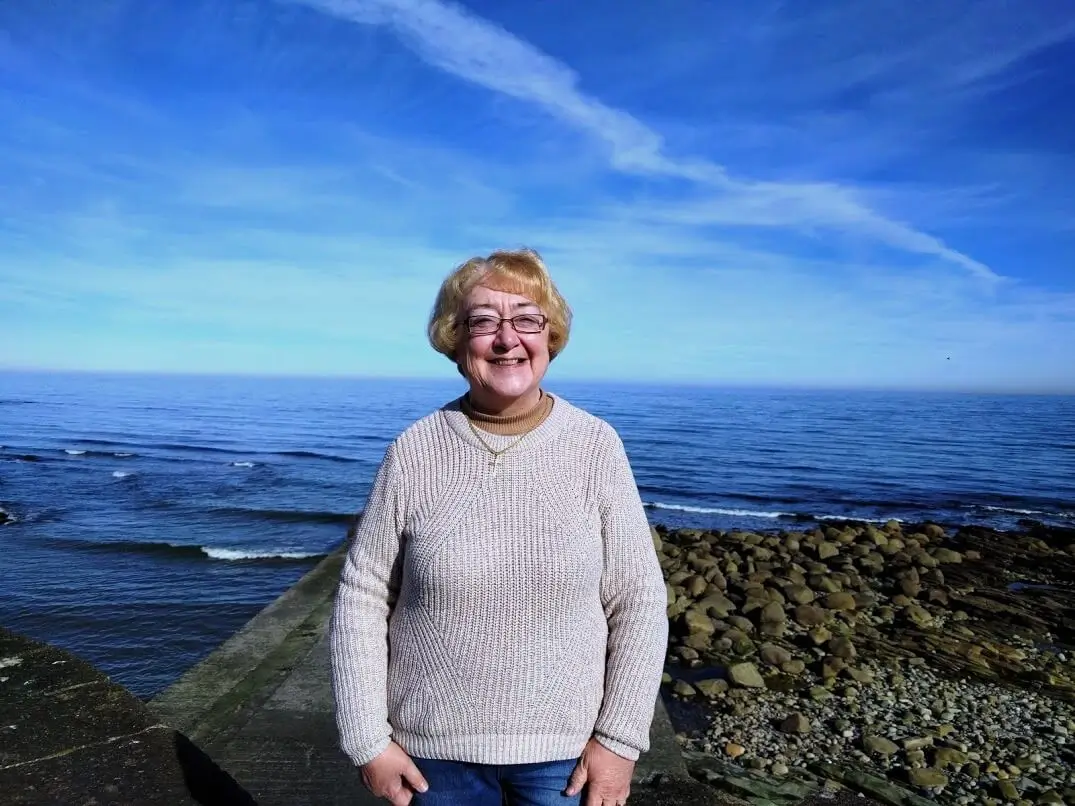
Carol Baraniuk has previously had short stories published in Poetry Now, Ireland’s Own and the Honest Ulsterman. She has lectured, broadcast and published in Ireland, Scotland and further afield on Irish and Scottish literary traditions. Her book, James Orr, Poet and Irish Radical, about the Presbyterian poet and United Irishman James Orr of Ballycarry, was published in 2014 and launched at the Linen Hall Library. She has also contributed an essay to The Contemporary Irish Detective Novel (Palgrave, 2016) and is preparing an essay on Scottish crime fiction for the forthcoming Blackwell Companion to Scottish Literature. Carol is a Research Associate in Robert Burns Studies at the University of Glasgow. She has written creatively throughout her life and has recently finished her first novel – a family saga set in Scotland, Antrim and Down.
More work by Carol Baraniuk


Tel: 028 7126 6946
Email: hueditor@theverbal.co
Verbal, Stable Lane and Mall Wall, Bishop Street Within, Derry/Londonderry, BT48 6PU
 company
Copyright © 2026 Honest Ulsterman