


Two Essays
Essay 1: Battle-Scarred.
Scars are all about remembrance, all about memory; indeed, what is memory but a series of interventions (for good or ill) on the everydayness of existence? We forget far more than we remember and that which we do keep is that which has scarred the ordinary, that we might consider extraordinary however subjective that term is. An individual is made up from these scars, these interventions, it what makes each of us unique. The biggest flaw in the concept of the collective memory is that it can never be fully collective as we each experience these scars differently
For societies, what does the collective memory mean? It is a contested term first used in 1902 by one Hugo von Hofmannsthal who referred to the ‘dammed up force of our mysterious ancestors inside us’ and ‘piled up layers of accumulated collective memory’. [1] An important study in 1925 by French sociologist Maurice Halbwachs made an important distinction between ‘history (seeking objective, truthful accounts of events based on professional scholarship) and collective memory (selecting and socially constructing perceptions of the past, influenced by family, religious, geographic and other connections).’ [2] Though it’s arguable that historical objectivity in its pure form doesn’t exist (we are all part of history after all) collective memory doesn’t have to be real to be reality so to speak. For example in our own (Northern Irish) sphere King William of Orange is often depicted going into battle on a white horse which most historians agree is very unlikely as it would have made him a highly visible and very easy target. It is more likely that he had a dark coloured steed. Though ask most ‘people in the street’ what colour his horse was, and they very probably may tell you it was definitely white.
However, Halbwach’s concepts of collective memory were a move away from concepts of race, heritage and identity that had very racist overtones:
Building on the work of Emile Durkheim, Henri Bergson and Sigmund Freud, Halbwachs coined the term ‘memoire collective’ (collective memory) in his book Les Cadres Sociaux de la Memoire in 1925, “making the claim that his contemporaries were not yet used to attributing memories to groups” within and comprising society. More specifically Halbwachs shifted the focus from racial or biological interpretations of memory and remembering, to the influence of social groups such as “families, social classes, and religious communities. [3]
For Halbwach, the ‘specific character that a person derives from belonging to a distinct society and culture, is determined by the socialization and customs of the group of which the person is a member, rather than through phylogenetic evolution.’ [4]
Collective memory is of course a created almost mythic thing. As we noted above, something doesn’t have to be reality to be considered real. Nietzsche noted “without mystery, culture loses the healthy natural power of its creativity: only a horizon defined by myths completes and unifies a whole cultural movement.” (Ibid) In other words, communities, cultures etc need myths as a sort of glue to keep them together as well as emphasise their uniqueness. Something that would be emphasised with disastrous consequences throughout the 20th Century.
The media and government (when it suits them) have idealised elements of history so many times that their idealised version has become so to speak an uncontested ideal state. During the Brexit saga and the Cov-19 pandemic we’ve often heard of the Blitz spirit, harking back to a time when, despite of Nazi bombardment the English (and it’s usually the English rather than the British) character reached it’s apogee in its defiance and resilience:
The war-time imagery is compelling. It identifies an enemy (the virus), a strategy (“flatten the curve,” but also “save the economy”), the front-line warriors (health-care personnel), the home-front (people isolating at home), the traitors and deserters (people breaking the social-distancing rules). [5]
Though it’s really very likely he wasn’t the first, it was suitably a British physician Thomas Sydenham, who is credited with inviting the military metaphor into Western medical discourse by writing, in his 1676 treatise, that a "murderous array of disease has to be fought against, and the battle is not a battle for the sluggard."
Susan Sontag would point this out in her essay on metaphors and illness:
The controlling metaphors in descriptions of cancer are, in fact, drawn not from economics but from the language of warfare: every physician and every attentive patient is familiar with, if perhaps inured to, this military terminology. Thus, cancer cells do not simply multiply; they are “invasive.” (“Malignant tumors invade even when they grow very slowly,” as one textbook puts it.) Cancer cells “colonize” from the original tumor to far sites in the body, first setting up tiny outposts (“micrometastases”) whose presence is assumed, though they cannot be detected. [6]
Whilst it is no doubt true that there were many brave people that faced the Nazis threat, the ‘all for one and one for all’ attitude was an invention to help cover class and political differences. Churchill and the Royal Family were booed when they toured the ruins of London for example. Governments then and now are not interested in nuance, so it was necessary to emphasis the togetherness and mental strength of the population. In reality, much like with the pandemic now there was a worry about the mental health of the nation:
Psychiatrists at the time worried that there would be an epidemic of “air-raid phobia” and hospitals prepared for an influx of psychiatric casualties, but there were fewer admissions to psychiatric hospitals in 1940 than in 1939. One leading psychoanalyst, Edward Glover, published a Penguin Special in 1940 on how to conquer fear. His recipe was a simple pat on the shoulder and some firm words. He suggested carrying a packet of sweets or some biscuits, or a flask of brandy, to cheer up those unnerved by the bombs. [7]
The equivalent of the banality of many online inspirational messengers these days. Societal scars often provoke banal responses even by those often considered the best of humanity in classical times. Plato’s basic answer to fear in battle was to think positively. This lasted throughout the ages. When proper research was carried out for example in Hull, the Blitz Spirit was notable in its absence. The report indicated:
that people developed serious psychosomatic conditions, including involuntary soiling and wetting, persistent crying, uncontrollable shaking, headaches and chronic dizziness; men were found to indulge in heavy drinking and smoking after a raid, and prone to developing peptic ulcers. [8]
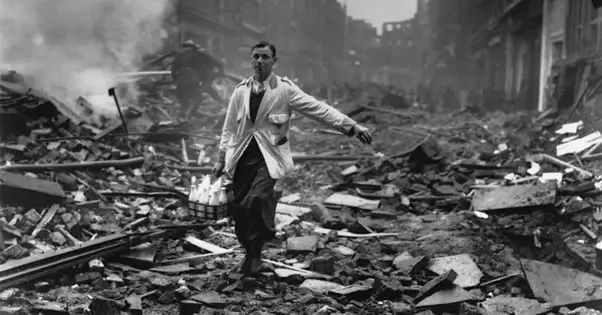
This of course wasn’t what the government wanted to hear so they focused on the resilience and spirit of the people. Art was of course used in this through many propaganda films and photographs. One of the most famous photographs of the Blitz (below) was staged by Photographer Fred Morley. The milkman is actually the photographer’s assistant. It’s actually quite a clever photo. The government had banned any photos of the ruins and rubble but the milkman defiantly delivers his round in the face of adversity so escaped the censor’s wrath.
When you ‘name’ an enemy you can
encourage the population to be on their guard, to ‘stay alert’ as the current
UK government put it. Names have power these days as the ‘Brexit’ saga shows.
In previous times people when it comes to mentioning disease there was almost a
primal fear:
In Stendhal’s Armance (1827), the hero’s mother refuses to say “tuberculosis” for fear that pronouncing the word will hasten the course of her son’s malady. And Karl Menninger has observed (in The Vital Balance) that “the very word ‘cancer’ is said to kill some patients who would not have succumbed (so quickly) to the malignancy from which they suffer.” [9]
Thus, myths build up about disease and those in authority can feed on the demoralisation of the patient.
The ‘pulling together’ during the blitz was often enforced and often along class lines. The workers lived near the factories that employed them and were hit the hardest when their houses were destroyed along with their factories. On the other hand, the posh hotels such as the Dorchester offered guests beds with silk sheets in their shelters. Just as in the Covid Pandemic the blitz was mostly experienced at home or within families. And just as in the pandemic the poor suffered most.
Though as Steven Fielding points out the bombing rather than pulling together brought to the fore ugly prejudice:
But there were limits even to working class camaraderie. In 1943, 173 people were crushed to death as a panicking crowd tried to squeeze into Bethnal Green tube station at the start of an air raid. This disaster occurred in a Jewish part of London and the reactions to it exposed ugly prejudice. The Mass Observation reports picked up many anti-Semitic comments such as this one: “They lost their nerve . . . They haven’t got the steadiness like we have. We may be slow but we are sure. But the Jews are different.” West Indians and Africans also complained they were made unwelcome in shelters shared with white East Enders. [10]
Once the pain and trauma of the Blitz subsided successive governments and right-wing media could use the scar left to build on the myth. From the Daily Mail:
War on coronavirus: Germans don't use WW2 rhetoric to describe the pandemic response because they associate it with loss - but Britain and the US are happy to invoke the 'Blitz spirit'
‘As soon as it became obvious that the new coronavirus posed a serious threat to public health in Britain, newspapers across the country were competing with each other to frame the virus in terms of war and combat,’ said Dr Sylvia Jaworska, associate professor in Applied Linguistics at the University of Reading.
‘The reality is that the coronavirus doesn’t distinguish between “friends” and “enemies” and no matter our physical strength or character they will not be enough to slow the death rate on their own,’ said Dr Jaworska. [11]
The deliberate mythologizing of scars such as the Blitz it as Arendt suggests not as a lie that negates the truth but to be free from things as they really were and really are. It is worse than a mere lie, it is a changing of reality, a return to year zero so to speak. We are in the age of mythology and the point of mythologizing the past is not just to romanticise facts but to change the very framework and fabric of present reality.
This creates a totalitarian view of memory which emphasises a party line and no questioning of the ‘facts’ will be considered seriously. This ‘memory regime’ doesn’t need the direct experience of events of the people who suffered through the Blitz for example. It needs later generations to add a mythic element that goes well beyond embellishment. The move is a shift from ‘communicative memory, that of lived experience to cultural memory, that of imaginative experience. (War Beyond Words) Cultural Memory doesn’t change or more accurately doesn’t change beyond in academic arenas. It has fixed points and is performed through ‘texts, rites, monuments’ and institutional communication: recitation, practice, observance’. These fixed points are given new meaning and new myths by each generation however to serve a particular contemporary need as we have seen in the re-visitation.
The War metaphor is an obvious but effective one to use and it has been used regularly: In for example the last few years:
several books were published warning us about “The War on Science” (Otto, 2016), “The War on Cops” (Mac Donald, 2016), “The War on Guns” (Lott, 2016), “The War on California” (Jennings, 2017), “The War on Sex” (Halperin & Hoppe, 2017), “The War on Truth” (Fairley, 2016), and, of course, the “Metaphor Wars” (Gibbs, 2017). [12]
And inevitably it’s one of the media’s favourite tropes:
One study found that 17% of all articles published in Time Magazine and 15% of all articles published in Newsweek between 1981 and 2000 used at least one war metaphor (Karlberg & Buell, 2005) (Ibid)
Many people escape the harshness or unfairness of the contemporary world through nostalgia (and nostalgia is a simplification of history and an ironing out of memory, both individual and societal) into a black and white landscape that is both understandable and has structure. As has been pointed out:
There is well-defined schematic knowledge for a prototypical war. It involves a fight between opposing forces with a clear distinction between an in-group (us, “good”) and out-group (the enemy, “evil”), who are engaged in a struggle to achieve different goals; there are strategic decisions to be made about how to use resources for attack and defence; there is a hierarchy to military force with roles for a leader like a general, lower-level fighters like ground troops, and a support staff like medics, as well as a role for people who have a stake in the outcome even though they are not actively involved in combat (civilians); and there is a hierarchy of events that unfold over time and space, since a war typically involves more than a single battle, with the ultimate goal of harming or even obliterating the opposing side. [13]
War, the scars of war and the absence of war permeate contemporary society and are particularly prevalent in our Covid era though its a cleansed, simplified but at the same time ‘dressed up’ version. R. H. Tawney (who would go on to become an economic historian of note) was aware of this during World War One:
‘I read your papers and listen to your conversation, and I see clearly that you have chosen to make for yourselves an image of war, not as it is, but of a kind which being picturesque, flatters your appetite for novelty, for excitement, for easy admiration, without troubling you with masterful emotions. You have chosen, I say, to make an image, because you do not like, or cannot bear, the truth; because you are afraid of what may happen to your souls if you expose them to the inconsistencies and contradictions, the doubts and bewilderment, which lie beneath the surface of things. [14]
Tawney a young officer, wounded at the Somme, felt betrayed by the politicians and the patriots at home because of the picture they painted. This make-believe picture of suffering with the NHS staff as picturesque ‘heroes’ in blue scrubs would be recreated during the early months of lockdown whom communities would be encouraged to clap for every Thursday night. Of course, what the current government is doing is from a cynical perspective, easily understandable. Sharing the Blitz Spirt and ‘pulling together’ negates those asking awkward or difficult questions by placing them at best as whingers or at worse as traitors when the country should speak with one voice.
Ursula K. Le Guin recognised this when she commented: “War as a moral metaphor is limited, limiting, and dangerous. By reducing the choices of action to ‘a war against’ whatever-it-is, you divide the world into Me or Us (good) and Them or It (bad) and reduce the ethical complexity and moral richness of our life to Yes/No, On/Off.” This is of course the very reason the myths and sanitised versions of historical events are brought back to the fore. If you’re not for us, you’re against us is still one of the most powerful phrases used. This is evident in the latest government missives that proclaim that it is a citizen’s patriotic duty to return to work.
Public support for war tends to fade over time with a ‘war fatigue’ emerging. The use of the war metaphor fails when there isn’t an apparent clear path out of the current crisis. We can see the fracturing of the ‘we should all pull together’ mantra as the young in particular ignore social distancing and other safety measures. However, it is still useful in branding individuals not ‘pulling together’ traitors or enemies of the people. And the scars of a ‘war’ can be worn with pride by victors and those that perish can be washed into collectivity and myth with national days of mourning and the occasional memorial. In the past according to Sontag TB and Cancer were both understood as diseases of passion:
With TB, the outward fever was a sign of an inward burning. The tubercular is one “consumed” or dissolved by passion, a passion leading to the dissolution of the body. First came the use of tubercular metaphors to describe love—the image of “diseased” love, of a passion that “consumes.” Eventually the image was inverted, and TB was conceived as a variant of the disease of love. Love is now lethal. In a heartbreaking letter of November 1, 1820, from Naples, Keats, forever separated from Fanny Brawne, writes, “If I had any chance of recovery [from tuberculosis], this passion would kill me.” As a character in The Magic Mountain explains: “Symptoms of disease are nothing but a disguised manifestation of the power of love; and all disease is only love transformed.” [15]
Cancer was associated with sexual repression, ‘an affliction of those who are sexually repressed, inhibited, unspontaneous, incapable of expressing anger.’ [16] Covid is said to have emerged from human greed or desperation through the eating of ‘taboo’ animals such as bats. This contextualising of disease with perceived human emotional/moral frailty is very useful of course for commentators, politicians and even terror groups. Both ISIS and Hulk Hogan called Covid – 19, a punishment from God. TB which was associated with the poor and starving poets/artists is perfect for assigning to moral failings or lack of character:
TB sufferers may be represented as passionate but are, more characteristically, deficient in vitality, in life force…This is how those two famously tough-minded observers, the Goncourt brothers, explain the TB of their friend Murger (the author of the book from which La Bohème was drawn): he is dying “for want of vitality with which to withstand suffering.” TB is celebrated as the disease of born victims, of sensitive, passive people who are not quite life-loving enough to survive. (What is hinted at by the languid, etherealized belles of Pre-Raphaelite art is made explicit in the emaciated, hollow-eyed, tubercular girls depicted by Edvard Munch.) And while the standard representation of a death from TB places the emphasis on the perfected sublimation of feeling, the recurrence of the figure of the tubercular courtesan indicates that TB was also thought to make the sufferer sexy. [17]
In that weird logical/non-logical way of seeing things the TB look was considered very attractive in both males and females in certain sections of society, though obviously not if you were poor and dying from it. In much the same way as heroin chic in the later 20th Century was considered a sexy look, a pale and deathly visage was good to have in wealthy artistic circles in the Nineteenth. You weren’t much of a poet if you looked vaguely healthy.
‘We are in this together’ so we’re told of this pandemic numerous times, but of course the poor, the marginalised and ethic minorities suffer more than most. The war metaphor allows for the glossing over individual suffering in the name of the greater good whilst at the same time blaming individual behaviour for the spread of the virus. The ‘bigger picture’ is not considered when using the war metaphor thus neoliberalism/capitalism, environmental destruction etc are not discussed as contributing factors to the spread of a particular disease. At least in the present, historians have shown us how ancient and medieval plagues used globalised trade and military routes to spread rapidly.
So this duality of ignoring the individual’s pain whilst blaming that pain on his/her behaviour fits in perfect with both the war metaphor and scarring.
Scars have a duality all of their own. They are signs of healing, of potential recovery, of positivity, of life. On the other hand they are evidence of trauma, of injury, of something wrong. They have a slightly uncomfortable position in our age of certainty, of moral absolutes, of judgement. No-one wants a scar, yet without them there is no return to health. Those with blemishes are still considered morally or socially suspect, something that echoes back to ideas of purity and beauty dreamed up millennia ago:
In a world where the “beautiful” are given many advantages, it is easy to understand why appearance is weighted so highly. The old adage, “What is beautiful is good” is still true today, when being perceived as attractive creates a halo effect (Dion et al. 1972). Attractive people are treated more positively (Langlois et al. 1972), judged more favourably (Thombs et al. 2008), are more likely to receive help from strangers (Thombs et al. 2008), and receive better job performance evaluations (Hosoda et al. 2003). [18]
Myths and the pseudo ideals of the spirit of the past are created to mask the incompetence or the lies of those in power to ensure that people endure suffering without too much questioning. War metaphors allow the spreading of disinformation through appealing to assumptions of a golden age when ‘we all stood together’. It’s no coincidence that the We’ll Meet Again topped the charts recently. The current pandemic has been retro-fitted into the mythologising of a collective national scar. It remains to be seen how long this new ‘Blitz’ spirit will last
Essay 2: It’s all (INSERT AS APPROPRIATE) fault! And also a punishment from (INSERT APPROPRIATE DIETY)!
In the ancient world there were all sorts of ‘prophets’ seers and oracles predicting what will happen (no matter what we do) or dependent on us not improving our behaviour. Society was obsessed with the future, mainly because the present was so uncertain and to gain any advantage militarily, economically (or even just to keep on the good side of whatever God/esses you happened to worship) might mean you living a bit longer in happier circumstances. You believed or at least pretended to believe the strange seer woman or the raving old man if you knew what was good for you. Some disbelieved and it didn’t generally end well for them. Sometimes it wasn’t even your fault if you didn’t believe. Those that heard Cassandra, a former Princess of Troy and possibly a priestess in the temple of Apollo, were cursed never to believe her. Cassandra according to the great Greek dramatist, Aeschylus, caught the eye of Apollo, who promised her the gift of prophecy if she would give herself to him. Cassandra agreed, became a prophet and then changed her mind in regard to Apollo. The God revenged himself by ordaining that her prophecies should never be believed even if they were absolutely accurate. She correctly predicted such events as the fall of Troy and the death of Agamemnon, but her warnings went unheeded which was really unlucky for you if she was your only source of potential information about the future. It didn’t end happily for Cassandra either who was raped by Ajax in the temple of Athena (who proceeded to sink the Greek fleet because of it) and then murdered by Clytemnaistra.
The Cassandra myth can be interpreting on one hand the as the silencing of women for their refusal to bend to the wishes of power. If you aren’t believed you might as well not have a tongue. It is also about ordinary people being collateral damage in the revenge of the mighty.
Similarly in the biblical myths non-believers (or those that have never heard the message) serve the purpose of being cannon-fodder for God’s wrath. As if the kids drowned in the Flood or killed in the destruction Sodom and Gomorrah deserved it.
Apollo was also said to be responsible for the ‘Plague of Athens’ which hit the city around 430 BC during the Peloponnesian War. Though Thucydides thought that the plague arrived via Ethiopia, Egypt and Libya many people considered it a poisoned gift from the gods, Apollo in particular, who was said to favour the Spartans:
Down from Olympus strode Apollo, Homer says and let fly arrows in his anger: “And the fires of the corpses burned thickly” Had not the envoys whom the Spartans sent to Delphi before sounding out their allies about an Athenian war been told that Apollo would help them? [19]
Nothing hits ‘ordinary people’ like a pandemic. It has been suggested, though never conclusively proven that the plague of Athens was in fact typhoid though typhus, smallpox and measles have been also suggested over the years based on Thucydides notes. Though it has to be said that Thucydides is not always reliable. The recent uncovering of mass graves dating from the ancient period whilst building for the Athens Olympics offered new hope that a definitive diagnosis was at hand as DNA analysis would hopefully give us a definitive answer as to what caused the plague. However, though the DNA sample extracted from a victim suggested typhoid fever as the primary culprit, this diagnosis was called into question as it was claimed that DNA degrades over time therefore potentially offering incorrect information.
At any rate Thucydides describes it as such:
Violent heats in the head; redness and inflammation of the eyes; throat and tongue quickly suffused with blood; breath became unnatural and fetid; sneezing and hoarseness; violent cough’ vomiting; retching; violent convulsions; the body externally not so hot to the touch, nor yet pale; a livid color inkling to red; breaking out in pustules and ulcers. [20]
He goes further describing patients whose fever was so hot that they preferred to be naked as any clothing even the lightest garment tortured them.; many people even preferred to be submerged in cisterns pf cold water. Thucydides also observed that those unfortunate to catch the plague were possessed of an unceasing thirst which no amount of liquid drunk could lessen. Many of the sick found it difficult to sleep, instead, displaying a constant restlessness. Many of the sufferers died within a week from the onset of symptoms.
As we can see from the Covid pandemic there is a mixture of myth-making and lawlessness that resulted from the plague. According to Thucydides, who actually caught the plague himself but managed to recover from it, Athens was no different. People though they might consider the plague a punishment from Apollo realising that no amount of prayer was helping them and that they were fated with death decided that there was no point in being law-abiding and pious any longer.
The Plague had a terrible effect on Athens, killing over a third of its population with bodies lying unburied in the street. The lack of a proper burial was something which was so appalling to the Athenian sensibility that Sophocles had written a play, Antigone, about it some years previously. Ensuring that the dead were sent on their way properly to the next world was considered a vital part of the functioning of the state. Sophocles has Antigone face execution rather than leave her brother unburied.
Just as many people blame the Covid crisis on incorrect or immoral modes of living, Thucydides does similar for the plague:
In his narration of the Plague’s devastation, he takes careful tally of instances of selflessness and courage, and those of selfishness and cowardice. It is clear that, for Thucydides at least, the death and suffering of a great epidemic (just like war) test the moral health of individuals and of societies. And a people who are not morally strong, when they become afraid, quickly slip into lawlessness and sacrilege: “For the violence of the calamity was such that men, not knowing where to turn, grew reckless of all law, human and divine.” What is also clear is that Thucydides does not think this collapse into immorality is simply a result of the Plague; rather, “Men who had hitherto concealed what they took pleasure in, now grew bolder.” [21]
There is always someone to blame during a pandemic. This can be seen in the Antonine Plague (165 - c. 180/190 CE) which hit the Roman Empire during the co-rule of Marcus Aurelius and Lucius Verus and is named after Aurelius’ family name, Antoninus. Estimates place the death toll at around five million though this could be a conservative estimate and the death toll could have been as high as ten million and included both of the joint rulers. The disease, which may have possibly been smallpox, was brought back to Rome by soldiers returning from the East. It was said that it was a punishment from the Gods because Verus violated the sanctity of a tomb during the siege of the town of Seleucia and released the disease as a curse for his actions. The Romans were supposedly being punished by the Gods for violating an oath they’d made not to pillage the town.
It decimated the aristocracy and military campaigns were called off or abandoned. The people beset by disease turned on the authorities and their Gods who were supposed to look after their interests. Many towns sent delegations to Temples of Apollo, who as we have discovered, is not the God with the greatest record in offering respite in times of pestilence. Aurelius needing a scapegoat found a convenient one:
He blamed the Christians for angering the gods by refusing to participate in religious rituals and so initiated persecutions against them. Christians responded by caring for the sick and dying, showing no fear of death because their faith assured them unconditionally of an eternal life beyond their present existence. Their courage in the face of widespread disease and death drew more converts to Christianity, weakening the state religion, which in turn weakened the state itself. [22]
As we have seen with Covid-19 the success of the (relatively) global nature of the Roman Empire meant there were excellent highways and byways for the disease to travel. Civilization (as it’s called) and disease often go hand in hand. Plague and religion are also very closely connected. This can be seen in the Plague of Cyprian (250-266 CE) named after the Christian cleric, who was Bishop of Carthage and who recorded its impact. The plague lasted nearly twenty years and at its height saw the death of five thousand people per day. Rome at the point the plague hit was suffering from internal disintegrations and external threats with a succession of emperors crowned and quickly deposed. Cyprian, perhaps, reflecting uncertain and dangerous times for everyone, especially Christians, saw the virus as an opportunity to stand high and believe amidst ‘the ruins of the human race’:
What greatness of soul it is to fight with the powers of the mind unshaken against so many attacks of devastation and death, what sublimity to stand erect amidst the ruins of the human race and not to lie prostrate with those who have no hope in God, and to rejoice rather and embrace the gift of the occasion, which, while we are firmly expressing our faith, and having endured sufferings, are advancing to Christ by the narrow way of Christ. [23]
This was of course only of comfort if you happened to be a Christian and as the Christens tended the sick and dying the popularity of the religion increased as the people considered that their own gods had abandoned or failed them. The pandemic strengthened Christianity’s position as the authorities and the traditional gods had no response to the pandemic.
God was seen to be the cause for the Plague of Justinian, named after the Byzantine Emperor Justinian 1, (approx. 527 – 567 CE). The historian Procopius attributed the outbreak of the plague to God’s anger at the iniquity of the Emperor’s reign. He comments that many people were visited by ghosts or apparitions before the disease struck them:
Apparitions of supernatural beings in human guise of every description were seen by many persons, and those who encountered them thought that they were struck by the man they had met in this or that part of the body, as it havened, and immediately upon seeing this apparition they were seized also by the disease... But in the case of some the pestilence did not come on in this way, but they saw a vision in a dream and seemed to suffer the very same thing at the hands of the creature who stood over them, or else to hear a voice foretelling to them that they were written down in the number of those who were to die. But with the majority it came about that they were seized by the disease without becoming aware of what was coming either through a waking vision or a dream. [24]
The pandemic probably originated in China and India though in this instance the start point is thought to have been Egypt and is known to have been Bubonic Plague (Yersinia Pestis) which would of course devastate Europe in the Middle Ages.
As with all plagues the formally ‘wicked’ became ultra-pious and devoted themselves to God and learn ‘respectability for a season by sheer necessity’: Procopius somewhat snarkily comments that:
those who in times past used to take delight in devoting themselves to pursuits both shameful and base, shook off the unrighteousness of their daily lives and practiced the duties of religion with diligence ... but then all, so to speak, being thoroughly terrified by the things which were happening, and supposing that they would die immediately, did, as was natural, learn respectability for a season by sheer necessity. Therefore as soon as they were rid of the disease and were saved, and already supposed that they were in security, since the curse had moved on to other peoples, then they turned sharply about and reverted once more to their baseness of hearts . [25]
As with previous plagues the excellence of trade routes and the endless conflicts within and without the empire proved maximum conditions for the spread of the disease. North Africa, in the 8th century CE, was ‘the primary source of grain for the empire, along with a number of different commodities including paper, oil, ivory, and slaves. Stored in vast warehouses, the grain provided a perfect breeding ground for the fleas and rats, crucial to the transmission of plague.’ [26] Accompanying this was an unusual cold spell that ruined harvests and led to food shortages and resulted in infected refugees moving throughout the empire, spreading the disease widely. It is thought that possibly twenty to forty percent of the inhabitants of Constantinople died as a result of the disease. Throughout the rest of the empire, almost a quarter of its population died with historians estimating a figure of 25-50 million victims.
Scientists recently have discovered that the strain responsible for the Justinian outbreak is related to, but also distinct from, all other known variants of Y. pestis, including the ones responsible for the Black Death which devastated Europe. They consider the strain of Bubonic Plague behind the Justinian outbreak was an evolutionary "dead end" that didn't survive to contemporary times. There were however less well recorded outbreaks in the Sixth Century, one of which Pope Gregory the Great decided was caused as a punishment for humanity’s sins and ordered people to repent and show contrition.
There were fifty-seven plagues in antiquity records Livy only a few of which are recorded in any detail. Though the Gods were blamed the authorities (either through genuine concern for the people or because of self-preservation) created banquets for the populace of all classes:
Throughout the City the front gates of the houses were thrown open and all sorts of things [were] placed for general use in the open courts; all comers, whether acquaintances or strangers, were invited to share the hospitality. Men who had been enemies held friendly and sociable conversations with each other and abstained from all litigation, the manacles even were removed from prisoners during this period, and afterwards it seemed an act of impiety that men to whom the gods had brought such relief should be put in chains again. [27]
Pandemics and diseases are as we have indicated already in this essay, perfect platforms for those with a tendency to see the world as wicked and people as full of sins to say “I told you so” loudly, again and again. During the time of the Black Death which overwhelmed Europe and the Near East between 1346 - c. 1360 CE. this was certainly the case. The plague was caused by the bacterium Yersinia Pestis which was carried by the fleas of rodents, primarily rats, who inevitably accompanied merchant caravans or troops returning from/going to war. The disease killed at least thirty million people in Europe and perhaps even as many as fifty million or more throughout the world. The term ‘Black Death’ was coined in the Nineteenth Century in referenced to the black growths that appeared on the body of victims. The original outbreak location of the Black Death is not known, with China, Mongolia, India, central Asia and Russia suggested as ground zeros for infection origin. Historians generally agree however that the disease moved west out of the steppes north of the Black and Caspian Seas and eventually into Europe. Interestingly (or predictably) the beginnings of the plague in Europe saw infected corpses flung into besieged cities, in this instance the city of Caffa, (now Feodosija in modern Ukraine) under siege from the Mongol Golden Horde in the first instance of proto biological warfare. Merchant ships near the city fled to Sicily and Genoa and beyond taking the disease with them:
“…As it happened, among those who escaped from Caffa by boat were a few sailors who had been infected with the poisonous disease. Some boats were bound for Genoa, others went to Venice and to other Christian areas. When the sailors reached these places and mixed with the people there, it was as if they had brought evil spirits with them: every city, every settlement, every place was poisoned by the contagious pestilence, and their inhabitants, both men and women, died suddenly. And when one person had contracted the illness, he poisoned his whole family even as he fell and died, so that those preparing to bury his body were seized by death in the same way. Thus death entered through the windows, and as cities and towns were depopulated their inhabitants mourned their dead neighbours.” [28]
Gabriele de Mussis’ Historia de Morbo (quoted above) attributed the cause to “the mire of manifold wickedness,” the “numberless vices,” and the “limitless capacity for evil” exhibited by an entire human race no longer fearing the judgement of God:
“Oh God! See how the heathen Tartar races, pouring together from all sides, suddenly invested the city of Caffa and besieged the trapped Christians there for almost three years. There, hemmed in by an immense army, they could hardly draw breath, although food could be shipped in, which offered them some hope. But behold, the whole army was affected by a disease which overran the Tartars and killed thousands upon thousands every day. It was as though arrows were raining down from heaven to strike and crush the Tartars’ arrogance. All medical advice and attention was useless; the Tartars died as soon as the signs of disease appeared on their bodies: swellings in the armpit or groin caused by coagulating humours, followed by a putrid fever. [29]
As in Athens the pandemic caused in the populous throughout Europe extreme religious responses and a rise in lawlessness and immorality. Though the disease was attributed to God’s wrath, primarily that didn’t stop people deciding that somebody is at fault for that wrath (except for themselves obviously), such as the Jewish communities for instance. Historical evidence points to the fact that over one thousand Jewish communities were completely destroyed and driven out in the two years between 1348 and 1350: men, women and children were burnt alive on islands or in their synagogues, accused of poisoning wells to destroy Christianity.
Boccaccio reports that some people thought that living moderately and isolating themselves would protect them whilst others thought that since they were doomed anyway they might as well live the life they had left to the full. Most people he reports took the middle way, getting on with life as best they could, taking suggested protections and of course dooming themselves and those they came into contact with. Isolation was of course it was quickly realised vital in stopping the plague. The port of Ragusa, now Dubrovnik, for instance introduced a policy which isolated ships for forty days and from whence we get the modern term quarantine.
The Black Death like Covid though considered to kill indiscriminately was in fact more deadly to those with compromised immune systems so the unhealthy and poor inevitably suffered more. The Black Death hit, like ancient plagues, trust in God and the religious authorities as people quickly realised that prayer wasn’t doing much to help them. The waves of Black Death that swept through Europe eventually changed its social, political and religious landscape, the effects of which are still felt today.
The ‘naming’ of a disease of course can increase of course the fear of it. Black Death for instance still stirs terror and fear in the heart of people. Naming can also of course place blame on a particular place or people as we have seen with Trump and the ‘China’ or ‘Chinese’ virus. Trump isn’t of course the first to do this: An outbreak of syphilis in the early sixteenth century for instance was called the Neapolitan disease outside Naples, the French disease outside France, the Polish disease in Germany and the German disease in Poland. Perhaps Donald is more up to speed with the history of viruses than we thought.
As we have a conspiracy believing person in power in the White House it might be interesting to briefly look at some of the stranger and at times quite deadly conspiracies that were thought as the cause of viral outbreaks. For example, at the beginning of the twentieth century there was a cholera outbreak in Italy that cause great social unrest:
At the end of August 1911, 1,200 ‘rebels’ attacked the town hall while the mayor was convening a meeting. The first to be seized was a clerk, who several months earlier had been involved in drafting the town’s census. A woman struck his head with a stick, another shot him and a third hacked his head off with a pruning knife. The attack was not random. Harking back to a basic plot of cholera conspiracies, the peasants believed the census was the town’s first step in selecting those ‘for the sacrifice’ to ease Italy’s overpopulation. Armed with spades, knives, sticks and agricultural implements, women, boys and men knocked down telegraph poles, cut the wires, wrecked the town hall, burnt its archives, the court house, the telegraph office and the mayor’s house and released prisoners from gaol. The mayor, a town clerk and a judge fled. A group of 11, including three women, caught the clerk and ‘hacked him to pieces’. On reaching the train station, the judge ‘died of fright’. Fearing reprisals, half of Verbicaro’s population fled to the mountains, leaving cholera corpses strewn through streets. The mayor escaped, but two days later was ordered to return and was immediately murdered, repeating the fate of his grandfather, mayor of Verbicaro in 1857, when a previous cholera uprising swept through town. [30]
It wasn’t just in Italy of course in which there was distrust in the medical and civil authorities. There were also cholera riots in Ireland:
Twenty-two riots are recorded throughout Ireland, including three in Sligo, two in Boyle, and outrages in towns as diverse as Derry, Drogheda, Claremorris and Kilkenny. There is little evidence to link the severity of the outbreak with actual riots – violence flared often based solely on rumour or superstition. In Ballyshannon a mob caused considerable damage to the hospital, despite the local physician working relentlessly for the poor. Interestingly, many of these mobs prominently featured women and children. [31]
Echoing contemporary times the citizens of in Kingstown, (Dun Laoghaire) who owned boarding houses attacked doctors investigating a suspected cholera case in the down, worrying that their income would be hit by confirmed cholera cases in the town.
Blame has been a constant feature of epidemics, even those in contemporary times. For example the Aids epidemic in American was blamed on Gaëtan Dugas, a French Canadian gay flight attendant despite the fact that it was proved that it was already in the population. We have a tendency to need to identify an individual to be responsible: Typhoid Mary (Mary Mallon) was blamed for an outbreak of typhoid and served twenty-six years isolation on a New York Island. Inevitably outbreaks of disease are also blamed on God, as punishments for immoral behaviour. This was particularly the case with AIDS spurred on in the US by the policies and attitudes of Ronald and Nancy Reagan.
The above is just a short and of course by no means a comprehensive survey of pandemics over the ages. I have focused mainly on those in the West as Covid is the first to really disrupt Western society generally so greatly in quite a time. This essay is designed to place the scars we suffer from the current Covid outbreak in perspective through presenting a historical context of God blaming and far more sadly people blaming. Though I have focused on who was blamed for various viruses it goes without saying that just like today, there were many acts of selflessness and empathy throughout the ages. The AIDS epidemic for instance produced positive community reactions and coming together despite right wing media and politicians scapegoating the gay community. We’ve seen the outpouring of love for the NHS recently also though in the end the clapping (like many contemporary western social occurrences/protests) became somewhat performative but there is no denying that there was appreciation contained within it. Perhaps there will be a change for the better for everyone after all this. I wouldn’t count on it, but you never know.
These essays are the first two in a series funded by the Arts Council of Northern Ireland Artist's Emergency Fund. My sincere thanks go to them.
[1] (Schieder, 1978, P2)
[2] https://www.mtholyoke.edu/sites/default/files/global/docs/Barsalou paper.pdf
[3] (https://historyhub.info/concept-of-collective-memory/)
[4] (Ibid)
[5] https://theconversation.com/war-metaphors-used-for-covid-19-are-compelling-but-also-dangerous-135406
[6] https://www.vox.com/culture/2020/4/15/21193679/coronavirus-pandemic-war-metaphor-ecology-microbiome
[7] https://www.theguardian.com/commentisfree/2020/mar/19/myth-blitz-spirit-model-coronavirus
[8] Ibid
[9] https://www.nybooks.com/articles/1978/01/26/illness-as-metaphor
[10] https://www.ft.com/content/14c86fe8-69d4-11ea-a6ac-9122541af204)
[11] Daily Mail 20/04/20
[12] >https://www.tandfonline.com/doi/full/10.1080/10926488.2018.1407992?scroll=top&needAccess=true
[13] Ibid
[14] A War Imagined, Hynes P117.
[15] https://www.nybooks.com/articles/1978/01/26/illness-as-metaphor/
[16] Ibid
[17] Ibid
[18] https://pubmed.ncbi.nlm.nih.gov/30439862/
[19] The Plague of War, Roberts P86
[20] Thucydides, 2.49-2.50
[21] https://www.theatlantic.com/ideas/archive/2020/03/great-plague-athens-has-eerie-parallels-today/608545/
[22] https://allthatsinteresting.com/antonine-plague)
[23] https://www.ancient.eu/article/1534/reactions-to-plague-in-the-ancient--medieval-world/
[24] Ibid
[25] Ibid
[26] https://www.ancient.eu/article/782/justinians-plague-541-542-ce/
[27] https://www.historytoday.com/archive/feature/plague-and-prejudice
[28] https://wwwnc.cdc.gov/eid/article/8/9/01-0536_article
[29] Ibid
[30] https://www.historytoday.com/archive/feature/plague-and-prejudice
[31] https://www.drfionagallagher.com/history-blog/cholera-riots-and-conspiracy-theories

Dr. Gregory McCartney is the editor of Abridged, the HU and an independent curator.
More work by Greg McCartney


Tel: 028 7126 6946
Email: hueditor@theverbal.co
Verbal, Stable Lane and Mall Wall, Bishop Street Within, Derry/Londonderry, BT48 6PU
 company
Copyright © 2026 Honest Ulsterman