


An Interview
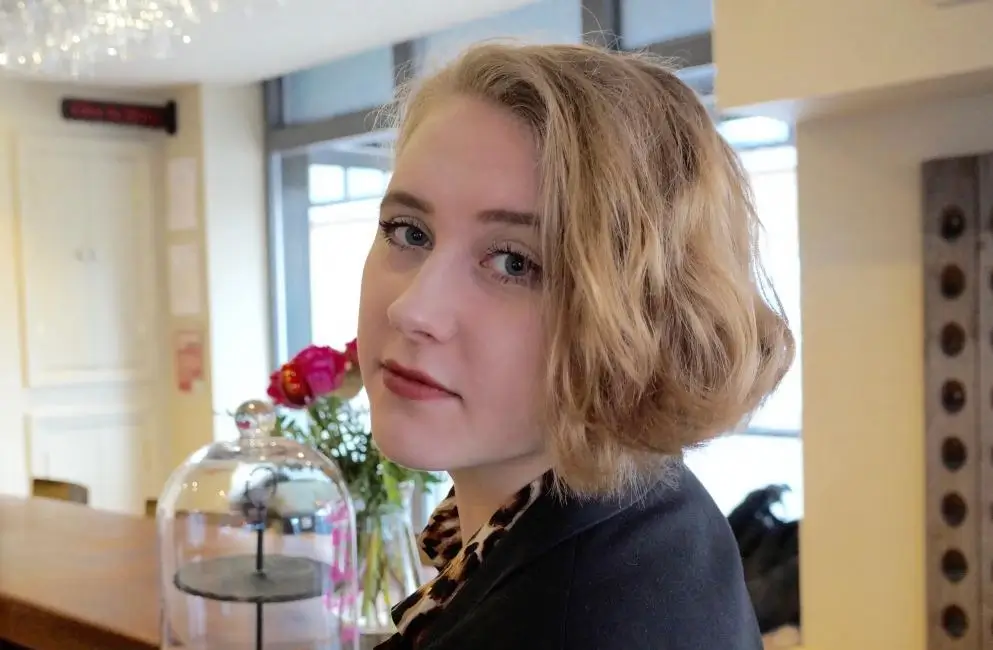
Phoebe Stuckes is a writer from West Somerset now living in London. She has been a winner of the Foyle Young Poets award four times and is a former Barbican Young Poet. Her debut pamphlet, Gin & Tonic was shortlisted for The Michael Marks Award 2017. She has been awarded an Eric Gregory Award and The Geoffrey Dearmer Prize. Her first full-length collection, Platinum Blonde is published by Bloodaxe Books.
Gregory McCartney: Hi Phoebe, Thanks for being in the Honest Ulsterman. I’m a big fan of your work so am glad that you’re in the HU. Can you tell me a bit about yourself?
Phoebe Stuckes: Thanks for having me. I’m a poet and writer, originally from West Somerset now living in London, I’m also a bookseller.
GMCC: Did you come from a background in which reading/literature was valued?
PS: Yes for sure, my mum is an English teacher and my dad is a vicar. There were always lots of books in the house, my mum is a great reader of novels particularly.
GMCC: I love Crisis from your Gin and Tonic collection. They say ‘once a Catholic, always a Catholic’ so your line the about the Church of England Standard Worship and the Dark Side of the Moon’ being lodged in your head forever I recognise. Can a person ever escape the guilt religious upbringings place in a person? Perhaps we all just become Nick Cave fans!
PS: If a person can I’d like to talk to them about it! I think it’s given me some good things, like I have a huge respect for faith and a big sense of personal accountability to the world in general. I saw a joke about people with religious backgrounds being forever trapped in a Venn diagram of really into horoscopes and terrified of paranormal horror films and that really spoke to me.
GMCC: Platinum Blonde is a brilliant collection. There’s a wonderful Saturday night / Sunday morning feel about it, the madness of the party and the hangover (in many senses) of the morning after. How much of yourself is in the narrator?
PS: Thanks! People keep asking me this and it's honestly hard to know, the speaker and I have experiences in common for sure but I think I’m softer than she is. I feel like I wrote the book in one very particular psychic space, one of profound anxiety, anger and longing. I don’t know that I feel like that anymore. it’s not that my beliefs have changed but I certainly feel very different.
GMCC: Veronica Lake’s on the cover of Platinum Blonde. A ‘femme fatale’ that fell from stardom. There is a element of drama throughout the collection and a sense of that the narrator fears but also looks forward to the inevitable fall from grace. Would you say that was accurate? You went to the Golden Age of Hollywood for a cover-star rather than somebody relatively contemporary. Perhaps the stars are all in the past?
PS: A few years ago in an editor's note for an issue of The Rialto Will Harris described a couple of my poems as ‘powered by a sense of their own endangerment’ and I loved that. I think that’s a little bit about my anxiety, my general sense that at any moment something terrible is about to happen, it’s difficult to try and have fun with the end of the world on your mind all the time. I don’t know if the stars are in the past but I am obsessed with those women who lived in that ‘golden age’ of Hollywood, they all had these bonkers exploitative contracts, it was all about maintaining a perfect image. You know sometimes they had their back teeth pulled out to make their cheekbones stand out? That’s Rilke’s ‘beauty is nothing but the beginning of terror’ for you.
GMCC: There’s also an atmosphere (if that’s the right word) throughout the collection that reminds me of early Soft Cell and Smiths songs though from a female perspective. I’m not sure if you’re influenced by 1980s Indie music but the narrator portrays a certain gloomy glamour in the poems. Is there a glamour?
PS: Glamour and gloom are all tied up together, it’s all about light and darkness, anyone we would think of as glamorous is probably having a terrible time emotionally.
GMCC: Platinum Blonde tells stories that are universal but also very of the moment: Watch out, / the mad chicks are in the street outside, / ripping up the pavement with their tombstone / teeth, smashing shop fronts with their wings, / there’s nothing in this world that can stop them now. And ‘I’ve written enough/thank you notes and apology letters/now is the time/ for manifestos and songs.’ I think you blend the micro and macro, the personal and the social/activist very cleverly. Perhaps for yourself they are one and the same?
PS: I think it’s impossible to separate the two if the actions of this government affect you and people you love negatively, which they do, constantly and unrelentingly. I’m very aware that it’s not enough to just write poems about it though, I would never confuse the political elements of my work for real activism.
GMCC: Violence, both actual and metaphorical, by other people and on the self is hinted at throughout the book. Is this something you bring to the fore deliberately? Or does it surface subconsciously?
PS: I think both, I was very aware of living with fear, both because of my anxiety and because as a woman and a queer person, the fear of violence, both at the hands of strangers and intimately is something I live with. I think when I was writing this book I saw a lot of the conversations around sexual violence as sort of inadequate, it struck me that the problem runs so much deeper and is so much worse than anyone really wants to acknowledge and I was frustrated by that.
GMCC: I always ask people this, but how do you put a collection together? How do you figure what goes where and what doesn’t work with what?
PS: I find this sort of difficult to answer because my way of writing is obsessive and I tend to write about the same themes until I’m sick of them and then I do something else. The poems sort of went together from the beginning, the order got completely up-ended though, and there was a small section of poems that went with each other but not the collection as a whole and subsequently got cut as a result. Annoyingly, when there isn’t a linear narrative I think it's an intuitive thing.
GMCC: Your work is very performative. Is the social element, reading to an audience, an important part of your practice, and how have you taken to Zoom readings etc?
PS: Yes absolutely, I like performing but also getting dressed up for readings is a huge part of the ritual for me. I miss the feeling in the room when you finish a poem, you can’t sense anyone’s reactions on Zoom and that sort of panicked me at first. But I think it's the best thing we’ve got right now and I like that zoom means people can join that wouldn’t normally be able to, I think that’s something to be excited about.
GMCC: ‘It’s a rough time to be young / or to care about anything’. (from the Gin & Tonic Home version) How are you surviving the Covid crisis generally? Is it an opportunity to read and/or write or (like many people) did you find it difficult?
PS: I think it’s weird to see it as an opportunity with so much at stake, but I tried to see it that way at the beginning. I thought I was going to read so much and add to my list I was keeping of all the books I’ve read this year, then I accidentally deleted the list off my phone and sort of had a meltdown, like what’s the point of documenting that anyway? After that I was able to relax a bit and read some books I’d been putting off.
You can buy Platinum Blonde here: https://www.bloodaxebooks.com/ecs/product/platinum-blonde-1231

Dr. Gregory McCartney is the editor of Abridged, the HU and an independent curator.
More work by Greg McCartney


Tel: 028 7126 6946
Email: hueditor@theverbal.co
Verbal, Stable Lane and Mall Wall, Bishop Street Within, Derry/Londonderry, BT48 6PU
 company
Copyright © 2026 Honest Ulsterman