


An interview
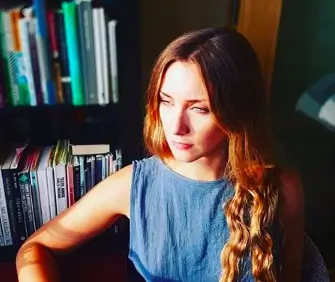
Sue Rainsford’s novel Follow Me To Ground was published in May 2018 by New Island. Building on her existing art writing practice, the novel draws on art historical references and looks at Sue’s ongoing research into the abject female body. The book was developed over five years, during which time Sue completed an MA in Visual Arts Practices (Mavis) with IADT Dún Laoghaire and an MFA in Writing and Literature in Bennington College, Vermont. It centres around Ada and her father in an unnamed rural place, where the otherworldly and ethereal inhabits the everyday and the body. My first question to Sue when we met in Dublin was where Follow Me To Ground sits in her wider writing practice:
“I started working on it when I was doing my final project during the MAvis programme. It came out of the critical discourse I’d been looking at, for example writers Simone de Beauvoir and Julia Kristeva and installation artists such as Jenny Keane. (1) I’m interested in how metaphorical and fantastical imagery is applied or projected onto to female experience. Jenny Keane is dealing with these fantastical projections as they occur in horror films. I had known for a while during my MA that I wanted to write fiction - I had written a lot of it while I was doing my undergraduate degree. I was more influenced then by the realist literature that I’d been reading. In Follow Me To Ground the character Ada embodies all of this critical discourse that I had been researching. Once I found the mechanism to talk about all of these things through fiction it was a very natural process and the story kept growing. I suppose I’m looking for ways for text to intervene, so when I’m working in the visual arts I’m thinking what can text do here: how they function in new ways or in a different way. So I’m used to approaching things in that peripheral way; although I wasn’t used to writing fiction of that length. Working on the novel over 5 years while also developing my critical writing practice further - going in and out of those registers - was quite natural: they all operate in the same way for me.”
The main character Ada, and a secondary character Olivia, are powerful and uncompromising in their desires, and then have to deal with the consequences of their impulses. Sue says of Ada: “I wanted to write an uncompromising female lead, and wanted her to be feared and off-putting: it’s not a likeable character from the reader’s perspective. She occupies a blurred, uncomfortable space. She’s uncompromising in her desires which makes her appealing from a feminist point of view, but while things she does makes sense to her, they are disturbing and troubling from an ethical point of view.”
Ada, along with the characters Olivia and Lorraine, are punished for their desires, some rightly so. The novel is pitched by publisher New Island as a deconstruction into stereotypes of predator and prey, victims and perpetrators - what we expect them to look like and how we expect them to behave, at our own peril. Sue explains: “Ada, Olivia and Samson are all forms of predator: Samson because he finds things in Ada that allow him to express a compromised or troubled part of himself and he feeds on that. However Ada feeds so much on him she doesn’t notice or care. I loved writing Olivia, she is so awful, a woman in a small town hasn’t been given many options – not that that excuses her actions – and there is an uncompromising sensuous side of herself that has no positive place to go.”
The characters in Follow Me To Ground have names that may be familiar to readers through Biblical, Greek and Roman classics; Samson and Delilah for example. The main character’s name, Ada, was chosen to reference Ada Lovelace:
“I read Zeros and Ones: Digital Women and the New Technoculture by Sadie Plant which looks at the 2 relationship of women with machines and technology and their importance of digital technology. I became obsessed with Ada Lovelace and I love how the name ‘Ada’ sounds.”
In the novel Ada moves between different spaces, and different men who occupy those spaces. Rather than referring to the story of Persephone - who is voiceless and forced to live part of the year (Summer) on Earth and other other part (Winter), in the underworld, Ada moves freely between these worlds and has agency in her relationships with the respective men. The classical and Biblical references came to Sue via her Art History studies, specifically the work of Rembrandt and Reubens during her undergraduate programme: “The idea of Samson and the shorn hair came into the book very early on, but I didn’t know how it was going to fit. The image of the beautiful male figure so easily emasculated came from 17th Century paintings.” However despite the loaded references one could deduce from names, the most important thing for all the characters was how their names sounded in the reader’s mind.
The novel is punctuated with mini chapters or witness statements written in in the first person by other characters in this nameless community. Their presence questions the reliability of the main narrative and the manipulative abilities of Ada. These perspective pieces are further along the timeline; thus distorting the reader’s subjectivity while also offering a wider view of the context that Sue has created. The pieces are also in dialogue with each other; for example different members of the same family offering opposing perspectives of the same event. They take the reader out of the enchantment that Ada has put them under; revealing that the dreamlike story is not a fairy-tale and that there are very real consequences to Ada’s sometimes surreal or unbelievable actions. Sue talks about how these testimonials were conceived:
“They began as appendices that I’d written for myself. For example with Ada, I’d written letters from Ada to Samson to understand what she does when I’m not looking: how does she behave? In order to try and imagine her as fully and get the full scope of her I wanted to think about how other people see her. So I wrote pure perspective pieces for myself. I thought that they couldn’t be serviceable because I had such a good time writing them! I had a collection of different styles and voices that were interspersed playfully in one of the edits I completed near end of my time in Bennington. In the next edit they were polished and their placement into the narrative was more methodical in order to build tension, ambience and a sense of community. It took a while to get the rhythm right.”
The novel is set in a nameless place, but while that gives the impression that it could be anywhere, the place itself is quite unique, with specific place names natural elements such as lakes and forests that are themselves characters. Some readers got the impression that the place was in the southern states of the USA, probably due to the intense Summer heat that envelopes the story throughout. (2) However Sue says the inspiration for the place is a lot closer to home:
“I’m happy with the American interpretation: some people said it reminded them of Mississippi or New Orleans. When I was writing I was actually thinking of the West Cork – I have visited there since I was 17 and spent a lot of time there when I was conceptualising the scene where Ada and the Father are digging a grave. Regarding the climate, I completed the first draft while living in Ranelagh in Dublin in 2013. It was a scalding hot summer and I was fixated on how the sun weathers things: you could say that it creates items of nostalgia because everything becomes bleached and faded even though they’re contemporaneous with daily life. With the place-names I tend to stay away from specifics - it’s something that I’ve struggled with at times, I think sometimes if a place is too recognisable it becomes distracting. I still want the place to feel quite real, it’s not unearthly - I’m not trying to create a different world. I wanted it to be some backwater place that doesn’t get too much traffic where there isn’t to much of a sense of a wider world, although it is vaguely referred to. The place-names speak of a vernacular.”
One of the taboo actions conducted by Ada and her father is that of burying the living in order for the ground to cure them, which could be linked to a folk remedy of sleeping in a bog in order to be cured of certain ills. While this was not a conscious intention of the writer, the references to a ‘changeling’ - a common trope in Irish folklore, was intended:
“I was really interested in the interpretation of Jane Eyre where she is in fact a changeling. It terrified me and I was compelled by it. The story of Bridget Cleary being a changeling - and being murdered by her husband because of it - was also compelling. 3 While on the MAvis programme an artist doing the course, Helena Tobin, took Bridget Cleary’s narrative as a starting point for her final project. If the theory of the changeling was true, what would it look like? The punishing and murdering of changelings is in our recent history: a woman was burned in Limerick in the 1950s. And now women are still suffering and dying from the ideals that are projected onto their bodies.”
In the novel, Ada and her Father, although outsiders and ‘other’, they are tolerated because they can cure almost anything. Rather than researching Irish folk cures, Sue was informed by early medical writing on the interpretation of organs in dissected bodies, physical symptoms of female depression and Foucault’s History of Madness.
“I wanted to re-imagine things we take - or used to take - as fact, for example if your cerebellum was very dry it was a sign of insanity. So the more fantastical aspects that arose as a result of bringing those factual suggestions to their logical conclusions became more and more interesting to me, as well as how those conclusions can lead to a new way of thinking. I also referred a lot to an abridged copy of Grey’s Anatomy as I wanted to show that Ada had a poetic misunderstanding of anatomy. Western medicine does exist in the wider world where these characters live - albeit quite far away - but the community has Ada and her father to fulfil those needs so they don’t go looking for it. In an earlier draft the father refers to cousins who cure or operate in different way, closer to something like western medicine - it wasn’t totally absent. But I didn’t want there to be institutions such as churches or the state and then the reader has too much expectation and there is a rehearsed response. (3) But the community’s way of being healed is normal to them: people come to dread going to see Ada in the same way that they would dread going to the dentist - it’s normalised.”
Sue is currently working on a new novel entitled Redder Days. Sue says it has a similar sensibility to Follow Me To Ground and like Samson and Olivia, some of the characters have an intense sibling relationship. Sue is interested in her characters having loving nurturing relationships that given certain conditions, can toxify and become detrimental. Olivia and Samson are people that haven’t been given right support systems and have been forced to survive in a harmful infrastructure. Sue wanted to explore what happens when these characters struggle and fail to love and behave positively. There is a fine line between toxic relationships and abusive relationships, and Sue is clear that she does not want to be gratuitous about the latter. She instead looks at what happens between adults when emotion overrides all other reason.
Follow Me to Ground is published by New Island and will be published as a Doubleday hardback in
August 2019 and by Scribner in the US. Rainsford’s second novel, Redder Days, will be published
simultaneously by Doubleday UK and Doubleday Ireland in 2020.
2 https://www.publishersweekly.com/978-0-385-48260-8
3 https://www.libraryireland.com/articles/Burning-Bridget-Cleary/index.php
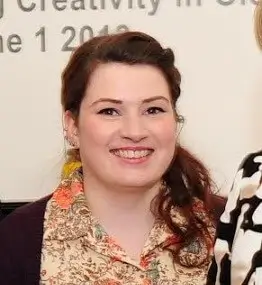
Maeve Mulrennanis a curator and writer based in Galway. She is the Head of Visual Art + Education in Galway Arts Centre, where she has worked since 2006. This role includes exhibitions, critical writing, residencies and education programming. In 2008 she founded Red Bird Youth Collective, which is now a youth led art collective working in visual art, architecture, animation and film. She is the co-curator of the youth & outreach programme for Cúirt International Festival of Literature. Maeve has been on the Board of Directors of Tulca Festival of Visual Art since 2006. Maeve lectures oin the MA Arts Policy & Practice in Huston School of Digital Media, NUI Galway and is an online- Lecturer with NODE Center for Curatorial Studies, Berlin. Maeve is a short story writer, with fiction published in several online journals, The Doire Press 2013 Anthology and The Galway Review. She is currently completing a BA in English Literature and Sociology + Politics in NUI Galway.
More work by Maeve Mulrennan


Tel: 028 7126 6946
Email: hueditor@theverbal.co
Verbal, Stable Lane and Mall Wall, Bishop Street Within, Derry/Londonderry, BT48 6PU
 company
Copyright © 2026 Honest Ulsterman