


An interview
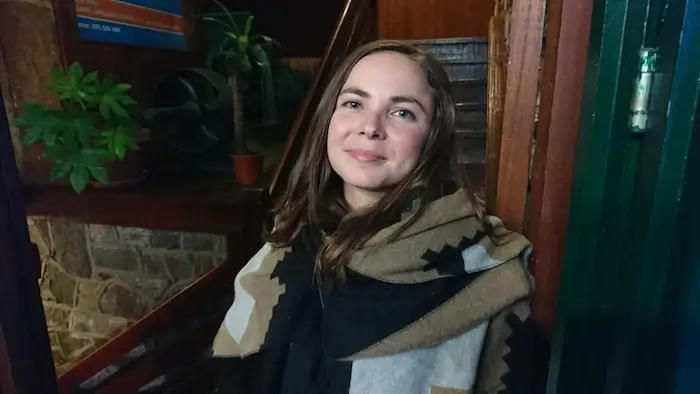
Elaine Cosgrove’s first collection of poetry, Transmissions, was published by Dedalus Press in 2017. Elaine completed the M.Phil in Creative Writing in Trinity College Dublin. Speaking about the impact of the Masters programme, she explains; “So in Trinity you do a portfolio, mine was 20 poems, and from that I think about half went into the book. The manuscript I initially sent to Dedalus Press was too long, so I did a bit of work with Pat Boran, the editor of Dedalus, on just bringing it down. For a debut collection I completely agree with him, it’s best not to have too much. So that was a really interesting process and half of those poems from my portfolio stayed in thankfully. There was also a lot of older work that I edited. The editing on my part was picking and choosing what to cut out and then Pat gave me wonderful advice. It’s interesting because now I couldn’t even tell you what I cut out. Initially there was a bit of self-doubting, I thought that if I took certain poems out would I ruin how they read together - sometimes you have sister poems and relationships between work that you know go together for whatever reason, but Pat is so experienced and told me not to worry, that it will read fine and he was dead right.”
Cosgrove’s debut collection shows the writer’s interest in structure and how her work is presented visually, as well as the aforementioned relationships between certain poems. One poem, Giant’s Causeway, is presented in a series of tall narrow columns. Elaine says of the writing process:” I had a really clear idea when I was at the Giants Causeway. I did want to write something that emulated the landscape. That was one of the first times I actually thought about structure itself and how it looked on the page. The spatial element came first then the writing came after but then other poems like Reservoir evolved after they were written - that was initially a block and now it’s in three columns with one or sometimes two words per line. I wanted to play with that drip dropping, drip dropping pattern and it was kind of more just to make sure that each word owned itself on each line.”
The collection’s title, Transmissions, reflects the multiple themes of communication, connections, inter-connectability and peering points – the voluntary interconnection between two points, for example two networks, for mutual benefit. When asked if this was a conscious subject or a theme that revealed itself through writing, Elaine confirms that it was something that gradually revealed itself through both the writing and editing processes. “Initially I wanted to do the focus on the idea of re-growth and new beginnings. But then when I started to edit out a lot of the other poems I realised the central theme was more along the lines of transmission of information and how you receive it and how we connect with people and so that took over as an overtone that brought the collection together.”
“We become electric.
On and off beings flowing
again and again,
endless in this sudden
glittering world of interruptions.”
- Endless
There are also several poems in Transmissions that relate to travel and movement. “I spend a lot of time on buses and trains and in transit. I think about how it seeps into your writing. Because you spend a lot of time looking out windows and you know, you have a lot of time to think. They’re naturally really nice vessels for carrying poets you know. I was lecturing on contemporary Irish poetry in NUI Galway as part of a summer school. I chose Heaney and some 20th / 21st Century Irish poets and one of the themes I noticed coming up a lot was driving and thoughts that occur while driving. So I suppose being on buses and on trains is my version. There is a tradition of train poems as well so I’m connecting in with that.”
Mentioning Heaney, Elaine also quotes a line from the poet at the beginning of her poem The Crossing; ‘Sea broke on land to full identity’ (Lovers on Aran, Seamus Heaney, 1966). The Crossing addresses the current refugee crisis being televised more frequently and the uncertainty around forging new identities in unknown territories. She says; “Two or three years ago when that became more visible in the media I was reading a lot of Heaney at the time as well and the image of someone jumping from a boat wearing an orange lifejacket stuck with me. I had been on Inis Óirr in the Aran Islands only a few weeks before that and I just found it so surreal. It’s obviously really sad and I thought of that line from Lovers on Aran. It’s about his trip to the Aran Islands trying to find your own identity from the sea but the current refugees are also being forced into finding a new identity.”
The Crossing stands out in the collection as being one of the few that refers to an international concern rather than the self or Ireland. Elaine agrees that it is different – “I am not saying that all poets work the same way but it’s my experience that you start out writing about yourself a lot and then you move more and more away from yourself as your practice evolves over time. There is only so much you can write about yourself and say poems like The Crossing or what I see as my newer poems in my mind are definitely from the period where I was moving on from the poems that were personal poems to more beyond the self.”
The poem Firemen Waiting was published in the anthology Best New British and Irish Poets by Eyewear Publishing in 2017. The poem moves away from the first-person narrative that other poems in the collection have and into a more observational and objective style. Elaine refers to the process of writing that poem: “You’re a carrier of thought and absorbing the images. It’s like using yourself almost like a cable carrying that information across the page: you absorb it, take it and you pass it on to the page. Initially with Fireman Waiting there was an “I” in there. I attended a workshop in Dublin by Poetry Ireland and someone asked if I had thought about taking out the “I” and just making it really objective. I did it and it actually worked really well.”
The multiple references to music in Elaine’s work has been noted, as well as references to song lyrics and bands there is also a poem, Bass Guitar, which charts her own guitars over time. Elaine agrees that music plays a very strong role in her work: “I’ve referenced music way more then I referenced poets or literary works. Maybe I’m more comfortable with it. Or maybe I’m just indulging myself really!”
“A.
The stage lights blow up: spinner-flash on racks of young faces.
Heart’s chambers boom in The Ambassador; bass clef springs
alive.”
- Bass Guitar
In her poem Cruinniú, Elaine plays not with structure, but with the slippage between communication and language. It refers to a real meeting that Elaine had with a group of Irish speakers as part of her job in community development. Elaine says that it is a poem she likes to read to an audience for the rhythm of the words and for the themes that the poem touches on: coming together (‘cruinniú), the anxieties around difference, and the terror that a lot of Irish people have around speaking Irish. She claims “I don’t know how to speak proper Irish.”
“They look at me, a strange Marconi of Sligo-learnt Irish,
as I tap, tap transcribe a gcuid smaointe onto flipchart
in a nursing home’s rosewater day room.”
- Cruinniú
The collection features a poem entitled The Loop, where a woman is on her way to England to have an abortion. The language used is not explicit, yet it is clear as it is a reflection of how people talk about this experience. Elaine agrees that this way of speaking is ingrained in both the everyday and in aspects of the poem. The title, she clarifies, refers to the name of the Duty-Free area of Dublin Airport.
“little ice lights blink in rhythm across the sea,
the loving sea, green sea that banishes me.”
- The Loop
Elaine initially worried that using The Loop brand name in this context would lead to trouble but the name was kept as there are statistics on how many women travel through the airport to get abortions abroad, and for that to happen they do have to go through this space. The title also implies a feedback loop or a return to the beginning. Elaine expands on the choice of title: “I wanted to use that because it’s such an everyday action – walking through that space – it gets repeated, or looped, everyday. You wonder also will this loop ever end. The journey itself is really terrifying, you don’t know what to expect so it’s like a heightened reality but it happens so often in some ways it’s normal and every-day. You’re going on this journey and people around you in the airport are going on holidays and business trips. It’s really surreal: you’re doing something that is illegal in broad daylight, surrounded by holiday makers and the duty free. You have all these luxury brands and perfumes and your thinking ‘I’m going across to England to have an abortion like.’ It’s this thing people know happens all the time so it’s normal in that respect but it’s such a surreal experience.”
Elaine’s approach to description also includes references to the impact of emotions and anxiety on the body. “I think anything about the body would always come from like a very anxious point of view. I struggled with anxiety for years so I suppose I am always really aware of the tone of my voice, or wanting to say something but you physically can’t because your voice feels blocked or muted. I’ve also written about the pounding or tight chest, the lump in the throat or the flushed face - that comes up very clearly when I think about the anatomy of anxiety. Going back to when I first started writing, those works focusing on the self would come from that place of trying to understand anxiety through the body.”
“I climb through air vents
avoiding conversation
on knee to palm to knee engrams,
afraid the world might not like my gush
of preference, my smile when it falls through.”
- Two Guys
The recent publicity around the launch of her collection has meant that Elaine has grown to enjoy public readings of her work; something she has worked on: “I enjoy readings a lot more then I use to. I had really bad stage freight for a long time and was genuinely terrified of readings. However the urge you have for people to hear what you’re doing means that you have to get more comfortable with the idea of being on stage doing readings. There are some different techniques I’ve used, such as Cognitive Behaviour Therapy and acting techniques. I think now I am finally at a stage where I am more comfortable. I don’t know if that translates across to an audience, but I definitely feel I can do a reading and be happy with it and actually even enjoy it. You’ll always have one or two in the audience who give you a deathly stare, but I’ve taught myself to be less receptive of the bad negative looks. You see someone who is enjoying it you take them in rather than the person who is staring right through you! I suppose I’ve just been trying to flip that more so I enjoy it way more and do less dissecting of the reading it in my head afterwards. I don’t spend two or three days worrying that I did a bad job and being really self-conscious about readings now.”
I ask Elaine what were the notable readings by other poets she witnessed. “I went to see Paula Meehan in Cúirt International Festival of Literature a few years ago. I don’t know what happened but there was something different going on. I had seen her reading before but there was something about that particular reading where you’re so absorbed within it that it does feel like you’re going to another place. There was something almost spiritual about her but not like in a religious way. She has this ability that she can really grab and absorb your attention so it’s like you’re going into this mindful space with her. That stays with you when you read her work then afterwards that memory of the live heightened experience returns, like with music I suppose.”
All poem excerpts reprinted courtesy of Dedalus Press.
Elaine Cosgrove will read at the Cork International Poetry Festival on 16th February. For more information please go to: https://www.corkpoetryfest.net/CSLF Images/2018/cosgrove_elaine.html
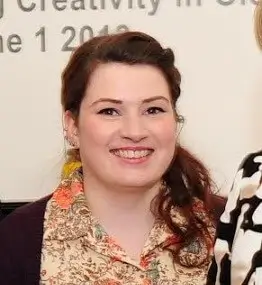
Maeve Mulrennanis a curator and writer based in Galway. She is the Head of Visual Art + Education in Galway Arts Centre, where she has worked since 2006. This role includes exhibitions, critical writing, residencies and education programming. In 2008 she founded Red Bird Youth Collective, which is now a youth led art collective working in visual art, architecture, animation and film. She is the co-curator of the youth & outreach programme for Cúirt International Festival of Literature. Maeve has been on the Board of Directors of Tulca Festival of Visual Art since 2006. Maeve lectures oin the MA Arts Policy & Practice in Huston School of Digital Media, NUI Galway and is an online- Lecturer with NODE Center for Curatorial Studies, Berlin. Maeve is a short story writer, with fiction published in several online journals, The Doire Press 2013 Anthology and The Galway Review. She is currently completing a BA in English Literature and Sociology + Politics in NUI Galway.
More work by Maeve Mulrennan


Tel: 028 7126 6946
Email: hueditor@theverbal.co
Verbal, Stable Lane and Mall Wall, Bishop Street Within, Derry/Londonderry, BT48 6PU
 company
Copyright © 2026 Honest Ulsterman