


Borscht Belt Comedian
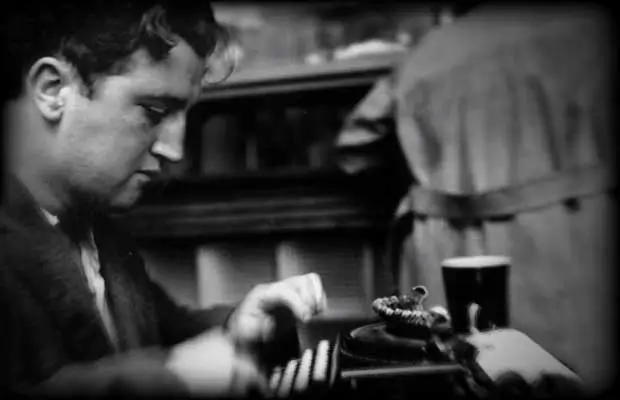
“New York humour is largely an Irish-Jewish creation.”[1] -Ulick O’Connor, Brendan Behan
“It was inevitable that Brendan should fall in love with New York, for it was nearer to his dream of the Never-Never Land than he would ever find elsewhere. . . . It was inevitable, too, that the Americans should fall in love with Brendan.” [2] - Rae Jeffs, Brendan Behan, Man and Showman
One of the “gentlemen” of the press writing for Time magazine reported the chaotic events of the evening this way:
Washington’s scruffy Ambassador Theatre, normally a pad for psychedelic frolics, was the scene of an unscheduled scatological solo last week in support of the peace demonstration. . . . Slurping liquor from a coffee mug [he] faced an audience of 600, most of them students. . . . “I don’t want to grandstand unduly,” he said, grandly but barely standing.
It was one of the few coherent sentences. Mumbling and spewing obscenities as he staggered about the stage . . . . [3]
The obscenity-spewing guzzler in this passage is not Brendan Behan, but Norman Mailer on the eve of the march on the Pentagon on October 21, 1967 in protest of America’s role in the Vietnam War. Among the estimated 50-100,000 protestors were peace activists, academics, public figures like Dr. Benjamin Spock, poets Robert Lowell and Allen Ginsberg, and hundreds of young men who threw their draft cards in a bag that was then dumped on the doorstep of the United States government. What began as a peaceful demonstration eventually devolved into confrontations with U.S. Marshals armed with tear gas, rifles, and fixed bayonets. Nearly 700 people were arrested, Mailer among them. The night before, however, it appeared that he might not be welcomed by this predominantly younger crowd of would-be demonstrators. As the reporter for Time observed, Mailer stumbled about the stage, drunk and barely coherent, when he experienced a kind of epiphany. His earlier deployment of an Irish brogue elicited laughter and, referring to himself in the third person, “[H]e was beginning to recognize for the first time that bellowing without a mike demanded a more forthright style—‘I shall now engage in confession.’ More Irish accent. (He blessed Brendan Behan for what he had learned from him).”[4] More laughter followed, and occasional booing. And when Mailer, not necessarily renowned for his keen sense of comedic timing, procrastinated in delivering the verbal goods the audience wanted, several screamed, “The confession. The confession!” Thanks to Behan’s tutelage, he had managed to gain their attention.
The next morning afflicted Mailer with more than a hangover, however, as cultural critic and former editor of The Partisan Review Dwight Macdonald, on the podium with him the night before, asked if he had read newspaper accounts of the evening. He had, he admitted, including a “short but cutting reference to Macdonald” which Mailer found mildly diverting. Amused himself but also chafed at the slight, Macdonald believed Mailer had been made a kind of “hero” at his expense, and he didn’t like it: “Yes, it’s all very funny . . . for you, my God it is, you stand up there and carry on like some absolute hybrid between William Burroughs and Brendan Behan, and don’t even let Lowell and me speak. . . .[5] This moment in The Armies of the Night, like Mailer’s epiphany about comic performance the night before, suggests Brendan Behan’s penetration of the cultural imaginary of post-war America. For more than three years after his death in 1964, Mailer turned to Behan’s comic technique, and his audience clamored for more Irish “confession”; further, intellectuals like Macdonald immediately recognized Behan in Mailer’s performance, however hybridized it might have been by the added suggestion of figures from the Beat movement like Burroughs. This connection between Behan and the Beats was made well before Macdonald alluded to it, particularly by Mailer, and Behan knew and admired figures like Ginsberg, whom he met in New York in 1959.
But Behan shared more—and much less--with postwar American culture than the Bohemian predilections and anti-capitalist politics of the Beat movement. Indeed, it might be argued that he is actually misplaced in this context, which is as conceptually slippery as the notion of ‘the Irish literary tradition’ in which Behan is invariably situated, albeit often in rather different places. As John Brannigan observes, Behan has been variously described as the heir to Joycean linguistic invention, as a cross between Boucicault and O’Casey, as the practitioner of an irreverent strain of Irish writing represented by Oliver St. John Gogarty, Shaw, and Oscar Wilde.[6] While all of these comparisons are illuminating, none seems perfect. Similarly, casting Behan as a Beat writer is fraught with its own set of difficulties, especially if one agrees with critiques like Norman Podhoretz’s of those “Know-Nothing Bohemians” Ginsberg, Burroughs, and especially Jack Kerouac. For Podhoretz, these “new” Bohemians adhered to a kind of “know-nothing populist sentiment” in which “whores” and “junkies” were regarded as more interesting than most educated and professional people (as the former are in Behan’s The Hostage). In this indictment the Beats are conspicuously anti-intellectual when compared to the literary bohemians of the 1920s and 30s (T.S. Eliot, Ezra Pound, Ernest Hemingway); and perhaps most seriously, their ‘predilection for bop language’ and jazz signals a contempt for “rational discourse” and language itself. “To be articulate,” in Podhoretz’s snide ventriloquizing of the Beats, “is to admit that you have no feelings (for how can real feelings be expressed in syntactical language?).” And then there is the “darker side” of this essentially solipsistic cultural enterprise that privileges sensation and excess, “violence and criminality, main-line drug addiction and madness.”[7]
Such characterizations of or analogies to Behan are, alternatively, prescient—what Anthony Cronin terms Behan’s “voracious appetite” for “public notice,” for example, defines his own solipsism[8]--and wildly distortive, perhaps none more so than the charges of anti-intellectualism and inarticulateness. On the contrary, Behan was acutely aware of literary and theatrical traditions and greatly respected such figures as Oscar Wilde—to whose grave in Paris he and Cronin “made a pilgrimage” where they “asked his protection on our knees by the graveside” (Cronin, 43)—O’Casey, Beckett, and many more. And, far from being inarticulate, although he was often reduced to such in the last years of his life, he became a television celebrity in North America both for his skills in the art of conversation and his vivid use of language, appearing on two of early 1960s most popular and controversial shows, The Jack Paar Show and David Susskind’s Open End. His candor on such shows was often provocative as, for example, his pronouncement on Canadian television that Lord Beaverbrook was an “idiot” and that Englishmen, who typically lived “dull” and “rather mean” existences at home, flourished in colonial environments like Africa through their unprincipled use of “arms and armaments.” In the same remarks, he compared English colonial exploitation to German domination of Poland and Czechoslovakia during the war, a comparison of ruthlessness and force to which I shall return later.[9]
However imperfect, analogical theses and arguments often inform our understanding, for without it such basic concepts as discrete periods of artistic achievement or discernible aesthetic “movements”—romanticism, aestheticism, absurdism—would be literally inconceivable. And so the seemingly fanciful analogy between Brendan Behan and Borscht Belt comedians might also prove of explanatory value, though the conceit suffers from some obvious liabilities. Behan was not a professional “stand-up” comedian, although he possessed the wit and performative skills to succeed as one, as he proved countless times in Dublin pubs and onstage at the Blue Angel in New York to an appreciative audience that included Shelley Berman, who in fact was a Borscht Belt comedian.[10] He therefore was not a headliner at popular resort nightclubs in the Catskill Mountains located some 100 miles north-northwest of New York City known as the “Borscht Belt” because of its clientele of Jews of Eastern European heritage. At the height of its popularity in the 1950s and 60s, the ‘Borscht Belt’ included some 1000 lodging houses, smaller hotels, and swanky hotel-resorts complete with restaurants, golf courses, and nightclubs where such entertainers as Milton Berle, Henny Youngman, Alan King, Totie Fields, Buddy Hackett, and scores of others honed their skills. This summer holiday destination became popular earlier in the century, offering working and middle class Jews an escape from the stifling heat of the City. Impecunious vacationers rented cookaleins (or kuchaleyns), rooms with a kitchen for the renters’ use—in some villages in Ireland these are known as “self-catered” vacation cottages--while more affluent visitors enjoyed sprawling hotels with planned social activities like the one depicted in the film Dirty Dancing (1987).[11] As Stefan Kanfer notes, two technological advances in the mid-1950s—television and the development of affordable air conditioners—“conspired to change the Catskills forever.” That is, “guests who [spent] good money to watch comedians and singers in the resorts cold now see them for free in their own bedrooms.”[12] By the 1980s, the Borscht Belt would be reduced to one-tenth of its former glory.
When Brendan Behan came to New York in the spring of 1960, however, like many Borscht Belt comedians, he quickly became a star, in part, because television was emerging as a mass cultural force. The Ed Sullivan Show (1948-1971), a variety program that ran for an hour every Sunday night, became the venue for singers and emergent music groups like The Beatles, whom Sullivan introduced to screaming teenyboppers in 1963. Media historians also emphasize Sullivan’s promotion of Broadway musicals, the songs and choreography from which were performed to eager audiences across the country. But Sullivan similarly booked rising comic stars, many of whom had refined their acts in clubs like the Blue Angel, like the husband-wife team of Jerry Stiller and Anne Meara, who appeared some thirty-seven times between 1962 and 1969. Stiller remembers a partially improvised skit they performed of a young Jewish man matched by a computer on a first date with a young Irish-American Catholic girl; not surprisingly, the skit humorously magnified the miscommunication between the pair caused by their different backgrounds. Stiller and Meara’s agents initially advised them that Sullivan would never allow the skit on his show, as the country was predominantly Protestant and wouldn’t find Catholic and Jewish banter amusing. The agents were wrong, and a year later Stiller and Meara took their act to London, where they met Behan’s brother Dominic, who proclaimed their comedy “terrific.”[13]
But why? Why was it terrific? What did Dominic Behan find so entertaining in Stiller and Meara’s comedy? In part, I think, familiarly hyperbolic performances of Irishness and Jewishness that paralleled features of his brother’s comic inventory. I want therefore to take stock of these devices, extrapolating from my epigraph from Ulick O’Connor that New York humor is and was largely an Irish-Jewish creation, in the process making three additional and complementary claims. One is that Behan’s affection for New York originates not only in his frequent visits to Irish bars on Third Avenue to meet his many Irish-American friends, as Michael O’Sullivan observes,[14] but also in his interactions with his large cadre of Jewish-American friends and his uncanny familiarity with and enjoyment of aspects of Jewish culture. Here, I intend for “uncanny” to resonate in at least one of the ways Freud defines: namely, the point at which a paradoxical strange familiarity exists; the emergence of a comfortable and homely feeling (heimlich)in a surprising or foreign (unheimlich) setting, even to the point where something secret or concealed comes into the revealing glare of daylight. (Freud’s observations about the fearful and eerie elements of the uncanny are clearly less relevant here.) My second assertion pertains to what O’Sullivan terms Behan’s “bad boy image” in America, Britain, and Canada fostered by his appearances on television. Recent interventions in the theorizing of celebrity make it possible, I think, to unpack this image with a more fine-grained particularity, one result of which will return us to the kinship between Behan and Mailer who shared, as many biographers have observed, a kind of notoriety that in some ways defined their relationship. Indeed, along with Allen Ginsberg, Podhoretz, Grove Press publisher Barney Rosset, bandleader Peter Duchin, and other celebrities, Behan was invited to the November 19, 1960, party where, in the early hours of the morning, Mailer stabbed his wife Adele.[15] He was arrested at the hospital where she was recovering, just as he had been arrested the week before on a disorderly conduct charge.[16] How is the kind of celebrity, what O’Connor terms the “odd notoriety,” Mailer and Behan shared, relevant to a Jewish-Irish New York humor?
Such questions underlie my third and perhaps largest claim: that Behan, the inveterate entertainer, was more than an avatar of the Stage Irishman or an exponent of a “paddywhackery” that many Irish-Americans despised.[17] Rather, like Mailer that tumultuous night in Washington, he performed an eccentric Irish Jewishness or, if you prefer, a Jewish Irishness, a claim premised in part by the notion that both terms share a uniquely performative quality. In particular, unlike almost all other words derived from an ethnic or national origin, “Irish” can also be used as a verb or verbal as in the infinitive phrase to “Irish up” or enliven something (often through the addition of alcohol), thus implying an “action,” “practice,” or “performance.”[18] Similarly, and uniquely in the lexicon of ethnicity, “Jew” can be wielded disparagingly as a predicate, as in the infinitive phrase “to Jew down,” or to haggle unscrupulously in commercial negotiation with the aim of increasing one’s own profit. This stereotype has informed performances of Jewishness for centuries, as Behan exploited in his radio play The Big House (1957). Indeed, one might argue further that Behan himself, in a sentiment attributed to his mother, regarded Irishness as inherently performative in the first place, as the following exchange from owners of the ‘big house’implies:
ANANIAS: You forget, Boadicea, that I am Irish. Like my ancestors before me, I was born here.
MRS. BALDCOCK: If an ass is born in a stable, does that make it a horse?[19]
Here, Mrs. Baldcock, the haughty English owner of the big house, references Behan’s notion that ethnic identity is not rooted in national origin, as his brother Dominic recalls when quoting him in a conversation with Gainor Crist on the topic of Anglo-Irishmen:
Anyway, there’s no such animal as the Anglo/Irishman . . . . A bloke is either Irish or not Irish. It hasn’t got much to do with where you were born; as my mother says, “because yeh were born in a stable doesn’t make yeh a horse”.[20]
If this is so, if performance distinguishes ethnic identity, then Brendan Behan might be regarded as an honorary Borscht Belt Comedian.
***
“[He’d] been a brain guy once in this city of New York, Jew York, Jew Cork Ireland.”[21] -Benjamin Appel, The Dark Stain
Brendan Behan’s New York (1964), however often it has been disparaged,[22] clarifies that his New York was very much like the place punningly re-named in Benjamin Appel’s crime novel, The Dark Stain (1943)—namely, an Irish-Jewish city. In the opening pages, Behan recalls eating lunch with Frank S. Hogan, the District Attorney, and later dining with Bernie Hoffer, a “strong Zionist” who sent his family for a time to Israel. He alludes to the Protestant schoolteacher from Country Antrim who founded the annual St. Patrick’s Day Parade, which in part began as a “piece of defiance against the Ku Klux Klan and other kinds of nutty people of that sort who didn’t like the Irish very much at the time” (18). He goes with a Jewish friend to the Blue Angel where, as I have mentioned, he performs in front of Shelley Berman. As they enter the club, Behan asks the Irish doorman if “many of our own” were inside, to which his friend responded, “I hate that expression, ‘our own,’ Brendan . . . Everyone is your own” (19). He considers the different ways Irish and Jews celebrate St. Patrick’s Day and Yom Kippur, and buys an expensive coat at Brooks Brother to attend a Bar Mitzvah. His account of the experience underscores his uncanny familiarity with “Jew York”:
At the service I was beside Frank Loesser . . . and there was. . . Paddy Chayefsky, the author of Marty and The Tenth Man, and numerous other notabilities, so I felt quite at home. (24)
More generally, Behan felt strangely familiar with Jewish cultural practice. At the banquet hall after the bar mitzvah, he discovered that kosher cuisine was “cooked rather in the same way that the Catholic Irish used to cook it at home when I was a kid,” and dancing the hora was “much the same thing” as dancing the sixteen-handed reel (25). He later recalls that modern Broadway emerges from a nineteenth-century theatrical repertory in which “fully fifty percent” were Irish plays, “good old melodrama,” echoes from which still linger in the air (42).[23] “Jew Cork” was, for Behan, just that: an enjoyable mélange of Irish and Jewish cultures, friends, and events.[24]
Behan’s affinity for Jewish culture—and the similar affinity Jewish entertainers like Groucho Marx and intellectuals like Mailer felt for him—has origins that predate the 1960s. In Borstal Boy, for example,Behan encounters three young Polish Jews and views them with sympathy and affection. Looking frozen from the cold, the shivering boys became refugees simply “because they are Jewish,” leading him to quip “Out of the frying pan into the refrigerator.” Insulted by a Y.P. (young prisoner), one of the Poles “gave the English fellow a good look” with the result that the Y.P. “looked away first.” Such grit (chutzpah?) went a long away with the young Behan, motivating him to direct an oddly phrased, but sincere, prayer in their direction: “Ah well, God is good and His Mother is very decent, and it won’t be long before the three of yous are burning your bellies beneath the sun of David.”[25] In Dead as Doornails, Anthony Cronin recalls visits to Ralph Cusack’s house in Country Wicklow overlooking the banks of the Avoca River where Cusack, married to a Jewish woman, was delivered “rants” to guests about anti-Semitism, a veritable “capital charge” in the Cusack household (24). Behan required no such invective, as his equanimity would not allow him to embrace this or any prejudice; and like O’Casey in the 1930s, he grew to regard Jews and Irishmen as enjoying an especially close kinship.
Anti-Semitism, and the stereotyping that supports it, is introduced and quickly dispelled in The Big House when Chuckles Genockey, a “man from the slums of Dublin that never had as much land as would fill a window-box” (99), is hired as an agent to preside over the sale of the big house (Tonesollock House) Mrs. Baldcock can no longer abide. Always eager to make a little extra money, Chuckles and his Cockney partner Angel strip lead material off the roof of the house and sell it through a fence, an Irish Jew from Dublin known as “Eyes of Green.” When Angel responds that he has never heard of an Irish Jew, Chuckles replies, “Well you don’t notice, I suppose. Most Dublin Jews have an accent like mine, only a bit worse” (104), implying that the Jewish go-between may be more Irish than he is. And when the negotiation over the value of the “bluey,” the pile of lead Chuckles has pilfered, begins, the inevitable disagreement over its value has to be settled, Chuckles believing it is worth 100 quid and the fence dismissing the sum as too high:
EYES OF GREEN: I say eighty [pounds], what’s the difference?
CHUCKLES: A score of pounds.
EYES OF GREEN: Split it. I’ll give you ninety.
CHUCKLES: Done, and I hope the odd ten nicker chokes you.
EYES OF GREEN: That’s real decent of you. (Counts money.) Here you are. And Many thanks for your Christian sentiments.
CHUCKLES: Shalom alechim, Eyes of Green.
EYES OF GREEN: Slawn latt, Chuckles. (105)
Two elements of this dialogue limn the argument I’m attempting to make. One is that many nineteenth- and twentieth-century texts foster the stereotype of Jewish merchants haggling over prices and unfairly seizing the advantage in such negotiations (when they weren’t portrayed, that is, as cheating naïve gamblers or selling worthless goods at inflated prices). Behan’s scene rejoins such stereotypes. The second pertains to the notion of surrogation so central to performance: that is, an actor on stage, a comedian performing a skit, or an inebriated Mailer promising “confession” takes the place of someone else. At the end of this exchange, Chuckles expresses a traditional courtesy in Hebrew (“peace be upon you”); Eyes of Green, in Irish (“health to you”). The Irish thief is a surrogate of the Jewish fence and vice-versa.
So, in that tense moment on the stage of the Ambassador Theatre, why did Mailer silently bless Behan? What had he ‘learned’ from him? Several things, not the least of which is Mailer’s playing a part that Behan, too, had performed to perfection, what, nodding to Sharon Marcus, might be termed a variety of “impudent celebrity.” Theorizing celebrity through the careers of Oscar Wilde and Sarah Bernhardt, Marcus’s thesis is equally helpful in providing contexts for Behan’s conquest of America in the early 1960s. For Marcus, “celebrity” and “fame” fail to denote the same cultural status or phenomenon. While fame connotes a kind of “permanent renown,” something “genuine,” “masculine,” and “dignified,” celebrity—one might say mere celebrity—connotes the “factitious, superficial, and transient, associated with feminine artifice and the shameless public display of actions that should be kept private.”[26] Because Marcus’s distinctions are rooted in the careers of Bernhardt and Wilde—the former, an object of salacious newspaper reporting about a roster of lovers and a son born out of wedlock; the latter, involved in a sensationalized trial in part sparked by the allegation of being a ‘sodomite’—it is not difficult to understand her privileging of gender in these definitions. Mailer’s and Behan’s performances work differently. Both tended to meld “shameless public display’ with a hyper-masculinized pugnacity, humor with an edgy politics that effaced the line between propriety and audacity. Mailer’s frequent recourse to the retort “Fuck you” when hecklers accused him of being a “publicity hound” come immediately to mind. Like Wilde and America’s Beat writers, impudent celebrities flaunt their “indifference to popular opinion and middle-class conventions.”[27] Moreover, as Anthony Cronin observes, “Brendan was neither a woman nor a hysteric, but he constantly used the hysteric’s weapon of a public scene from which only one party could be the gainer” (110). Mailer’s “confession,” then, might regarded be as complexly gendered, an amalgam of tough guy bravado and hysteria.
By performing the swaggering and profane alcoholic, Mailer and Behan both offered audiences the distinct possibility that something naughty and wildly inappropriate might occur. They might just get arrested for their actions, or show up drunk, as Behan famously did on BBC’s Panorama with Malcolm Muggeridge, then admit as much to reporters the next day. Violence might erupt, as in the cases of Mailer’s attack of his wife or Behan’s assault of detectives in Toronto after creating a scene in his hotel over the management’s refusal to send a bottle of whiskey to his room. Indeed, such terms as “rumpus,” “pandemonium,” and “mêlée” inform Rae Jeffs’ and other accounts of Behan’s public behavior as his alcoholism worsened. In its own uncritical way, The Catskill Mountain News’ retrospective of Behan’s 1961 visit to the Catskills might have put it best under the headline “Famous Irish Playwright Found Haven Here Following Escapades”:
Brendan Behan, controversial young Irish playwright and a famous personality because of a number of famous escapades in this country, and Mrs. Behan were four-day guests of Mr. and Mrs. Joseph Brill over the weekend.[28]
Pleonasms aside, this small town reporter got it right: Behan was famous, his “escapades” were famous, and with both he and Mailer the possibility of another famous adventure was only a drink or punch or arrest away. And American audiences in the 1960s just couldn’t wait to see what might happen.
But perhaps the most significant lesson Mailer learned from Behan originates in well-established comic strategies, some of which were perfected in the nightclubs of the Borscht Belt. One of these involves a comedian playing his own ethnicity in hyperbolic and even self-deprecatory ways—exceeding comically the expectations of an audience by engagement with their knowledge of stereotypes--or performing another quite different ethnicity, as Mailer did when adapting a broad Irish brogue. Behan was an expert at the latter strategy, as Anthony Cronin describes in Dead as Doornails as an original form of “cabaret intime.” This spontaneous form embraced several conventions: the impersonation of a character or multiple characters different from the comedian himself; vocal changes to match the impersonations and, when required, an exaggerated dialect; grotesque humor; and a comic trajectory ranging from witty observation to satirical evisceration. These “miniature dramas” thus resembled playlets or skits and frequently involved a kind of narrative framing; in one of these, “The Childhood of D.H. Lawrence,” Behan played “scurrilous father,” “anxious mother,” and patronizing little boy “in various postures and with accents varying from broad Yorkshire to badly cultivated middle-class English.” At times, minor properties and costumes would enhance the performance, as when Behan employed a towel as a veil in “Maud Gonne at the Microphone.” Cronin adds that, where possible, these set playlets were “embellished” by songs, as Behan frequently did, frequently merging the passionately patriotic or left-wing political with “scurrilous comic pieces” (17-18). Mailer’s improvised Irish “confession” replicates this cabaret intime, with all of its ridiculous surrogation and exaggerated dialect, punctuated by profanity and impudent indifference to middle class values.
Behan and Borsht Belt entertainers had other tricks up their sleeves, too. One of these was to lacerate historical pieties, including the worst tragedies in modern times for both the Irish and Jews. So, in Borstal Boy, Behan recalls his father’s irreverent treatment of the Famine in a redaction of the song Phil Hogan sings in O’Neill’s A Moon for the Misbegotten:
Oh, the praties they were small over here,
Oh, the praties they were small over here,
Oh, the praties they were small, but we ate them skin and all
They were better than fugh-all over here. (72)
The elder Behan’s wife used to scold him that it was a “disgrace and a shame” to be “making game” of his countrymen who suffered during Black Forty-Seven, but young Brendan couldn’t help but be amused: “But honest to Jesus, you’d have to laugh at my old fellow” for inserting “fugh-all” into the most serious of texts and occasions (72). Similarly, Jewish comics like Alan King worked allusions to Adolf Hitler and Nazis into their stand-up routines or, in Mel Brooks’s case, into the song “Springtime for Hitler” from his musical The Producers (1968). King, for example, couldn’t resist needling fellow comedian Don Rickles by linking him to Nazi Germany in outrageous ways. In a “roast” of Rickles at New York’s famous Friars’ Club in 1968, King mockingly praised Rickles for displaying such a precocious writing ability at a very young age that he was retained as a ghost writer to “punch up” Mein Kampf.[29] At another roast of Johnny Carson, King referred to Rickles as the “Heinrich Himmler” of comedy.
Yet another strategy, linked to the cabaret intime discussed above, featured outrageous self-deprecations of “Irishness” or “Jewishness” and the exaggeration of each’s limitations or foibles. So, in one memorable line from The Big House, the Baldcocks’ butler Dionysus O’Looney exclaims, “Sure God help the Irish, if it was raining soup, they’d be out with forks” (98); and the same source of laughter emerges from innumerable exchanges between such comic creations like Mrs Brennan and Mr Crippen in Behan’s columns in the Irish Press in the early 1950s. Similarly, many Borscht Belt stars like self-described “Ultimate Jew” and former rabbi Jackie Mason achieved tremendous success exaggerating the vicissitudes of Jewish marriages and laughing at Jews’ mechanical inability and emotional insecurities: their incredulity at the results of weighing themselves; their recourse to “nose jobs” to change their appearance; their need for psychiatric help, especially about sex; and much, much more.[30]
Performing Irishness or Jewishness involved all of these strategies for “confession.” And Behan knew them all, enacting them in performances that Americans loved and remembered.
***
A five-issue correspondence in The New Statesman in the winter of 1962 compelled Behan to perform his Irish Jewishness (no hyphens here, which he could abide) in a more serious way. Reviewing Cecil Woodham-Smith’s The Great Hunger in an essay entitled “Genocide,” A.J.P. Taylor ignited a five-issue colloquy to which Leonard Woolf contributed twice, accusing Taylor of “whitewashing” Hitler and the Nazis by alluding to Ireland in 1846 as a “Belsen” or large scale concentration camp. Writing somewhat belatedly to The New Statesman in December, Behan challenged several of Woolf’s contentions, one of which concerned the relationship between working class Irishmen and Brits. But there was no question in the letter that Behan fully accepted the analogy between the genocidal intentions of the British government in the nineteenth century and those of the German government during World War Two:
[The Famine] was, I will admit, a more primitive attempt at a final solution than Himmler’s. At the same time, Lord Russel’s [sic] score wasn’t bad. He reduced the population [of Ireland] from eight million to four and a half in five years.[31]
In the same letter, Behan recalls meeting two Jewish boys “pinched” in New York for sending weapons to Israel in packets of clothing. He quips that the Irish sergeant who arrested the boys called them “good kids,” adding that he wished “we had a few more like them in County Mayo in 1920.”[32] Analogy here becomes homology: English imperialism is to Nazi brutality as Irish victims of the Famine are to Jewish victims of the Holocaust. A half century later in The Famine Plot: England’s Role in Ireland’s Greatest Tragedy (2012), Tim Pat Coogan, who eulogized Behan in the Evening Press in 1964, re-visits the controversy of Taylor’s allusion to Ireland as a Belsen and at times extends the indictment, accusing Irish historians, for instance, of a craven silence about anti-Irish prejudice in London at the time of the Famine.[33] If New York humor is an Irish-Jewish creation, genocide in these examples involves the destruction of Irish and Jewish people simply because, like the Polish boys Behan meets at the borstal, they are “who they are,” the nuances of performance theory notwithstanding. Power and its brutal exercise cannot be bothered with such distinctions.
Great comedians like Brendan Behan often base their antics, their comic bits, on such matters of substance. When not weighted down by the burdens of history and the self-imposed obligation to speak truth to power, great comedians like Brendan Behan, Mel Brooks, and Alan King impudently challenge middle-class hypocrisies, on stage and off, as they perform identities that rub against the grain of orthodoxy and reveal at times ugly truths many of us don’t really want to hear. This includes the very concepts of “Irish” and “Jewish,” which are always available for self-deprecation and comic exaggeration. But their star power is irresistible and people listen. Thus it is that an uncanny Borscht Belt comedian like Brendan Behan emerged into public celebrity in Cold War America with his “fugh-all” abrasiveness and brilliance.
Thanks to Stephen Watts and Oxford University Press for allowing publication. Published by permission of Oxford University Press from “Something Dreadful and Grand”: American Literature and the Irish-Jewish Unconscious (New York: Oxford University Press, 2015). https://global.oup.com/academic/product/something-dreadful-and-grand-9780190227951?cc=us&lang=en&
Notes
[1]Ulick O’Connor, Brendan Behan (1970; London: Abacus, 1993), 282-283.
[2]Rae Jeffs, Brendan Behan: Man and Showman (Cleveland and New York: World Publishing, 1968), 142-143.
[3]Norman Mailer, The Armies of the Night: History as a Novel, The Novel as History (New York: Plume, 1968), 3.
[4]Mailer, 37.
[5]Mailer, 64.
[6]See John Brannigan, Brendan Behan: Cultural Nationalism and the Revisionist Writer (Dublin: Four Courts Press, 2002), 24-28.
[7]Norman Podhoretz, “The Know-Nothing Bohemians,” in The Norman Podhoretz Reader, ed. Thomas L. Jeffers (New York: Free Press, 2004), 31-33.
[8]Anthony Cronin, Dead as Doornails (1976; Dublin: Lilliput Press, 1999), 66. All further quotations from this book will be followed by page numbers in the text.
[9]Thanks to the internet, these remarks and exchanges are widely available online.
[10]See Brendan Behan, with drawings by Paul Hogarth, Brendan Behan’s New York (Boston: Little, Brown and Company, 1964), 20.Quotations from this book will be followed by page numbers in the text.
[11] For a representation of a 1930s-era vacation in the Catskills, see Will Eisner’s story “Cookalein” in The Contract with God Trilogy (1978; New York: W.W. Norton, 2006), 125-180. At the opposite end of the economic spectrum, Grossinger’s Hotel and Country Club, one of the area’s best-known resorts, was spread over 800 acres with 600 rooms and a 1,700-seat dining room. See Stefan Kanfer, A Summer World: The Attempt to Build a Jewish Eden in the Catskills, from the Days of the Ghetto to the Rise and Decline of the Borscht Belt (New York: Farrar, Straus and Giroux, 1989), 7-8.
[12]Kanfer, 227.
[13]See Jerry Stiller, Married to Laughter: A Love Story Featuring Anne Meara (New York: Touchstone, 2000), 199-200, 205.
[14]Michael O’Sullivan, Brendan Behan: A Life (Dublin: Blackwater Press, 1999), 264.
[15]See Mary V. Dearborn, Mailer: A Biography (Boston: Houghton Mifflin, 1999), 161-164.
[16]“Norman Mailer Arrested in Stabbing of Wife at Party,” The New York Times, November 22, 1960.
[17]This antipathy, as both Ulick O’Connor and Michael O’Sullivan chronicle, manifested itself in Behan’s being banned from the 1961 St. Patrick’s Day Parade in New York. See O’Connor, 96-298, and O’Sullivan, 275-277.
[18]Pilkington, 3.
[19]Brendan Behan, The Big House, in Brendan Behan’s Island: An Irish Sketch-book (London: Hutchinson, 1962), 94. All further quotations from this radio play will be followed by page numbers in the text.
[20]Dominic Behan, My Brother Brendan (New York: Simon and Schuster, 1965), 100.
[21]Benjamin Appel, The Dark Stain (New York: The Dial Press, 1943), 32.
[22]As is widely known, Behan narrated Brendan Behan’s New York and Brendan Behan’s Island: A Sketch-book (1962) into a tape recorder, as he was no longer able to write in any sustained way during the latter years of his life. Frank O’Connor in early 1964 explained that he wished he “had it in [his] power to suppress Brendan Behan’s New York . . . . It will not be New York and it will not be Brendan.” See E.H. Mikhail, ed., Interviews and Recollections, 2 vols. (Totowa, NJ: Barnes and Noble, 1982), 2: 260.
[23]This praise of “good old melodrama” is hardly surprising given the careers of his uncle P.J. Bourke and his cousin Jimmy, also known as Séamus de Búrca.
[24]Writing from Hollywood on May 19, 1961, to his half-brother Rory Furlong, Behan praises New York as a “real city” while Los Angeles has “no navel” because it has no Broadway. Still, he enjoyed California sunshine and swimming pools: “I just leave my suite and go down in the lift wearing my togs with the Jews and smart Irish. . . .” See The Letters of Brendan Behan, ed. E.H. Mikhail (Houndsmills, Basingstoke: Macmillan, 1992), 196.
[25]Brendan Behan, Borstal Boy (New York: Alfred A. Knopf, 1959), 120. All further quotations will be followed by page numbers in the text.
[26]Marcus, 1010.
[27]Marcus, 1011.
[28]“Ten Years Ago,” The Catskill Mountain News, August 5, 1971: 1.
[29]This ‘roast’ of Don Rickles is commercially available under several titles such as Friars Club Roast of Don Rickles 1968.
[30]In a 1967 monologue on television, King lampoons the fourteen “nose jobs” his family members have received, his sister having two though her nose is still not “permanent”; in his bit “Jews and Gentiles,” Mason magnifies differences between the two, which includes Jews’ mechanical ineptitude and their anxieties over weighing themselves.
[31]The Letters of Brendan Behan, 217.
[32]The Letters of Brendan Behan, 220.
[33]Tim Pat Coogan, The Famine Plot: England’s Role in Ireland’s Greatest Tragedy (New York: Palgrave Macmillan, 2012), 3.

STEPHEN WATT is Provost Professor of English and Associate Dean for the School of Art and Design in the College of Arts and Sciences at Indiana University, where he teaches courses on Irish and Northern Irish culture and on nineteenth and twentieth-century literature. He has written on topics ranging from graduate education in the Humanities to the politics of James Bond and the psychology of zombies. His books include “SomethingDreadful and Grand”: American Literature and the Irish-Jewish Unconscious (Oxford University Press, 2015), Beckett and Contemporary Irish Writing (Cambridge University Press, 2009) and Joyce, O’Casey, and the Irish Popular Theater (Syracuse University Press 1991).
More work by Stephen Watt


Tel: 028 7126 6946
Email: hueditor@theverbal.co
Verbal, Stable Lane and Mall Wall, Bishop Street Within, Derry/Londonderry, BT48 6PU
 company
Copyright © 2026 Honest Ulsterman