


Posted in: September 2024 Edition
A reflection on Coast to Coast to Coast Journals since Winter 2020
Maria Isakova BennettMaria Isakova Bennett reflects on Coast to Coast to Coast.
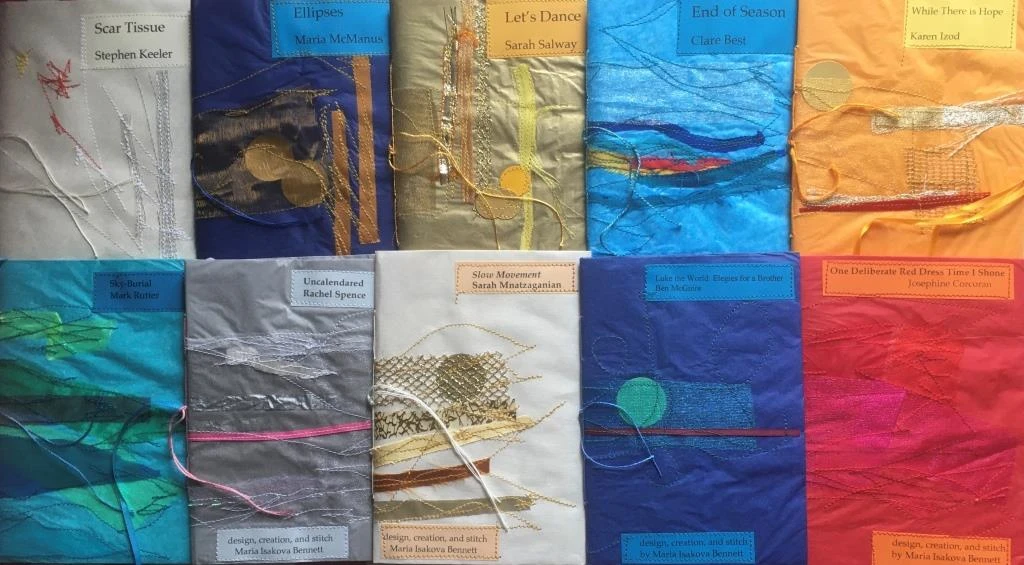
A previous article in the Honest Ulsterman, published in October 2020, was an opportunity to survey the development of Coast to Coast to Coast from the launch of the first journals in Summer 2017 to an exhibition and collaborative journal, mira, with poet John Glenday at StAnza in March 2020. The journey had set out as a belief in the importance of physical books. I created a series of unique stitched journals as art objects, bringing poets together between hand-stitched covers. Toward the end of that period, individual poet journals and single poet collaborations had begun to emerge as an important part of the project.
Personally, and with regards to my writing and creative practice, living through the past four years has been unpredictable and marked by the disappointments of deferral. Today, looking back on what has happened since that first autumn of the pandemic, the ways in which our social and creative worlds have been totally transformed loom large. As I set out to write this second chapter of the Coast to Coast to Coast story, what initially appeared as a time of delays and frustrations came into focus as a sharpening of the project’s essence.
Expectations for the world to resume as it had been drove us all on in the short term. But, after one lockdown became a second, we lived through a collective resignation that things might not ever return to how they had once been. Across creative and poetry worlds, this meant an adjustment to online meetings, an approach that was needed to sustain connections. I used these myself: participating in festivals, holding Stanza meetings and teaching. It was apparent for Coast to Coast to Coast though that any pivot from offline to on, from paper to screen, from in-person gatherings to Zoom, would in effect be the birth of a different project entirely. At times this felt like a sad resignation, the sense that what had been gathering momentum and growing had entered a period of decline where activities were reduced.
From a place of hindsight, I have been able to appreciate that Coast to Coast to Coast’s essence has emerged clearly. Throughout, it has been guided by an intuitive sense of what the project has been and what it wants to be. Strands of the project have continued to develop organically. Here, late summer 2024, seven years after that first launch in 2017, I reflect on what this evolution has allowed me to understand about the intent of the project, and how the unexpected or undesired – delays, shutdowns, deferrals – have allowed the organic creative process to emerge with more definition and potency.
Each short vignette below is titled for a quality that has become apparent as the essence of Coast to Coast to Coast.
PLACE
The poet and artist Etel Adnan said, to look at the sea is to become what one is, a sentiment that expresses much of my own relation to the sea. In its essence, Coast to Coast to Coast was born of this love of the coast, and an appreciation of its outward-looking, expansive hope for connection.
These feelings drove the Writing at the Coast Collaboratives. This strand of Coast to Coast to Coast has occurred three times: twice prior to the pandemic for Poetry in Aldeburgh (Aldeburgh Collaborative, 2018; 48 Poets Write at the Coast, 2019), and once during the pandemic for Poetry Day Ireland, 2020. Though digital technologies provide ways of connecting remotely, I wanted to instigate a form of ‘writing-together’ that was not bound to or through the screen, and which was attentive to each writer’s own experience of place. The idea was simple: interested poets were sent a prompt, which they were to take to a place near the sea/ a river, as close as possible to a specified time, to draft a piece of writing. For the first and third iteration, collaborators then selected and shared two lines which they felt were the essence of their experience, titling them with the place, date and exact time. While the prompt was to take people to the coast and encourage presence there, it also created a shared experience in time, uniting participants across disparate locations in a collective moment of creation.
It was only upon receiving the lines that a rhythm for the collective work began to emerge. The repetitions of month and time, as well as the incidental iterations of coastal words – bay, head, quay, harbour – suggested a musicality that guided the form of the work we had written as a collective, but working separately and remotely. Together, it became a litany that moved geographically, tracing the line of the coast, creating a community of poets writing near to the sea, together but apart.
Concertina Journal Reading of litany
PRESENCE AND TIME
While the Writing at the Coast Collaboratives aimed to instigate moments of focus and presence for each writer, creating a shared experience of distinct places across distances, the physical journals themselves serve as another means of fostering presence and intentional engagement with poetry. One of the first motivators of Coast to Coast to Coast was the intention to create a publication where each copy was an art object, with the size reminiscent of that of a prayer missal. The hope was to instigate a distinct, focused experience reading and revisiting a small volume of poems. I hoped readers would be encouraged to dedicate time due to the tactile quality and the preciousness of the object itself, in the same way I had dedicated time to making each.
The first years focused on open calls which brought poets together between hand-stitched covers. In some small way, I wanted to foster a sense of community in a world of writing that can feel, once a writer moves beyond the first years of writing, overly competitive, isolating and fast-paced. The time spent creating the covers was a way to honour the creation of each poem. I also wanted to inspire a sense of togetherness between poets that perhaps had not connected with each other previously, including between myself and the poets who were contained between the covers.
Recently, through the natural evolution of the project, impetus has shifted almost entirely to individual poet journals. Since the pandemic, Coast to Coast to Coast has created 10 such journals for poets: Clare Best, Josephine Corcoran, Karen Izod, Stephen Keeler, Ben McGuire, Maria McManus, Sarah Mnatzanigan, Mark Rutter, Sarah Salway, and Rachel Spence, underscoring the centrality of presence and time in the creative process. The competitions invite entries comprising just 12 pages of poems, each page no more than 24 lines – a precise and concise body of work. I think of this as a distilled potency and hope poets and readers are able to appreciate the different kinds of time that can be found in writing, reading and making. For me, this shift has created a greater space of resonance, allowing me to abstract and respond to the themes and ideas in the poems through the creation of the covers.
TRANSLATION [poems to stitched covers]
The covers are never intended to be representative or figurative depictions of the contents of the poems. Instead, there is a close-reading process, where lines, as stitch, but similar to drawing, and colour considerations emerge – a process in which a visual representation transforms a linguistic representation (a form of reverse ekphrasis). I see the artworks as a translation of an essence, gleaning themes and emotions and bringing them into a visual form. It is my hope that the covers, textured with materials and stitch, heighten this sense of translation and transformation and say something of the time spent in creation which mirrors time for the writer in creating the poems.
Unlike traditional illustration, which might depict specific imagery from a poem, my undertaking of this ekphrastic translation aims to capture intangible essences latent within the work. Much like the process of reading, these are impressions that emerge and shift, and which are abstract. Often poets have told me though that their covers reveal much of some aspect of the poetry, and this a pleasing outcome. Just as a poem leaves an emotion for the listener/ reader/ poet, it’s good to know that the stitched covers can do the same. I feel a sense of achievement when a writer says something along the lines of the following in relation to a cover I created linked to a place I have never visited but knew only through the work of the poet, It repeatedly strikes me how redolent of Morgan Bay the shapes and colours are, and I think people in Maine will assume that you based them on observation of the place...
CONCLUSION and FUTURE of Coast to Coast to Coast journals:
The qualities I’ve needed throughout the past seven years and which I’ll need for the years to come are faith in the project to change, transform, metamorphose for the best creatively; and an awareness of the delicate balance between planning and the ability to embrace something almost alchemical. This is important because I don’t want the journals to have a sense of being mass-produced. If there is a direction, I want to use less rather than more in their creation. I know a few lines of stitch can express the essence of a sequence of poems as much as a detailed collage. These are challenges I set myself as a writer and artist.
Notes and links
Ten individual poet journals mentioned: Coast to Coast to Coast Individual Poet J
2020
Clare Best: End of Season
An elegy for a place of solace and peace and for a loved one inspired by Cannero Riviera, on the northern shore of Lago Maggiore
Stephen Keeler: Scar Tissue
A portfolio of poems dedicated to the life of his late wife, an elegy for love and of place
https://www.scottishpoetrylibrary.org.uk/poet/stephen-keeler/
https://ninepens.co.uk/2022-poets/stephen-keeler
Maria McManus: Ellipses
Inspired by the Armagh Observatory and dedicated to Astrophysicist Dame Jocelyn Bell Burnell
Poems that cause a looking out and up from the self and the present
https://mariamcmanus.wordpress.com/about/
Sarah Salway: Let’s Dance
A sequence of haiku prefaced and shot through with encouragement: let’s dance/ until our hearts/ remember the steps
2021
Karen Izod: While there is Hope
Poems relating to time and its passage, they explore hope: what we hold on to and how long we can hold out before giving up or becoming subject to feelings of despair
https://www.karenizod.com/still-here/
Mark Rutter: Sky Burial
Poems of place created from a series of journals which record experience living in Morgan Bay, Maine between 1990 and 2002
2022/3
Josephine Corcoran: One deliberate Red Dress time I shone
Poems that engage with relationships with fabric and clothing, and art by Pauline Boty and Louise Bourgeois
Ben McGuire: Luke the world: elegies for a brother
A journal of poems of grief and growth from the years after loss of a brother
Sarah Mnatzaganian: Slow movement
A sensuous sequence of love poems expressed through the colours, sounds, materials, and obsessions of cello making and sailing
https://sarahmnatzaganian.co.uk
Rachel Spence: Uncalendared
A sequence of haiku as both observations of change and transformation, and testimony to a long life and its passing as something natural and beautiful even as it encodes loss
https://humag.co/features/rachel-spence

Maria, an artist, writer and editor from Liverpool, has a Peggy Poole Award from The Poetry Society and Vona Groarke; a New North Poet Award (Judge, Clare Pollard); and has won and been placed in several international competitions. Writer-in-Residence teaching for Mersey Care, NHS, Maria founded and makes the hand-stitched poetry journal, Coast to Coast to Coast creating collaborative work with writers in the UK and Ireland. Maria has five pamphlets and an exhibition and journal, mira, with John Glenday, her latest pamphlets are an o an x and Painting the Mersey in 17 Canvases (Hazel Press, 2023 and 2022)
More work by Maria Isakova Bennett


Tel: 028 7126 6946
Email: hueditor@theverbal.co
Verbal, Stable Lane and Mall Wall, Bishop Street Within, Derry/Londonderry, BT48 6PU
 company
Copyright © 2026 Honest Ulsterman