


In Irish Culture
There are many stories surrounding the man—or the men—we know as Saint Valentine, the patron saint of lovers (amongst other things). While popular culture would have Valentine secretly performing forbidden marriages during the reign of the Roman Emperor Claudius Gothicus in 269-270 A.D, recent scholarship tells us this did not happen. This romantic fallacy comes from Mediaeval myths and we have the twelfth-century English poet Geoffrey Chaucer to thank for the idea that Saint Valentine’s Day is a day for love birds (quite literally; it comes from a poem called ‘The Parlement of Foules’).
Like all the best romances, the myth of Saint Valentine seems to have sprung up around a couple of charismatic figures, a little bit of fantasy, some good storytelling and a sprinkling of the allure of the illicit. Forbidden love is universally captivating, from Pyramus and Thisbe to Leyli & Majnun, from the 'Butterfly lovers' of Liang Shanbo & Zhu Yingtai to Romeo & Juliet. Ireland, too, has its own tradition of such romances, often love triangles or triantán an ghrá: Deirdre & Naoise, Diarmuid & Gráinne or Tristan & Isolde are all obvious examples. Frederic William Burton’s painting of doomed Danish lovers, forbidden to marry by Helellil’s parents, ‘The Meeting On The Turret Stairs’ (1864), is Ireland’s favourite painting.
If Ireland’s favourite painting is that of a couple locked in an embrace, should we assume that the Irish are especially romantic? We do have our own little piece of Saint Valentine, after all; there’s a relic in Dublin’s Whitefriar Street Church. Or is it the taboo element to Helellil and Hildebrand’s love story that appeals to us?
Housed alongside Burton’s painting in the National Gallery of Ireland is another masterly nineteenth-century painting of a Mediaeval couple: Daniel Maclise’s ‘The Marriage of Strongbow and Aoife’ (1854). While this union had been arranged, not prohibited, by the bride’s father, this vision of a twelfth-century wedding is remarkable because such marriages, between ‘Irish’ and ‘English’ (technically, Strongbow was Anglo-Norman), would be criminalised in the fourteenth century. In 1366, the ‘Statutes of Kilkenny’ made such unions illegal. In the coming centuries, after the Reformation, further legislation would be put in place to criminalise marriages between those from the Church of Ireland, or Anglicans, and Catholics or ‘Dissenters’. For those seeking a ‘mixed marriage’ the course of true love seldom ran smooth.
Following the Cromwellian conquest of Ireland (1649-53), and again after the Williamite War (1689-91), a series of penal laws were introduced in Ireland which were designed to discriminate against, and oppress, Catholics and Protestant Dissenters. The aim of these was to to force acceptance of the established Church of Ireland. Even love did not escape regulation under these penal laws. Intermarriage between Protestants and Catholics was prohibited and involvement in such a marriage could lead to loss of inheritance or status. Later, the Marriage Act (1725) forbade all marriages carried out by ‘degraded clergy’ and ‘popish priests’; some priests lost their lives for daring to carry out the forbidden nuptials. Other laws of the period made it illegal for priests to perform ‘mixed marriages’ between a Catholic and a person from one of the Protestant denominations.
Couples who wanted a ‘mixed’ marriage faced further obstacles, as the civil laws of the time often clashed with those of the Catholic Church. The Catholic Church would only view marriages performed by one of their priests as valid. This placed any Catholic who wanted to marry a Protestant in a difficult position, whereby they could choose a marriage acceptable to the Church but forbidden by civil law, or a marriage prohibited under civil law but which the Church could accept. The double bind undoubtedly discouraged the Irish population from pursuing mixed relationships.
Despite these legislative deterrents, we know mixed marriages continued to happen. One of the most horrifying stories of mixed marriage is the so-called ‘Colleen Bawn’ murder of the early nineteenth century. Born in 1903, Catholic Ellen Hanley secretly eloped with Protestant Anglo-Irish John Scanlan in 1819. When Scanlan’s sister found him a more “suitable” bride, Scanlan had Hanley murdered. Scanlan was represented by Daniel O’Connell—‘The Liberator’—and it was thought his wealth and status might save him from the gallows. It did not. Both Scanlan and the servant who had helped kill Hanley were found guilty of her murder. Both were executed. The shocking case inspired Gerald Griffin’s novel The Collegians (1829) & Dion Boucicault’s play Colleen Bawn (1860), although the ‘mixed’ element of the relationship did not make it into Boucicault’s drama.
Various mixed marriages also found themselves at the centre of controversial court cases, often accompanied by a media circus and wildly sensationalised press coverage. The notorious Yelverton Affair of 1861 centred around the claim that the Catholic marriage of an English Catholic woman to an Irish Protestant man was not valid. In Ireland, countrywide media coverage painted Mrs Yelverton as a wronged woman, a victim of the despised landlord class. The Irish courts ruled in her favour but later the English Parliament would declare their union invalid. More positively, however, the case would lead to change in Irish legislation and the acceptance finally of a mixed marriage carried out by a Catholic priest.
Even after these legal changes, mixed couples still had challenges to face. Catholic Church regulation of these unions continued to be strict. The passing of the ‘Ne Temere’ decree in 1908 posed particular challenges. The decree required a dispensation from the Catholic Church to allow a mixed marriage to take place and couples were usually stipulated to marry in a Catholic ceremony and to promise that any children born to the marriage would be raised Catholic.
The consequences of this decree were significant and far-reaching. The potentially devastating effects of this new decree are perhaps epitomised in the infamous McCann case of 1910. Catholic Alexander McCann had married Protestant Agnes McCann in a Presbyterian Church in 1908. The couple initially enjoyed a happy marriage, settling in Belfast and having two children. But Alexander’s priest declared the couple’s marriage invalid and insisted that they must remarry in a Catholic ceremony. Agnes refused. Alexander took their children away and, tragically, Agnes never saw her family again. The story of a Protestant woman’s heartbreak, perceived to be at the hands of the Catholic church, united the various Protestant denominations and was used as propaganda in the anti-Home Rule campaign.
Amidst the turmoil and upheaval of the early twentieth century, several key political figures were either the children of mixed marriage, like Pádraig Pearse or Roger Casement, or were themselves in mixed marriages. James Connolly and Lillie Reynolds, Thomas MacDonagh and Muriel Gifford, Winnifred Carney and George McBride, and tragic Joseph Plunkett and Grace Gifford were all in mixed marriages. These were figures who fought for a different Ireland, often propelled forward by radical politics, even if their liberal tolerance would not characterise either of the two states created after Partition took effect in 1921.
Many of the stories of mixed marriage that we know about today are preserved because they involved famous individuals or because they left archival traces in national collections, museums and historical records. Unsurprisingly, these records tend to focus on cases that generated interest and left a paper trail such as legal documents or newspaper articles. Archives can never tell us the complete story. There are always gaps, omissions, silences. And we have to remember that archives are created through a series of decisions. Someone is responsible for asking: what is worth keeping and what will be destroyed?
If we know relatively little about the everyday realities and practicalities of mixed marriage, we could turn to literature. Although many novels, in that time-honoured romantic tradition, end with a wedding—just as the real love story is about to begin—there are a few that give us details about the texture of married life. The late Eugene McCabe’s novel, Death and Nightingales (1992), is haunted by a bitterly miserable mixed marriage and the memories of these violent arguments torment Beth, the novel’s main character, into adulthood. By contrast, Joan Lingard’s Across the Barricades (1970-1976) quintet, the mixed marriage itself between Belfast teeangers Kevin and Sadie is largely a happy one, even if some of the difficulties surrounding this union cause problems.
So what was life like for real couples living everyday with a mixed marriage in Ireland? We can presume that life was different for a mixed couple in Derry in the 1970s compared to Dublin in the 1940s but how and in what ways? The Belfast-based charity, the Northern Ireland Mixed Marriage Association (NIMMA), founded in 1974, has been a source of support, advice and resources for those involved in mixed marriages across the island. And, of course, a ‘mixed marriage’ can mean many things; there are many forms of mixed relationships to be found in Ireland beyond the familiar Catholic/Protestant or Nationalist/Unionist. Ireland has always been a diverse society and is so now more than ever.
We are two researchers at Queen’s University Belfast undertaking a multi-year study looking at the phenomenon of mixed marriage, and mixed relationships, across the island of Ireland. We want to know what experiences of mixed marriage and mixed relationships—broadly understood—have been like. We know that the history of mixed marriage is much richer than these limited paper sources tell us. We know this from the tantalising glimpses we get from history and from the people we talk to in taxis, cafes and hairdressers.
It seems like nearly everyone on this island, and in its diaspora, has a story about mixed marriage. If this is you, and you would like to share your story, we’d be absolutely delighted to hear from you. This includes people whose parents or family members might have been in a mixed relationship; we’d love to know more about family experiences. We’d also be keen to hear from people who may have previously been in a mixed marriage or relationship. It’s time to dispel some of the myths surrounding these love stories and get to the heart of the matter.
Ruth Coon is currently a Research Fellow in the School of Arts, English, and Languages at Queen’s University Belfast. Ruth is a historian of medical and oral history. Her expertise lies in modern British and Irish history: the Troubles, medicine, Irish society and culture. She particularly focuses on using oral history as a method to uncover hidden or sensitive histories. She received her PhD, which focused on the experiences of the health service during the Northern Ireland Troubles, in 2021. Her first monograph, based on her PhD research, is under contract with Liverpool University Press. She recently wrote ‘How Northern Ireland's doctors and nurses coped with the Troubles’ for RTÉ Brainstorm. You can follow Ruth on Twitter here.
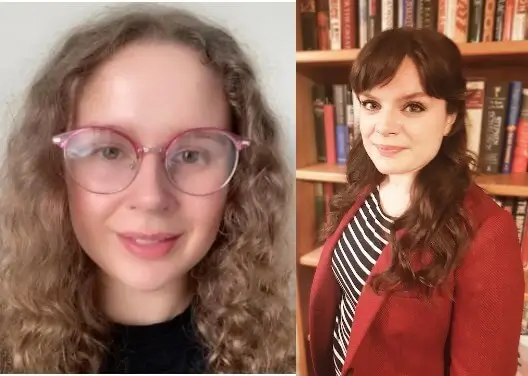
Alison Garden is a writer and critic based at Queen’s University Belfast. Her criticism, essays, reviews and interviews have been published in TIME, Aeon, Al Jazeera, The Irish Times, RTÉ and elsewhere. Her first book, The Literary Afterlives of Roger Casement, 1899-2016, was published in 2020 and she is writing her second book, a study of love during the Northern conflict. You can follow Alison on Twitter here.
More work by Ruth Coon / Alison Garden


Tel: 028 7126 6946
Email: hueditor@theverbal.co
Verbal, Stable Lane and Mall Wall, Bishop Street Within, Derry/Londonderry, BT48 6PU
 company
Copyright © 2026 Honest Ulsterman