


I’ve resigned myself to the fact that I will never be rich, never be what people call a successful man like my manager, Andrew Farrington. It doesn’t really bother me. There are other compensations, and one of those is to take a certain amount of pride in the work I do. Certain people think Civil Servants are lazy and over paid – and to be honest I have known some who have spent their days watching the clock – but in the main we are a diligent bunch who do important work under difficult circumstances without much thanks.
The department in which I work is constantly in the news and never for good reasons. Some of my more senior colleagues have developed the harried expressions of hunted animals in recent years. We started out young with ideas of career progressions that would see us end our days heading up departments or running divisions, retiring into a golden age of respectable ease. Perhaps an appointment to the board of one or more state bodies might be the only interruption to our leisure after a lifetime of service.
But the reality has been quite different. Here I sit, mid-career, at a tiny desk loaded with files in the middle of an anonymous open plan office in an ugly building in the centre of town. But I don’t complain. My role is clear. I have found my level and it is very much in the middle of things; I possess little power and therefore have little responsibility. Others carry that burden, those with more ability, more ambition, those who are not afraid to lead. People like my boss, Andrew.
Andrew is younger than me and for that reason I resented him when he first came to the department. That and the fact that he came from the private sector. But over time I grew to admire his professional manner, his enduring positivity in the face of repeated crises and his ability to deal with the Secretary General with just the right amount of arrogance sprinkled with deference. I remember feeling a strange sense of pride when I saw him on the TV news among a group of suited men advising the minister at one of the Public Accounts Committee meetings.
When he arrived, the rumour was that he had recently separated from his wife, but he gave no signs of his private trials impacting negatively on his professional responsibilities. In fact, he lost no time in seeking a replacement from among the departmental staff. Julia was a close friend of mine, had been for years. We went for coffee together most mornings and lunchtimes we would share a table in the canteen with other colleagues. She’d always been unlucky in her relationships, and I think we bonded because she saw in me a kindred spirit; we both still lived at home with ageing mothers. Once or twice new staff would assume we were an item, but she would always set the record straight for them. I didn’t mind. I knew the rumours that circulated about me, but I never fed those rumours in my words or actions. I have a reputation for being what my parents’ generation would have called a “cold fish”. I don’t do relationships. Considered something of a social failure, I am deemed to pose no threat to male or female, and as a result some people feel inclined to take me into their confidence.
At first all seemed well in the new relationship, and Julia appeared to be happy. I was pleased for her. Despite what Monks and others like him on the third floor might have said behind my back, I wished her only good things; she was my closest friend after all. It was only when she and Andrew bought a house together that I began to notice changes in her or, more precisely, in how she treated me. Small things at first. She began to have lunch with Andrew which was not surprising in the honeymoon days of their affair, but she was often unavailable to go for coffee in the morning, claiming she had too much to do. Maybe later, she would say, even though she knew that later was impossible for me. I always go for coffee at the same time every day.
Andrew, who had been a distant – if admired – figure for the general staff, began to engage me in conversation from time to time. Trifling stuff at first: the weather, the traffic, inconsequential things like that, but I took some pleasure in how my colleagues noticed the attention he gave me. Soon he began to call me into his office, a place I’d never set foot in before. He told me how highly Julia had spoken of me and thanked me for being such a good friend to her. I was polite of course, nodding, saying all the right things, accepting his praise in a dignified manner without saying much. I wasn’t sure what was happening, but I sensed that it was important.
I tried to talk to Julia at her desk one day, but she was evasive, almost to the point of being rude. Anytime I tried to chat with her there was always something to be done, emails to be sent, phone calls to be answered. I grew impatient. The next time Andrew called me in to his office I determined to question him about her. He was his usual smiling self and I was curious as to how he remained relaxed, unchanged, while Julia had so obviously withdrawn into herself since their relationship started. He told me he had plans for me, a project coming up for which he needed a team leader who would report directly to him. The success of the project was crucial to delivery of services in the department and the Secretary General himself was hugely invested in it. Was I interested? Of course I was.
It meant I got to move out of the open plan and into a partitioned office at the end of the floor. All six of my new team would be located close by. I was to attend a Management Development training course the following week and then the project would begin. The project required me to coordinate the collation of all paper records and the digitisation of old files in a comprehensive manner that would allow swift file retrieval. I had a small budget and Andrew, as my mentor, would be available to me as a source of advice and a general support in the project. The success of the project would, after all, reflect well on both of us and on the department.
Suddenly I was filled with a sense of possibility that I hadn’t felt in years. I couldn’t wait to tell someone so I sought out Monks; I knew I could rely on him to spread the word throughout the building. It was only hours later, dreaming idly at my desk, that I thought of Julia and felt guilty. When I told her she didn’t seem as excited for me as I expected her to be. I asked her if everything was going okay with Andrew, but she evaded the question and hurried back to her desk. Perhaps I should ask Andrew to make her part of my team, I thought; that way we’d get to see much more of each other while we were working on the project. But when I went back to his office that afternoon he wasn’t there – out at a meeting, his PA said.
All the following week I was out of the office at my training course. I was only slightly put off by the fact that at forty-two I was easily the oldest in the group. I also had the sense that I was the only one who didn’t know anyone else on the course. I don’t mind taking part in group exercises or role playing and I’m not afraid to speak my mind when necessary, but I found the break times tedious, not knowing who to sit with. At lunchtime the first day, after I ate the sandwiches provided, I went out for a walk to clear my head. I don’t know that part of the city very well and I must have got confused because I ended up getting lost. I had no data on my phone so couldn’t use the maps and, in the end, I had to ask a passer-by for directions. His instructions were unclear and, as a result, I was late back from lunch and they’d already started without me.
They were talking about making decisions in a time of crisis, knowing how to prioritise, identifying if something was urgent or important or both. The facilitator, Kevin, a much younger man, suddenly turned to me then. ‘What’s your take on all this, Michael?’ he asked. I wasn’t sure what he was asking. ‘Sorry?’ I said. He smiled. ‘Oh, don’t be!’ The group sniggered, and I felt my face redden in a way it hadn’t done since school days. ‘How do you define what’s urgent and what’s important?’ he asked me. I had heard of these types of questions before, of course, but now I had ten sets of eyes focused on me waiting for a response. I should have said something, talked about how time is the biggest constraint in the workplace and how we decide to prioritise our work is the most important part of our approach to our working day. Or I could have played it light; pointed out that it was his job to deliver the course, not mine. After all, what was the department paying him for if not to impart his knowledge. But I didn’t. I just sat there and shook my head quickly. After that, no one spoke to me nor I to them for the remainder of the week.
Back at work the following week, Andrew came to see me in my new office space. He called my team together and gave an impromptu motivational talk. I was only half listening. He said something about the importance of accountability, about files going missing in the past and how that couldn’t happen again. I was thinking about Eisenhower’s Decision Matrix. I never knew it was a President of the United States who dreamed up these notions of what was urgent and important. Andrew dismissed the team back to their workstations and looked me straight in the eye.
‘So how was the course? Did you learn anything?’ he asked.
‘Yeah, I learned about decision making, using the urgent and important matrix,’ I said.
He looked at me, smiling, nodding his head slowly. ‘Good stuff!’ was all he said.
I called him back just as he was about to leave.
‘Perhaps Julia could join the team?’ I asked. ‘It would be good for her to be working on a project like this.’
Andrew smiled. ‘No,’ he said. ‘I can’t be seen to favour her over the others. And anyway, she’s moving to another division on the other side of the city. She’s been looking for a move for a while now. Didn’t she tell you?’
I shook my head, but he had already left. All the hope I felt in recent weeks had gone again. I felt sorry for myself, just like a child. I knew that Julia wasn’t happy, but I didn’t know what I could do about it, so I did nothing. I didn’t want the project anymore. I never did. I knew that Andrew had played me for the fool I am. I wished I had a proper office, one with a ceiling and a door that I could lock and blinds that I could pull. I would unplug the computer and the phone and sit at my desk doodling on a note pad, waiting for the clock to point to five so I could leave.
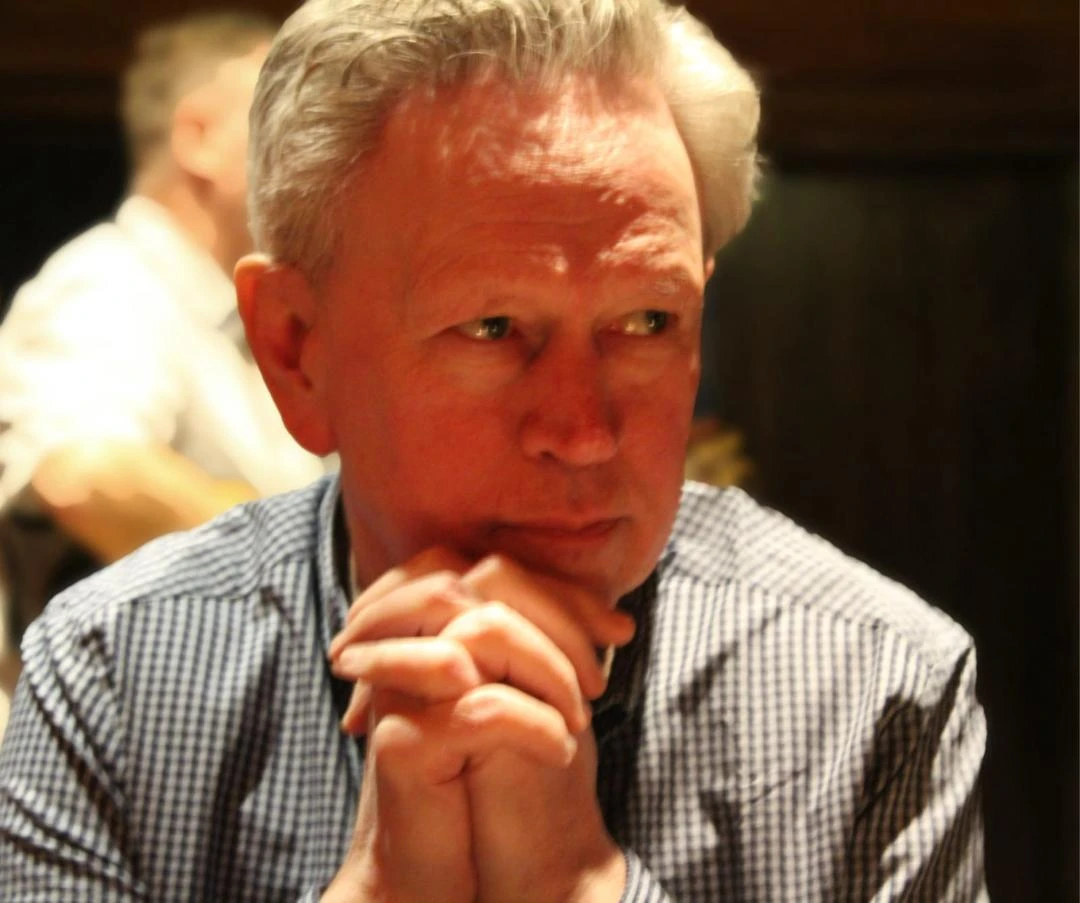
Brian Kirk has published two poetry collections with Salmon Poetry, After The Fall (2017) and Hare’s Breath (2023) and a fiction chapbook It’s Not Me It’s You (Southword Editions, 2019). His novel Riverrun was a winner of the Novel Fair 2022.
More work by Brian Kirk


Tel: 028 7126 6946
Email: hueditor@theverbal.co
Verbal, Stable Lane and Mall Wall, Bishop Street Within, Derry/Londonderry, BT48 6PU
 company
Copyright © 2026 Honest Ulsterman