


The land is flat and desolate. Rows of barren fields flash past my window. I search the overcast sky for birds, but nothing stirs in the grey void. We roar across the motorway, Pan Szymek with one hand resting on the wheel, a cigarette dangling from the other. Drew sits in the passenger seat and I’m in the back with his guitar case. It’s half-two in the afternoon. We’re on our way to teach in the satellite school in Barcin.
‘What a view,’ Drew says, pressing his face against the window like we’re headed to Disneyland.
I almost laugh, then realise he’s serious. ‘Stunning,’ I say.
Drew is the other newbie, fresh off CELTA like me. He’s from the States. He reeks of positivity and good intentions. I hate him for it. This is not the place for that nonsense. While I feel like I’m languishing, sinking deeper into a dark depression, everything in Poland is a ‘hoot’ to him – the landscape, the food, the people, even this journey. It winds me right up. He incorporates music into his lessons, often treating his students to acoustic sets whether they like it or not. He was lead guitarist of a folk-rock band called The Pencil Pushers back in Kansas City, as he likes to remind me.
The smoke from Pan Szymek’s cigarette keeps drifting back to me. His mixed tape is playing Werewolves of London by Warren Zevon for the umpteenth time since we started teaching in Barcin. The drive takes fifty minutes, though it feels twice as long.
Drew’s head twists around the headrest and he starts talking at me.
‘How you doing back there, Nicky?’ he says.
‘Just tremendous.’
‘What a hoot,’ Drew says. ‘You’re always so full of beans!’ He throws back his head and erupts.
I glance at Pan Szymek in the rearview mirror. A smile flickers across his pale eyes. People say he doesn’t understand a word of English, but I’m not so sure. He takes another drag from his cigarette and slowly exhales. I make a move to unwind my window, but he utters, ‘Nye’ in a toneless voice and I slump back into my seat. A quick word on our driver. He’s the director’s cousin and right-hand man. In his mid-fifties. He drives like a lunatic, as if he can’t wait to be rid of us and get on with his day. His knuckles are raw red. His greying hair is closely cropped. He keeps a roll of toilet paper and a torch stashed in the side compartment in case he’s ever caught short. He’s often the talk of the staffroom. Szymek has a reputation throughout the voivodeship as a bit of a player. People say he likes to woo women with his impeccable taste in music, playing for them his various mixed tapes. Though he’s never been married, rumour has it he is father to seven children, all from different women. Mr Zevon has no doubt played his part over the years. The thought disturbs me.
Pan Szymek takes the turn-off to Barcin. With the first sight of the church steeple, I shudder and a cold sweat runs down my back. Dark clouds gather in clusters around the spire. On a side road a man leans against his dusty Honda, baskets of radishes sitting on the roof. He watches us pass with vacant eyes. Szymek finally rolls down his window and tosses out his butt. I can breathe.
He drops us off at the school entrance without a word, then reverses and guns it out of the car park. The air outside is thick with pollution. I try not to breathe it in, but as we make our way to the door I feel it entering my lungs and clogging my insides. Drew leads the way inside, head raised high, his guitar strapped over his shoulder. His students are waiting for him outside his classroom. They cheer when he appears round the corner. A different kind of racket explodes from my classroom, further along the corridor.
I step into a world of chaos. The air is cloudy with chalk, juice bottles lie all over the floor, desks are turned over, as if the FBI has just raided the place, and most of the students are sitting in the corner playing a game of Snap! Two boys are arm wrestling, a few onlookers hovering around their table wagering sweets and chocolates. For a moment they all stop what they’re doing when they notice me enter. Then they start up again. There’s a dark juice puddle in the centre of the room. One boy, Arkadiusz, gets down on all fours and blows hard so the puddle expands.
I set up my things, some more students storm in, and then I try to begin the lesson, teach them some damn adverbs of frequency.
Nobody listens to a word I say. They talk when I talk, they stay silent when they are meant to talk. I write on the chalkboard using whatever chalk they haven’t already broken into tiny stubs. My fingers grow numb as I scrape the ends against the board. The sound makes my skin crawl. Meanwhile, the puddle flows gently through the classroom like a polluted river.
Sweet music drifts across to us from next door. My students fall silent. Drew’s angelic voice soars through the entire building, accompanied by gentle strumming and his students singing in broken English. The sound they make has a strange hopeful quality to it, tinged with sorrow. I feel myself welling up.
One girl lifts out of her chair and gravitates towards the door, like she’s possessed by the music.
‘Stay away from the door, Tosia,’ I say, my voice cracking.
I turn away from the kids and try to compose myself.
At break time I do my usual thing and stand and stare out the window at the empty playground wondering how my life got to this point. The kids all go out to the corridor and mingle with Drew’s class. Outside the light is fading, the swings and slides casting disfigured shadows on the tarmac.
When the lesson restarts, the children seem more subdued, no doubt feeling that sugar crash. I seem to have their attention, and for five minutes they are engaged, telling me how they Never do their homework. It’s the only sentence they get right. I say that’s good, but also bad. Some of them laugh, and the atmosphere lightens. But when I turn my back someone hurls a piece of chalk and it hits my shoulder, breaking into tiny pieces on the floor. I swivel round and they snigger into their sleeves. I feel my face flush. I line my students up against the wall and interrogate them one-by-one to find the culprit, my voice shaking. Nobody steps forward. They are only eight years old. My main suspect, a chubby-faced boy called Olek, grins up at me through ink-stained teeth. Then the class ends and they flood out of the room without saying goodbye. I look down at my trousers covered in chalk. I go over to the small sink in the corner of the room and wash my hands, trying to get the stuff out from under my nails. I then gather up my things, leaving the room just as I found it. I can feel the impatient eyes of the cleaner on me as she waits in the doorway.
I meet Drew at the entrance.
‘How was it then?’ I say.
‘Incredible,’ he says. ‘When you see all those little faces light up, there’s no better feeling in the world. That’s the power of music.’
‘And did you teach them anything useful?’ I say. ‘Maybe from the coursebook?’
Drew waves the idea away. ‘There’s more to teaching than following a book, Nicky,’ he says. ‘And how was your lesson?’
‘Oh great,’ I say. ‘I can see a real improvement.’
‘Isn’t it wonderful?’ Drew says. ‘Making such a difference in young lives?’
I don’t say anything.
There’s no sign of Pan Szymek’s black Volkswagen in the car park. All the children have been picked up. We stand around ten minutes in the freezing cold, holding our boxes full of materials. Darkness closes in around us.
‘You think he’s forgotten us?’ Drew says.
‘Looks like it.’
‘What do we do?’
The cleaner locks up and says, ‘Dobranoc,’ on the way to her car.
‘Dobranoc, Agata,’ Drew says.
We both watch her reverse out of the car park and disappear into the night.
Twenty minutes later, it’s still just the two of us. We decide to set off in the direction of the town centre in search of the nearest bus stop. The streets are empty. Our heavy breaths escape in white puffs as we hurry along the pavement. Just off the square we find a rotting shed with a timetable pinned to the wall. The last bus for the city left an hour ago.
‘I don’t believe this,’ I say.
‘It’s going to be fine,’ Drew says.
‘Just how is it going to be fine?’ I say. ‘Please explain to me, Drew. We’re stuck in the middle of nowhere with no way of getting back.’
‘Maybe phone the director?’ Drew says.
I try the director but it goes straight to voicemail.
There’s nothing else to do but keep warm so we shuffle into a grimy-looking pub in the square. The air inside is stale and oppressive. Two bald men are slouched in the corner talking in low voices. An old mangy dog snoozes in the corner. We sit down at the bar and order two beers. The men look up, startled to hear English spoken in this place. The sour-faced female bartender slams our bottles down on the sticky bar. She looks like she’s sucking a gobstopper.
‘Dzięki,’ Drew says.
We each take a long pull. The beer is bitter. Something about Polish beer crushes my spirit, and a shadowy weight descends upon me. Drew takes in the smelly pub with wide eyes.
‘She’s gorgeous,’ Drew says, indicating the bartender with a nod of his head.
‘She’d be alright if she lost the scowl,’ I say.
We order more beer. Drew chats up the bartender and finds out her name is Olga. I call the director again, but get the same result. When I put my phone back in my pocket, I feel a sudden aching need for Drew to share in my misery.
‘So Drew, is this what you expected when you came to Poland?’ I say.
‘It’s eclipsed my expectations,’ Drew says.
I stare at him. ‘Oh really?’ I say. ‘In what way, exactly? Is it the grey skies that appeal to you so much? Or the bland food? Or maybe it’s the long hours and low pay? The miserable, unsmiling people, perhaps? Or what about this ridiculous jaywalking law, having to stand waiting like an idiot even though there’s not a single car on the road.’
‘You focus too much on the negativos,’ Drew says.
‘When there’s no positivos, what else can I do?’
He laughs and so do I. I take a quick drink then tap him on the shoulder.
‘What about that filthy dog over there,’ I say, pointing at the wretched mutt. ‘Disgusting, right? Could do with being put out of its misery, don’t you think?’
‘How can you say that? All dogs are beautiful.’
Around the time Drew says this, a strange feeling comes over me. I watch Olga glowering at us from behind the bar. Then I’m looking down at myself from a spot on the ceiling. I appear tiny sitting down there. No more than a splinter on the bar, or a speck of dust. Totally insignificant. Just like my life. The sensation quickly falls away, and here I am again sitting next to a man I can’t stand. He is gabbing away but I cut him off.
‘Why can’t you just say things as they are?’ I say. ‘Nothing about this experience is good. Why you have to be so positive all the time?
Drew holds his hand up like he’s under arrest. ‘That’s just me,’ he says.
‘Well you don’t have a clue,’ I say. ‘We’re languishing here. Absolutely languishing.’
I wiggle my fingers at Olga to get her attention.
‘Piwo,’ I say.
She looks at me with pure hatred in her eyes.
We pick up our boxes and stagger outside ready to try the car park again. On the way back we nip into a corner shop, crossing the quiet road when the pedestrian lights are red. We buy hot dogs drowning in mustard and sit down on a bench facing away from the shop. For a brief moment I wonder if it’s wise to eat this lumpy blood bogey, or if it’ll give me explosive diarrhoea. But I’m too hungry to care and wolf it down. I notice Drew hasn’t touched his yet. He stares at his hot dog then bursts into tears.
About time, I think. Barcin has finally got to him.
‘What’s wrong?’
‘What am I doing with my life?’ Drew says.
I pat him on the shoulder. ‘There there.’
Sirens flash in the dark street. A police car pulls up outside the shop. We both look up.
Two officers jump out the car and approach us, guns holstered. They stare at our boxes sat on the curb, full of folders, textbooks and markers. Then one slaps the hot dog out of Drew’s hand and it flops into a gutter. Drew jumps. They yell at us in Polish, gesticulating and pointing at the street we crossed a short while ago.
‘What’re they saying?’ Drew says.
‘How should I know?’ I say.
Drew takes out his wallet and shows them his driver’s license for some reason.
‘Nye,’ one of the officers says. He makes the universal money gesture sign, rubbing his thumb against his fingers.
‘We’re skint,’ I say.
‘Co?’
‘No MO-NEY,’ I say.
‘Kurwa,’ the other man says.
‘Can you fellas give us a ride to the city?’ Drew says. ‘We’ve been abandoned.’
They yell at us some more, then hoist us up from the armpits and throw us into the back of the police car. Drew’s head smacks against the headrest and he groans. One of them grabs his guitar and dumps it in the boot. The boxes are left behind on the edge of the cracked pavement. They drive us to the local police station, which is barely more than a small shack with a couple of windows. Inside, they confiscate our mobile phones, tossing them into a plastic tray. They then lock us up in a damp cell that stinks of shit and vomit. There’s another guy in there with us – a stocky man lying on a bench muttering to himself. A filthy toilet sits in the corner.
The minutes crawl by. Drew sits with his back against the wall, shivering. His face has turned a sheet of white, and he looks close to vomiting. A dim lightbulb hangs from the ceiling inside our cell. I peer through the bars into the shadowy corridor, hoping one of the officers comes back. After a while I get tired of standing and drop down to the cold floor beside Drew.
‘What we in here for?’ Drew says, rubbing the back of his head.
‘I think we just got done for jaywalking,’ I say.
My stomach churns. I don’t feel well at all. The hot dog might have been a mistake.
‘You reckon Pan Szymek is coming for us?’ Drew says.
I picture the man tearing away from Barcin after he dropped us off, his eyes burning behind the wheel, the terrain around him flat and unchanging, the tyres sending up clouds of dust – probably headed to see some old girlfriend.
‘Sure,’ I say. ‘I bet he’ll be here any minute now.’
A cockroach scuttles out from a crack in the wall by the bench. I watch it crawl over the muttering man’s stomach. He doesn’t notice.
‘Those cops missed one thing when they searched us,’ Drew says sometime later, pulling out a harmonica from his back pocket.
I look at the small metallic instrument glinting in his hand.
‘Check this out, Nicky. I came up with a little bitty song.’
‘Oh goodie.’
‘Gentlemen, I call this The Barcin Blues.’
He blows into the harp and the man on the bench makes a snorting sound like he’s just woken from a deep sleep. He sits up and watches. Drew sings in a low, raspy voice, almost a moan:
‘Oh Lord, I’m feelin’ mighty low
Stranded with nowhere to go
Have you heard the news?
I got them Barcin Blues
Pan Szymek disappeared like smoke,
This feels like some kind of joke
Have you heard the news?
I got them Barcin Blues
We wandered the dark streets
And not a soul did we meet
Have you heard the news?
I got them Barcin Blues
I bought a mushy hot dog
But it didn’t clear the fog
Have you heard the news?
I got them Barcin Blues
Drew belts out some more notes on his harmonica, the shrieking sounds echoing through the empty corridor. Then he stops.
The man claps once, then lays back down on the bench and gets back to his muttering.
‘Thank you very much,’ Drew says in little more than a whisper.
It feels like the moment to say something nice to keep his spirits from plummeting.
‘That was sublime,’ I say. ‘How can you just make up a song like that?’
‘You think we’ll die in here?’ Drew says.
His eyes now have a hollow look about them. They seem to have sunk deep into his skull. His lips quiver, like they’re still blowing on the little holes of the harmonica.
The two of us sit side-by-side in the dank cell for who knows how long. It could be hours, or mere minutes. Any sense of time has escaped me. I feel worn out and my stomach won’t leave me alone. My mind grows dull and heavy. At one point Drew’s head slumps against my shoulder and he starts snoring. I stare into the dark corridor and wait for the sound of footsteps.
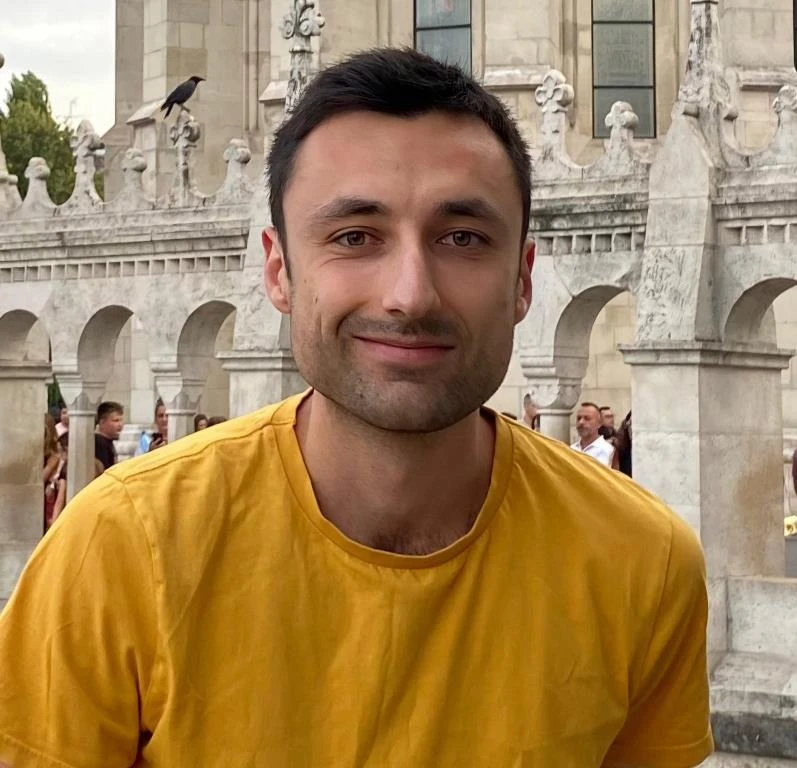
Callum McGee is a writer and English teacher from Aberdeenshire. Having previously worked in Spain and Poland, he now lives in Portugal. His short stories have appeared in Stryvling Press and Litro. He can be found on Instagram @cjamcgee97.
More work by Callum McGee


Tel: 028 7126 6946
Email: hueditor@theverbal.co
Verbal, Stable Lane and Mall Wall, Bishop Street Within, Derry/Londonderry, BT48 6PU
 company
Copyright © 2026 Honest Ulsterman