


With Others In Your Absence
The temporality of publishing often leaves a writer out of joint: you find yourself, years after having written a series of poems whilst in a certain headspace, having to think yourself back to an emotional state or intellectual groove from which you’ve since moved on. It’s not unlike being haunted, which is to say the experience of one time intruding on another.
I felt this acutely when producing my first pamphlet, Pisanki (Emma Press, 2017). I was trying to edit and, some months later, promote poems about cultural inheritance at a time when I’d been freshly bereaved. On 6 January 2017, after more than ten years of intermittent ill health, my dad had died in intensive care from post-surgical complications at the age of sixty, and wrapping my head around anything outside that loss seemed impossible, because the loss was everywhere.
I relied heavily on my friends not only for emotional support but also for backup artistic judgment at a time when I felt like I couldn’t rely on my own. They made it ok for me to cry on them in bars; to be sad in front of their children; to send them endless poems; to keep talking. They were patient while I tried to read and write my way out of grief, patient when that didn’t work, and patient while I subsequently worked things through with a qualified mental health professional instead of constantly retraumatising myself.
These days, I no longer want to talk about those days. Perversely, given the global circumstances, I’m happier than I’ve been in years: I’ve fallen in love and moved to another country; I’m comfortably out and learning how to be queer on my own terms; I’m writing out of something more than grief because there’s more to life than grief. Or perhaps I should say rather that grief is no longer the primary lens through which I experience even the most positive of emotions. After all, the poems in With others in your absence are love poems, too: poems that came out of those sustaining friendships that gave me time and space to grieve; poems which were written through the things I grew to love because of my dad.
This is another way in which I feel a little haunted thinking about these poems. In many ways, it was my dad who gave me the tools not only to navigate my way through having lost him but also to understand my own particular navigation process. For instance, the poems 'A Boat Lies Waiting' and ‘Second person singular’ are both responses to music by David Gilmour, formerly of 70s prog rock band Pink Floyd. ‘A Boat Lies Waiting’ deals with the idea that in some ways you’ve always been already mourning, and that the songs or poems or pictures that help you to elegise the dead may have already been with you for years. (In my case, a song from Pink Floyd’s 1994 album The Division Bell—whose mostly doom-laden tunes I realised I was going to have to learn to love from the age of six onwards—ended up as part of the soundtrack to dad’s memorial.) ‘Second person singular’, meanwhile, came about after my first real moment of wanting to share something banal with my dad and being unable to do so: preparing resources for a seminar on the sonnet, I had found a recording of Gilmour singing a musical setting of Shakespeare’s famous Sonnet 18 (‘Shall I compare thee to a summer’s day?’).
‘Second person singular’ touches on another of the things with which these poems are grappling: the idea of having lost one of the people towards whom I had existed my whole life. I say ‘towards’ because it is through our relationships with others that we develop as selves, and through our relationships with our parents or parent-figures that we first learn to be in the world with others in mind. When my dad died, I wanted to write therapeutic elegies for myself, but found I was unwilling to make use of the lyric ‘you’. This was partly due to my lack of belief in an afterlife and an attendant sense of the futility of addressing the dead: my dad was gone, and talking to him as though he might be able to hear seemed a cruel and unusual way of trying to attenuate absence. It was also partly due to a sense that the lyric ‘you’ had been somehow diminished or destabilised by the loss of one of the people to whom, to a greater or lesser extent, I had always been addressing my thoughts. At the time, I felt about the ‘you’ of elegy the way I sometimes feel about the ‘you’ of the early modern sonnet, which can be reduced to a way of positioning yourself in relation to a longed-for other who remains largely anonymous, and who exists mostly to facilitate the creation of a longing lyric ‘I’. And indeed Sonnet 18 concludes with a promise of immortality it can never deliver as long as the only thing we know about the beloved is that they are loved: ‘So long as men can breathe or eyes can see,/So long lives this, and this gives life to thee.’
This was something I had been addressing more fully in a project I called The Gift Shop Elegies, which was begun much earlier in the grieving process. (Parts of this have subsequently been published in The White Review and, most recently, in the Lifeboat Press anthology Queering the Green.) I found I required formal and metrical supports to hold my thoughts together, so I began to write elegiac responses to images from art postcards acquired at galleries and museums over the years. I then began to expand them with essayistic prose sections written in loose pentameter without line breaks. Only at the very end did I feel I had worked through enough to attempt a lyric elegy, though looking at it now, I notice that it is still resolutely without a lyric ‘you’.
By the time I came to write the poems that became With others in your absence, I realised my writing had changed. In Pisanki, I was writing almost exclusively short lyrics around the length of a sonnet; the first half of this new pamphlet is skewed significantly towards prose poems. The poems comprising the second half are full of a lyric ‘you’ that I reimagined for myself as a kind of aggregate or composite, containing an idea of friendship that encompassed multiple different people. It was, in effect, a second person plural masquerading as a second person singular that made sense for me to use. I don’t claim that it reads as anything other than second person singular at the level of the individual poem, but framing it like this for myself was a way I could start exploring a way of being not only with but also towards others in the knowledge of a life-altering absence. Specifically, it allowed me to write a sequence of platonic love poems in which friendship is a means of navigating a world made strange through grief.
That I was able to do this at all was thanks to another love inherited from my dad—the one he harboured for classic sci-fi time-travel series Doctor Who. Over the course of many Saturday nights in the early 2000s spent with my dad, my sister, and inadvisable quantities of jelly babies, I had gained an encyclopaedic knowledge of the first few seasons of Tom Baker’s tenure as the Doctor in particular. And in the relationship between this benevolent alien and his human best friend Sarah Jane Smith (played by the late Elisabeth Sladen), I found a vocabulary for talking about friendship in the context of suddenly finding yourself out of joint and haunted—in another time or on another world.
Given that much of the pamphlet was painful or at least difficult to produce, it is particularly important to stress that the Whovian poems were a joy to write. I was still talking about bereavement, but I was moving through a landscape of images that was familiar and therefore comforting in a way that didn’t cross the line into the uncanny. Instead of trying to express to individual friends the degree to which their support had helped me find a way through the worst parts of grief in real life, now I could simply write as a lyric I-am-not-I addressing a lyric you-are-not-you. What’s more, I was wilfully neglectful when it came to preserving the difference between the two fictional characters through whom I was writing. I would cavalierly switch perspectives where it made sense for me to do so without bothering to signpost it, because it was that relationship between self and other that I was interested in mining. For instance, if you happen to know the serial ‘Revenge of the Cybermen’ well, you might notice something jarring about the poem ‘Fifteen minutes’, from which a helpful friend excavated the title of the pamphlet. This is because it switches regularly between the Doctor and Sarah in listing what are, outside the context of a Cyberman attack, increasingly strange and sinister ways of showing their affection for one another.
This muddling of fictional and lyric people was far from symptomatic of an aversion to being seen to be writing poetic fanfiction (which I wholeheartedly endorse). Rather it came out of my desire to use the raw material of 70s Doctor Who to write about friendship using a vocabulary of images that I knew intimately and which came out of good memories I had of my dad (rather than traumatic ones surrounding his death). What mattered at the time of writing was not that some fellow geek would notice the many, many Easter Eggs these poems contain, but that most people probably wouldn’t. They’re not even particularly sci-fi: the poem based on a story about killer plant-life (‘Cliffhanger’) is mostly about moments of minor panic; the poem based on an android invasion (‘July 6’) is largely set in a pub. What mattered was that ‘I’ was a bereaved self addressing ‘you’, a friend-other, in a time and relative dimension in space that was decidedly out of joint.
When I switched on my dad’s computer for the first time after he’d died, it was also the first time it had been switched on since he left to go and have the risky, necessary operation that led to his death. What I found was a desktop that was entirely empty, except for a folder full of all his photographs. I realised then that he had left them there for me to find in the event of his death, so that I could find not only all the pictures he’d taken of us over the years but also pictures of him to use for his memorial—for the first steps towards processing his loss. With others in your absence is, above all, a book about grief and friendship. But it is also another example of how my dad gave me the images and vocabulary I needed both to mourn and to heal, as well as a way of understanding those processes. When someone you love dies, you are never really ready for it, but the things I shared with my dad made me realise the altogether subtler way in which Tom Baker’s final words as the Doctor ring true: ‘It’s the end, but the moment has been prepared for.’
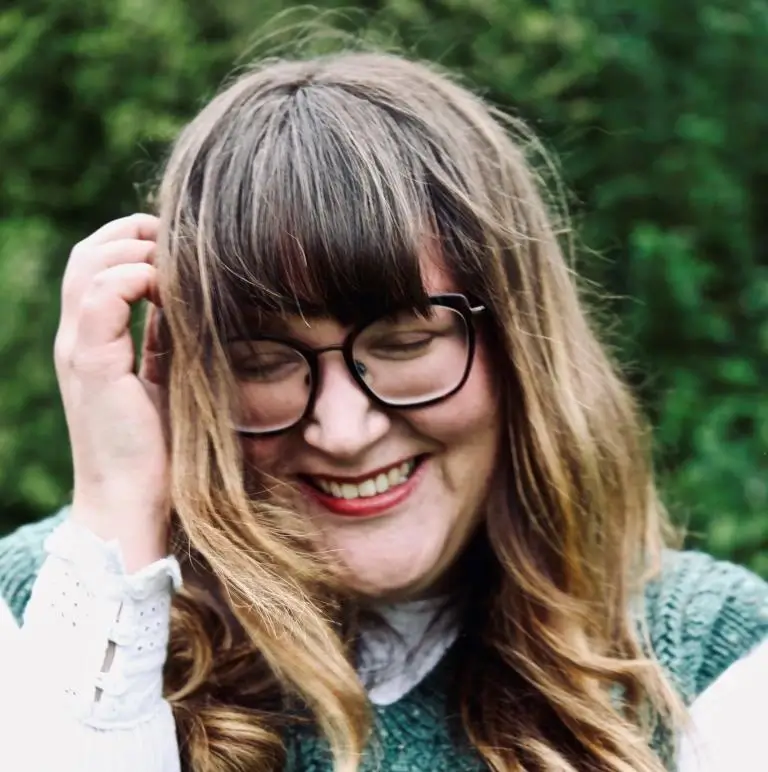
Zosia Kuczyńska is the author of two pamphlets with The Emma Press, Pisanki (2017) and With others in your absence (2021). Her work is featured in Queering the Green: Post-2000 Queer Irish Poetry (Lifeboat, 2021) and has appeared in The White Review, Poetry Ireland Review, and The Tangerine.
You can buy With Others In Your Absence here: https://theemmapress.com/shop/poetry/pamphlets/with-others-in-your-absence/

Zosia Kuczyńska is the author of two pamphlets with The Emma Press, Pisanki (2017) and With others in your absence (2021). Her work is featured in Queering the Green: Post-2000 Queer Irish Poetry (Lifeboat, 2021) and has appeared in The White Review, Poetry Ireland Review, and The Tangerine.
More work by Zosia Kuczyńska


Tel: 028 7126 6946
Email: hueditor@theverbal.co
Verbal, Stable Lane and Mall Wall, Bishop Street Within, Derry/Londonderry, BT48 6PU
 company
Copyright © 2026 Honest Ulsterman