


On Wolves and Wolfstongue
The last wild Irish wolf was killed in County Carlow in 1786, hunted down after preying on sheep on Mount Leinster: so the story goes. Wolves had lived in Ireland for 25,000 years but they could not survive their persecution by the humans. Growing populations of people and livestock had to be protected; native oak forest had to be destroyed so that farmland could spread. In 1653 Cromwell's government had set bounties of £6 for a female wolf, £5 for a male, £3 for a hunting juvenile and 10 shillings for a cub. Hundreds of pounds were paid yearly to wolf-killers. The story of human progress is the story of the wolf's extermination.
'All stories are about wolves,' says a character in Margaret Atwood's novel The Blind Assassin. 'There's escaping from the wolves, fighting the wolves, capturing the wolves, taming the wolves. Being thrown to the wolves, or throwing others to the wolves so the wolves will eat them instead of you. Running with the wolf pack. Turning into a wolf. Best of all, turning into the head wolf. No other decent stories exist.' Wolves have been prowling through human storytelling from the beginning, standing for the ferocity of the natural world and for a wildness we suspect inside ourselves. We are never done with telling the wolf's story because we cannot settle what it means. Are we like wolves or unlike them?
If you intend to drive a species to extinction, you will want to tell a convincing tale about the animal in question: certainly about what a cruel and ravenous beast it is, but perhaps also about the kinship which means we cannot leave it alone. The wolf in Ireland was known as Mac Tíre, the Son of the Land — a name that admits a prior claim, a right to be here which is older and deeper than ours. The myths are full of human beings transforming into wolves and wolves who can speak to humans. Cormac mac Airt was suckled by a wolf and kept the company of wolves throughout his life as High King. And yet the wolf is not us; it shadows us. For Louis MacNeice, contemplating the fragility of our well-being, wolves are what threaten from the outside, as natural and inhuman as the ocean: 'come closer, form a circle, / Join hands and make believe that joined / Hands will keep away the wolves of water / Who howl along our coast…'
The human habit of making wolves into symbols can destroy the reality. 'Eyes / Have worn him away,’ Ted Hughes writes in 'Wolfwatching’, of an animal diminished by captivity in a zoo. The wolf, well fed and admired by parties of schoolchildren, no longer knows what he is. 'He's waiting / For the anaesthetic to work / That has already taken his strength, his beauty / And his life.' He has been robbed of his wolfishness so that the humans can encounter an idea of a wolf:
He's a tarot-card, and he knows it.
He can howl all night
And dawn will pick up the same card
And see him painted on it, with eyes
Like doorframes in a desert
Between nothing and nothing.
Like the cunning fox or the regal lion, the Big Bad Wolf is a well-worn card in the human tarot. We turn other living beings into aspects of ourselves. The harnessing of animals to an order of meaning must be one of the oldest functions of storytelling. It runs close to the root of the power of self-imagining — the human ability to talk ourselves into a story — that has made us the most dangerous species in the history of the planet. As Angela Carter has it, ‘the worst wolves are hairy on the inside.’
*
In my book Wolfstongue, a twelve-year-old boy called Silas is bullied at school because he has speech difficulties. They call him 'Silence', ask him if he's as stupid as he looks and wonder aloud if he can say his own name. One day, walking home, he has a strange encounter. He meets a wolf on the cycle path and discovers that there is a hidden world where animals speak. In that world, which is called the Forest, the wolves are being persecuted by the foxes: the silver-tongued fox leader controls everything with his clever talk, and the wolves, who do not know how to speak for themselves, have become slaves in his underground city. Silas's sympathy is with the wolves, but if he is going to help them he will need to find words.
Like Silas, I was quiet at school and seldom able to find the words I needed. My sharpest memories of school days involve being shamed for not speaking up. To bullies, silence signalled vulnerability, but more than that it seemed a provocation in itself. They responded to silence as if to an insult, and I can understand why. If you are silent you have not consented to the story we're all supposed to be telling. Later I found that a tongue-tied childhood is good for a writer: it schools you in observation, gifts you the outsider perspective, makes empathy imperative. If you're a certain kind of writer, it's precisely because you have been baffled by language that you need to work with it so obsessively. Thomas Mann says that 'a writer is someone for whom writing is more difficult than it is for other people', but then again that's what turns language into such a source of delight. The magic space of writing is where words finally behave as you wish they would, fall into place and express what is true.
I started writing Wolfstongue when my own children were reaching school age and beginning to struggle with words. We are a neurodiverse household: for us, the word neurodiverse works best when applied not to individuals but to the group, because it's in the gaps and frictions between our different ways of responding to the world that the challenges and joys of our neurodiversity manifest themselves. Each of us experiences language in a different way; for each of us it has unique dangers and potentials. Wanting a story to make sense of the challenge of words, I found myself thinking about the cycle of medieval European beast-fables called Reynard the Fox. Reynard is a clever trickster who lies and schemes to get the better of the other animals, especially his hapless foe Isengrim the Wolf. I realised the wolf and the fox that Silas meets on his way home from school are Isengrim and Reynard carrying on their rivalry in the present day.
The trickster-figure, the charming, amoral mischief-maker, exists in every storytelling tradition and plays an indispensable part in defining what it is to be human: the creature who is not the biggest or the strongest, but who always has a cunning plan and a persuasive story to tell; the one who is a little too clever for his own good, liable to get caught in his own snare. The trickster makes a living from gaps and frictions. ‘Trickster is a boundary-crosser,’ writes Lewis Hyde. ‘Every group has its edge, its sense of in and out, and trickster is always there, at the gates of the city and the gates of life, making sure there is commerce.’ Reynard the Fox tricks Silas across the boundary into the Forest, as if we are in a fantasy about portals between parallel worlds; but Isengrim the Wolf tells him that there is only one world. The trickster knows some kinds of things but the trickster's mark knows others. There are no portals, and travelling between the human world and the world of the Forest is only a matter of shifting your attention.
*
Animals are living beings like us, but unlike us they live outside language, and it seems that this mixture of like and unlikeness is irresistible to the human storytelling instinct. We have never not told stories about animals who speak. Your childhood favourites and mine — from The Jungle Book and The Wind in the Willows to Redwall, The Rats of NIMH and Varjak Paw — belong in a tradition which runs back through Grimm and Aesop, back long past the beginnings of written language, back into the truly old tales of Coyote and Crow and Monkey and Anansi the Spider. Maybe telling stories about animals who talk is a way of coming to terms with the uncanny fact that there really is a speaking animal, and it's us.
Aesop told fables about animals rather than people because fables seek big, simple truths, and human characters would complicate the search too much, according to G. K. Chesterton: ‘we cannot talk of such simple things without using animals that do not talk at all.’ Except that in the fables they do talk, because the storyteller forces them to. For Chesterton, animal fables express the idea that 'everything is itself, and will in any case speak for itself. The wolf will be always wolfish; the fox will be always foxy.' But in stories as in life, it is only because they do not speak for themselves that animals are such easy company. The wolfishness of the wolf is a tale some human has told. If we actually met a wolf who could talk to us, the challenges of understanding one another would begin. We would no longer find it so easy to tell the wolf what a wolf means.
Trickster invents language to capture the world and gets caught in his own snare. In his book The Uninhabitable Earth, David Wallace-Wells writes that ‘the story of nature and our relationship to it … seemed for a long time to be contained within the simple logic of parables and allegories. Climate change promises to transform everything we thought we knew about nature, including the moral infrastructure of those tales.’ We have used the natural world as a source of metaphors for human concerns, not least in fables about animals who speak with our words. But it is not good enough to read nature as parable when crisis collapses the distinction between ‘human’ and ‘natural’ worlds. Nature’s story is ours not figuratively but literally. There are no portals.
Wittgenstein said that if a lion could speak we could not understand him. Our point of view is so remote from the animal's that we could never make a statement with meaning for both parties. It's a reasonable assumption, given that even human beings with shared language and culture spend most of their time failing to communicate; but it is an admission of a defeat that we can no longer afford. Animals, says Wallace-Wells, ‘are mute when we do not project our voices on to them.’ Our words make the world we live in, but there is a silence beyond. It can be a comfort to think that in our animal selves we are part of the silent world too. We can try to imagine the place in which the lion, the fox or the wolf might indeed speak, but somehow without ceasing to be mute: the magic space of the Forest where, creatures of language as we are, we can shed our struggles with words and join in the silence of animals. Such a place is impossible. That's why we need to make it up in a story.
Sam Thompson grew up in the south of England and now lives in Belfast. His novel Wolfstongue was published by Little Island in 2021. Previous novels are Communion Town (longlisted for the 2012 Man Booker Prize) and Jott (shortlisted for the 2019 Encore Prize). His short fiction has appeared in Best British Short Stories 2019 and on BBC Radio 4. A story collection will be published by Unsung Stories in 2022. He teaches writing at Queen’s University, Belfast.
You can buy Wolfstongue here: http://littleisland.ie/books/wolfstongue/
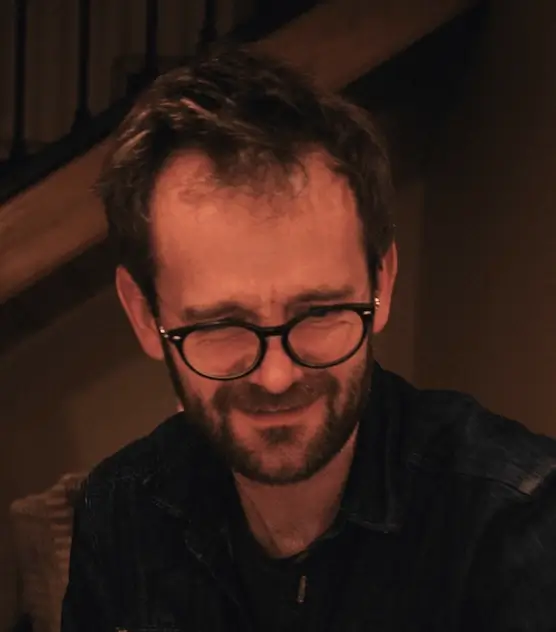
Sam Thompson’s first book Communion Town, which is about a kaleidoscopic city, was longlisted for the 2012 Man Booker Prize. His second book Jott is about friendship, madness and modernism. It was shortlisted for the 2019 Encore Prize. His third book Wolfstongue is about the hidden world where animals speak, and won a 2022 Spark School Book Award. His short story collection Whirlwind Romance was published by Unsung Stories in April 2022. A new novel, The Fox’s Tower, is available now from Little Island. His short fiction has appeared in Best British Short Stories 2019 (Salt Publishing) and on BBC Radio 4, and in anthologies from Blackstaff Press, Unsung Stories and No Alibis Press, among other places. He teaches creative writing at Queen’s University, Belfast. He grew up in the south of England and now lives in Belfast.
More work by Sam Thompson


Tel: 028 7126 6946
Email: hueditor@theverbal.co
Verbal, Stable Lane and Mall Wall, Bishop Street Within, Derry/Londonderry, BT48 6PU
 company
Copyright © 2026 Honest Ulsterman