


An Interview
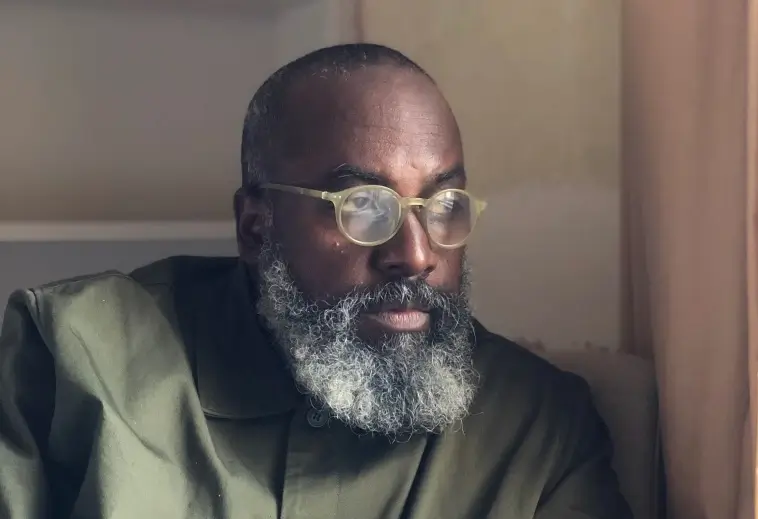
Roger Robinson is a writer and educator who has taught and performed worldwide and an experienced workshop leader and lecturer on poetry. Roger won the 2019 TS Eliot Prize for Poetry and the 2020 RSL Ondaatje prize for A Portable Paradise. He was chosen by Decibel as one of 50 writers who have influenced the black-British writing canon. Roger has received commissions from The National Trust, London Open House, BBC, The National Portrait Gallery, V&A, INIVA, MK Gallery and Theatre Royal Stratford East where he also was associate artist.
Emily Cullen: Roger, the last time I had the pleasure of chatting to you was on the stage of the 2022 Cúirt International festival of Literature in Galway where you charmed us with readings, discussion and even a spot of impromptu singing. You’ve been busy during the past year, touring with Johny Pitts and bringing out two new books, Home is Not a Place and On Poetry. I’d like to ask you about each. In the former, you set out to explore the question: ‘What is Black Britain?’ What were some of the discoveries you made about Black British communities that surprised you?
Roger Robinson: Hi Emily it was such a nice reading and meeting you was fun.
We didn’t know what to expect so the trip was a bit of an investigation. The answers we got were completely different from what we might have expected. Black British communities mostly have quite idiosyncratic relationships with the sea which range from metaphysical, political, historical to natural and everything else in between. Also that Black communities settle in an area for nearly whimsical reasons, like one of my friends lived here, or I visited here on holiday with my dad. Also, when there was conflict based on race, they mostly felt it was their job to work against it and not move away from it.
EC: So that idea of forging a sense of ‘home’, not based on a fixed idea of ‘place,’ but often more so by the joyful agency of whimsy and by synergies of connection and a commitment to healing tensions? And perhaps carrying cultural memory, ‘always on their person’, integrating a ‘portable paradise’?
RR: I think the way you put it is great but that’s all in hindsight. Going out there we really went with empty minds. The journey that Johny and I were having in the car in a way was our first insight. We never stopped talking about what we were seeing, what we were thinking and what we actually encountered. It’s a rare thing to travel the coast with a friend who only likes ‘90s soul music. For a year and a half I had to listen to his music because he drove and in black culture drivers choose the music. So I’d see the white cliffs of Dover with Erykah Badu banging in the car. The contrast shaped me in a way to look for other strange juxtapositions of which there were many.
EC: When I spoke of tensions there, I was referring to the resilience of new Black communities working against racism. But I love your digression about the road trip! I can clearly picture you and Johny touring around in your red Mini Cooper as the great Erykah Badu went “on and on and on and on” (pardon the pun), especially if it was driver’s choice only! I hope you played some Soul II Soul too! You took a consciously ‘coastal’ approach in your odyssey, and the idea of the sea and of ‘thresholds’ flows seamlessly throughout the book, culminating in your potent piece ‘The Cliff’s Edge’ with its ‘White Cliffs of Dover’ which ‘keep looking out to the sea,/… Giving no welcome. / Giving no quarter.’ ( (Read the full poem here). As we mark Windrush 75, and with the glaringly hostile Illegal Migration Bill under debate, would you agree that things are getting more difficult for immigrants to Britain?

Image: Emily Cullen and Roger Robinson, taken by Boyd Challenger at Cúirt International Festival of Literature 2022.
RR: Most definitely because there is a blanket assumption of criminality when black and brown migrants are involved. Looking for a better life has nothing inherently to do with criminality. It’s an association that I don’t believe is given to say white migrants from Canada. I don’t hear them being tarred with the idea of being criminals. So I guess it is reserved specifically for migrants of colour.
EC:Not to mention the fact that many asylum seekers are taking such huge risks to escape persecution – it’s not a simple question of immigrating in order to earn a better wage. It’s maddening, really, that what this Bill proposes is so simplistic and uncaring.
Given the deeply traumatic history of Empire, Home is Not a Place could have been justly propelled by rage, but the book feels much more subtle, haunting and richly layered than that. What role does poetry and art play in widening the discussion about racism, inequality and discrimination?
RR: One of the things that I noticed on the trip is that England is an incredibly beautiful country (I never knew). We wanted to get some of that beauty into the book. We also wanted to highlight the idea that sometimes the struggle is quiet as a man swimming to shore in the night with all his clothes on trying to find a better life. The physical characteristics of the coast become part of the tone of the book, so in part the book is about nature writing through the eyes of two Black British men in as much as it is about ethnography.
EC: I really like that idea of nature being the conduit for the poet-ethnographer and photographer’s observations. I was struck by your approach, in your new book about poetic technique, On Poetry, to writing poems that are “politicised but not didactic”. Can you tell us a bit about the approach you took to writing the poems in your collection, A Portable Paradise, using an intimate, confidential voice?
RR: I really didn’t want to be preachy because I don’t like being preached at. I was also trying to make the reader lean in and feel what I saw and felt. I was interested in escaping from the literary “I” in poetry. I wanted the poems to act as a camera but have the tone maintain a close psychic distance. I consider myself a creative citizen which I consider as different from an activist. As a creative citizen I try to build the world I want through my art, so the poetry and poet remains a primary component of my identity.
EC: You’ve certainly achieved that fluid, visual sense of poem-as-camera in Home is Not a Place to stunning effect.
On Poetry is full of axiomatic gems and valuable lessons about craft and artistry. You talk about approaches to terror in poetry and the “nuanced poetics of terror”. Can you talk about the process of sitting with discomfort and how poets can confront and work with terror?
RR: What’s terror to one person might be joy to another, it’s all relative. When I speak about terror I’m mostly speaking about using poetry to say really hard things. Poets can translate trauma into something manageable and digestible for their readers, to some extent I think that’s the job of the poet, why they are valued in every community and country.
EC: Yeah, I agree, and ‘to bring the marginalised into the poetic centre’, as Eavan Boland exhorted us to do. I’m reminded of your powerfully moving sequence on the Grenfell Tower disaster in A Portable Paradise and your chilling poem about police oppression of black men, “The Darkening Red of Your Blood.”
In On Poetry you write that “the best poetry rescues the reader from a sense of impotence and gives readers an avenue towards mastery that they are in command of their life.” Your own poem, “A Portable Paradise” does this in abundance. Can you tell us something about how you came to write the eponymous poem of your collection and why, in a time of war and international refugee crises, it feels so vital to our age?
RR: A poem that seeps into any culture and is repeated depends on timing, context and repeatability. I’m incredibly lucky that that poem has made its own way. If I knew how to do it again I would, but every now and then a poem occurs in a poet’s life where it feels like God's in the next room. “A Portable Paradise” was one of those poems.
EC: And what a classic it is. Thanks Roger for those thoughtful responses. It’s been a pleasure catching up with you.
Emily Cullen is the Meskell Poet in Residence at the University of Limerick where she teaches on the MA in Creative Writing. Her third collection, Conditional Perfect (Doire Press, 2019), was included in The Irish Times round-up of “the best new poetry of 2019.” Emily gained a PhD in English from NUI Galway in 2008. She is a former Director of Cúirt International Festival of Literature (2017-2019) and the Patrick Kavanagh Centenary (2004).

Emily Cullen is a Galway-based writer, scholar, curator and harper. She is the Meskell poet in Residence at the University of Limerick where she lectures on the MA in Creative Writing. Emily was the inaugural Arts Officer of NUI Galway between 1999 and 2002. Her first collection, No Vague Utopia, was published by Ainnir Publishing in 2003. In 2004, Emily was appointed Curator of the national Patrick Kavanagh Centenary celebrations Also in 2004, she was selected for the Poetry Ireland Introductions series. Awarded an IRC Government of Ireland fellowship for her doctoral study on the Irish harp, Emily completed her Ph.D. in English in 2008. She frequently publishes essays on Irish music and cultural history and she is also a qualified teacher of the harp who has performed throughout Europe, Australia and the United States. A former member of the Belfast Harp Orchestra, Emily has recorded on a number of albums and also as a solo artist, giving lectures and recitals nationally and internationally. Emily’s second collection of poetry, In Between Angels and Animals, was published by Arlen House in 2013 and her third collection, Conditional Perfect (Doire Press, 2019) was included in the Irish Times roundup of “the best poetry of 2019.” For two years, Emily served as Programme Director of Galway’s Cúirt International Festival of Literature. Before joining the teaching team at UL, she taught Creative Writing and Poetry at the University of Melbourne and with the School of English at the University of Galway. Emily has received professional development funding and two Agility Awards from the Arts Council of Ireland. Commissions received include: resident poet on '1923 Reflections' Decade of Centenaries Project 2023, Dromineer Literary Festival 2022, Galway County Council Decade of Commemorations Committee 2021, Strokestown International Poetry Festival 2020.


Tel: 028 7126 6946
Email: hueditor@theverbal.co
Verbal, Stable Lane and Mall Wall, Bishop Street Within, Derry/Londonderry, BT48 6PU
 company
Copyright © 2026 Honest Ulsterman