


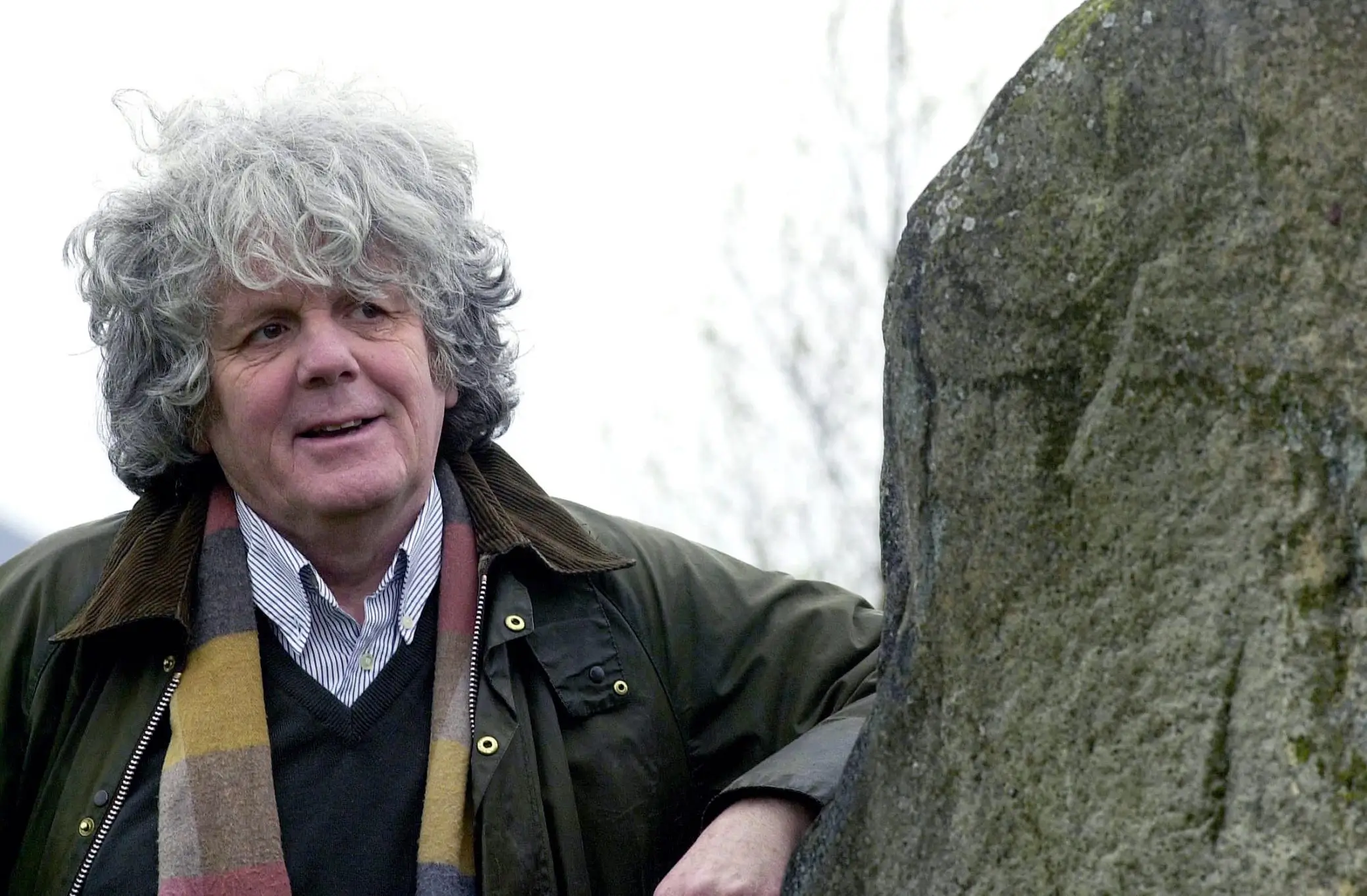
- Martin Shaw on John Moriarty
From 'A Hut At The Edge Of The Village'
It was like that with Martin. Listening to him sometimes, I would feel that for him the wind and the rain and the rocks were newcomers. A sense I would have is that nothing can be as old as an old human being. Compared to Mary Ann Danny O, certainly as I remembered her, the stars were like last night’s dew. They would come and go but she still would be there looking out at the rain, at the wet rain, through her cobwebbed window.
Like most of us most of the time, it was incidentally and indirectly that Martin revealed his sense of the world. He’d break into a story saying, I was one night in my house, out in harvest time it was, and a knocking came to my door …
That was the revelatory phrase, a knocking came to my door, for, given the world he lived in, Martin would never assume that it must be a human being who knocked. It could be the Angel Gabriel, it could be the Pouca, it could be the Bean Sidhe, it could be his mother’s ghost, though she would hardly knock, she would just lift the latch and walk straight in, it could be Christ or it could be a changeling on her way back from half a lifetime with the Fairies.
In Martin’s day little boys would be dressed like girls. The intention was to confuse the Fairies who, for some reason, most attempted to lure young boys not young girls away to their world. And yet, in a house a couple of fields away, it was a girl of eighteen years that they put their call on. But for the priest from Roundstone, who prayed all night by her Resemblance in the bed, she’d be gone to this day. He bought her back, but on his way home, he sitting wrapped up in his sidecar, his servant boy holding the reins, it was there at Inishnee Cross, a mighty stronghold of the Fairies, that he was attacked, and for three days afterwards his mouth was gone round to the side of his head.
Martin shared his word with other beings, most invisible and, whatever else, he mustn’t provoke them, and in all situations, no matter how big the cost in inconvenience to himself, he must take them into account. However great his need, he wouldn’t just choose the most suitable site and build a house on it. First, he would consult the invisible world and this he would do by erecting three stones at the very centre of the proposed foundation. If they were knocked in the morning, that would be that; unhesitatingly, he’d move and try again elsewhere. Never would it occur to Martin to build his house on a fairy path. Apart from anything else, there would be no sleep in such a house. All night long the Fairies would be trooping through and, given the sacrilege, it isn’t blessings they’d be leaving behind.
No, Martin couldn’t be a capitalist. He couldn’t just look at the world and see it as an economic opportunity, that and no more.
Standing in the door one day, didn’t his mother look west across the bogs to the setting Sun and didn’t she see it, the shuddering, the whole world shuddering with the joy of angels, and that shuddering coming towards her and passing through her and through her house.
Opening it one night in my house, an ordnance survey map of Connemara made little sense to Martin. Mostly, it was what was isn’t in it that he had an eye for. Refolding it, he handed it back to me saying, ‘What chance have we when that’s where we think we live.’
An awful lot that I had forgotten and an awful lot that I had yet to learn came in my door every evening with Martin.
Listening to him, I had already concluded that there was and is an Irish Dreamtime, and so fully did he live in it and talk to me out of it that it wouldn’t have surprised me if, climbing to his house one day, I saw his wet top-coat hanging from a sunbeam.
Martin Shaw on John Moriarty
Some of us like a wrestle with what we choose to think about. In an era when much is designed to slip down smoothly, to be easily processed, we begin to notice a loss of taste, a distinct loss of chew. And humans are designed to enjoy a good chew. That observation is a good entry point for John Moriarty. The late Irish philosopher’s work has significant roughage – just a paragraph or two should keep us full for days.
There is always something of a thrill when you discover a secret, and out there in the wider world John is pretty much that. His work rattles around in the deep interior, is not invested in handrails. Moriarty is speaking to a wiser, stranger part of ourselves. A dimension we may barely register. He circumnavigates small talk and escorts us from the shopping mall and out under a hundred thousand stars. There are badgers loafing about and a woman is hurling shoes at the moon.
His writing is a massive thing to approach. Out where the buses don’t park.
The books are a kind of dreaming, and should be understood as such. Read as daylight treatise of reasonable, cautious polemics we won’t last long with them. This is night intelligence mostly, swimming around with whales that spume the ink that lands in the pen of Shakespeare and Octavio Pas. You either like this kind of thing or you don’t. And if you do, my friend you have arrived at a very sweet spot.
I first read Moriarty on a Christmas Eve train journey between Devon and Norwich. I opened Dreamtime and the next thing I remember is that it’s dark outside the carriage and I had used the tube and changed trains in London and had no memory of either, I’d barely lifted my head from the pages. I read for seven hours straight and cackled away at his brilliant shenanigans. There’s a distinct register of chant in his words, almost as if something is being sung into the reader. And that first time, with no distractions, his work got real and enduring purchase.
Years later I noticed that my students, often the younger ones, loved to think about Moriarty’s ideas together. In his books they sometimes got so lost in they gave up, but if they gathered around one or two pages then the heated conversation gave riches.
For all the myriad associations arising from his work, there is a continual emphasis on how we move from seeing to beholding the world around us. This move is the key to spiritual progress and mythic deepening. It changes everything. Life is no longer just brutish and abstract, but suffused with meaning. It means renegotiating an old love affair with the earth we have grievously neglected. In this time of climate emergency, a Moriartian consciousness enables us with beauty, not just statistics and bad news. As I have said for years:
Reverie can lead to participation.
The mess out there is because of a mess in here.
It’s not an indulgence to read John Moriarty. It’s a kind of open-heart surgery. Don’t expect to understand it all – just submit to the encounter and it’ll almost certainly do you good. Rilke says we secretly want to be defeated by something bigger than us, and I think John understood that. That doesn’t make him a saint or guru, but an outstanding guide to what he called Divine Ground. To live as close to the soul’s furnace as John did is to make a tough life sometimes for both yourself and also the folks around you. There is a cost to work like this. But the rewards as readers are extraordinary.
I recommend that as readers we move slowly through its labyrinth – don’t get flustered but just circle around certain images and ideas that won’t leave us alone. We can avoid the bends by ascending its deep waters at a measured pace.
There is an old Sufi idea that as you grow into your true self then so does an angel just up ahead of you. It may be that you are reading Moriarty not for yourself at all, but for the sake of your angel.
*
Martin Shaw is a writer, mythographer and wilderness rites of passage guide. Dr Shaw is author of Smoke Hole: Looking to the Wild in the Time of the Spyglass and many other books. To see more of his work visit
schoolofmyth.com / cistamystica.com / drmartinshaw.com

Martin Shaw is a writer, mythographer and wilderness rites of passage guide. Dr Shaw is author of Smoke Hole: Looking to the Wild in the Time of the Spyglass and many other books. To see more of his work visit
More work by Martin Shaw



Tel: 028 7126 6946
Email: hueditor@theverbal.co
Verbal, Stable Lane and Mall Wall, Bishop Street Within, Derry/Londonderry, BT48 6PU
 company
Copyright © 2026 Honest Ulsterman